
Iwata W400 Spray Gun Models Compared by Finish

For a general-purpose W400 choice, Iwata W400LV-134G stands out for its 1.3 mm nozzle and 270 mm pattern; choose Iwata W400LV-WBX 1.3 mm instead if you specifically want the WBX version developed for primer and sealer. The WS400 and LS400 models are related Iwata guns, but they are different series, so buyers seeking a W400 should compare those only if they are open to another model family.
We earn a commission if you buy through links on this page. As an Amazon Associate I earn from qualifying purchases. Products are compared on manufacturer specifications, not hands-on testing.
- Best overall: Iwata W400LV-134G – Its W400LV-134G designation, 1.3 mm nozzle and 270 mm pattern give a clear baseline for comparing W400 options.
- Best for primer: Iwata W400LV-WBX 1.3 mm – The W400LV-WBX is specifically described for primer and sealer, with a 1.3 mm gravity-feed setup.
- Best for clear coat: Iwata WS400 S2 Clear 1.3 HD – This is a WS400 S2 Clear gun with a 1.3 HD designation, rather than a W400.
| Product | Best for | Nozzle | Pattern width | Weight | Shop |
|---|---|---|---|---|---|
| Iwata W400LV-134G | General W400 use | 1.3 mm | 270 mm | 2.0 lb | Check Price on Amazon |
| Iwata W400LV-WBX 1.3 mm | Primer and sealer | 1.3 mm | — | 2.0 lb | Check Price on Amazon |
| Iwata WS400 S2 Clear 1.3 HD | Clear coat | 1.3 HD | — | — | Check Price on Amazon |
| Iwata LS400 HVLP S2 Base 1.3 ET | Base coat, ET | 1.3 | — | 2.6 lb | Check Price on Amazon |
| Digital Iwata LS400 S2 Base 1.3 OBS | Humid base coat | 1.3 mm | 255 mm | 1.0 lb | Check Price on Amazon |
Iwata W400 Spray Guns and Related Models
Compare the exact W400 options first, then consider the related WS400 and LS400 series if their finish focus better matches your work.
Iwata W400LV-134G
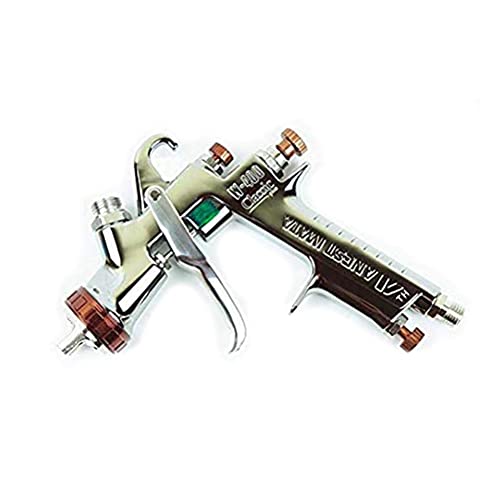
Among these choices, this W400LV model has the clearest general-purpose specification set: a 1.3 mm fluid nozzle and a 270 mm pattern. Its maker gives an atomizing pressure of 20 PSI, 10.5 CFM air use and 140 ml/min fluid output, which help when matching it to a compressor and coating workflow. Choose it if you want a W400 with operating figures. Its 10.5 CFM requirement is a real setup constraint; a compressor that cannot sustain that delivery may not keep the gun operating as intended.
Bottom line: Pick this if you want a W400 with a defined nozzle, pattern and air-use figures.
Iwata W400LV-WBX 1.3 mm

The W400LV-WBX differs from Iwata W400LV-134G by its primer-and-sealer focus and red North American-exclusive air cap. It is a 1.3 mm gravity-feed gun with a split nozzle; the maker says the design supports a wide fan and low-pressure operation. That makes it a relevant choice for buyers building a primer/sealer step into a W400 refinishing setup. The figures do not include an air-consumption number, so verify the gun’s air requirement and your compressor’s sustained CFM before choosing it for a production workflow.
Bottom line: Choose this for primer or sealer work when the WBX configuration is the priority.
Iwata WS400 S2 Clear 1.3 HD

This WS400 is the clear-coat-oriented option, not a W400; the model name identifies an S2 Clear gun with a 1.3 HD designation. It may suit a buyer willing to consider a different Iwata series for clear finishing, while Iwata W400LV-134G and Iwata W400LV-WBX 1.3 mm are the actual W400 choices here. The specifications provide no operating pressure, air consumption or pattern width for this WS400, so those measurements cannot be compared directly with the W400LV-134G. Confirm the setup specifications before matching it to a compressor or spray booth.
Bottom line: Consider this only if a clear-coat WS400 is acceptable instead of a W400.
Iwata LS400 HVLP S2 Base 1.3 ET

The LS400 HVLP S2 is a base-coat gun in a different Iwata series, and its 1.3 ET designation distinguishes it from the W400 options. Its split nozzle and ergonomic design are named features; a digital pressure gauge is an optional regulator, not an included standard feature. Consider it if base-coat setup matters more than staying within the W400 family. The fields give no pressure or air-consumption figure, so buyers comparing compressor needs with Iwata W400LV-134G should verify those requirements for this LS400 configuration.
Bottom line: Pick this only if an LS400 base-coat model fits your needs better than a W400.
Digital Iwata LS400 S2 Base 1.3 OBS

The Digital LS400 S2 Base 1.3 OBS is the humid-climate base-coat option here, rather than a W400. Its maker gives a 2.0 bar (29 PSI) operating pressure and an approximate 255 mm pattern, making it the only related LS400 option with both figures. The digital regulator uses a Click-Mag lock for removal during battery changes and maintenance. Choose it if that OBS base-coat focus is relevant; buyers who specifically need a W400 should stay with Iwata W400LV-134G or Iwata W400LV-WBX 1.3 mm instead.
Bottom line: Choose this for the specified humid-climate base-coat use, not as a W400 substitute.
How to Choose an Iwata W400 Spray Gun
Start with the coating step, then match the nozzle and air supply to the gun. The W400LV-134G has a 1.3 mm nozzle, 20 PSI atomizing pressure and 10.5 CFM air use; those values make compressor capacity a practical filter. A compressor’s advertised peak output is not the same as sustained CFM at pressure, so compare its delivered-air rating with the gun requirement. For primer and sealer, the W400LV-WBX is specifically described for that purpose, while the WS400 model is identified for clear coat. HVLP means high-volume, low-pressure atomization; it can reduce overspray, but it still needs adequate air volume and correct setup. If sustained compressor delivery falls below the gun’s demand, choose a better-matched setup rather than relying on a larger tank alone.
W400, WS400 and LS400 Model Differences
The model prefix is the quickest way to avoid treating these as interchangeable guns: W400 options are distinct from WS400 clear and LS400 base series. The WBX W400 is called out for primer/sealer, while the W400LV-134G has specific pressure, air-use and pattern figures. The WS400 entry names an S2 Clear 1.3 HD model but provides no comparable operating measurements. The LS400 options are base-coat models; one has an OBS nozzle for humid-climate spraying and a 255 mm pattern. Use this simple decision table by application, not by a broad claim that one series is universally better.
| Need | Model family to consider | Key distinction |
|---|---|---|
| General W400 match | W400LV-134G | 1.3 mm nozzle; 270 mm pattern |
| Primer/sealer | W400LV-WBX | WBX air cap and stated finish focus |
| Clear coat alternative | WS400 | Separate series; S2 Clear designation |
| Base coat alternative | LS400 | Separate series; ET or OBS variant |
Match the Spray Gun to Your Compressor
Air delivery matters more than tank size alone: a 10.5 CFM requirement for the W400LV-134G should be compared with the compressor’s delivered CFM at the working pressure. A tank can buffer short bursts, but it cannot compensate for a compressor that continuously supplies too little air during a long pass. Use a regulator and gauge near the gun to set pressure at the inlet while air is flowing; static pressure with the trigger closed can read higher than operating pressure. Hose length, inside diameter, fittings and filters add restriction, so undersized air lines can cause pressure drop. Before purchasing or setting up any model here, confirm its required air delivery and pressure against the compressor output and hose system.
Spray Setup and Safety Basics
Automotive spray coatings require controlled ventilation and respiratory protection; many professional coatings can contain hazardous solvents or isocyanates, so use the coating safety data sheet to choose appropriate protection and booth controls. A spray gun’s low-pressure or HVLP label does not make airborne paint safe to breathe. For finish quality, follow the coating maker’s specified reduction, tip range and flash time, then test the fan and fluid delivery on a practice panel before spraying a vehicle. Keep the gun square to the panel and use consistent distance and overlap; changing angle mid-pass can create uneven film thickness. Clean the fluid passages and air cap promptly after use with compatible materials, since dried coating can distort the spray pattern.
Frequently Asked Questions
What does a 1.3 mm spray gun nozzle suit?
A 1.3 mm nozzle is a common automotive refinishing size for base coats and many clear coats, but the coating maker’s recommended tip range takes priority. Primer viscosity may call for a different nozzle size or reduction.
How much compressor air does a W400 spray gun need?
The W400LV-134G specifies 10.5 CFM and 20 PSI atomizing pressure. Match sustained delivered CFM at pressure, not just tank volume or peak output, and verify the requirement for other models before setup.
How do I tell W400 and WS400 guns apart?
The prefix identifies different model families: W400 is not the same series as WS400. In this group, the WS400 is identified as an S2 Clear 1.3 HD gun, while the W400 options include a WBX primer/sealer model.
Can an HVLP spray gun use a small compressor?
Only if the compressor can sustain the gun’s required air volume at working pressure; tank capacity alone does not answer that. For example, the W400LV-134G specifies 10.5 CFM, so compare the delivered-air rating before connecting it.
What respiratory protection is needed for automotive spray painting?
Use the coating’s safety data sheet to identify the required respirator and ventilation controls; coatings containing isocyanates can require supplied-air protection. Do not treat HVLP or a spray booth as a substitute for correct respiratory protection.