
JEGOAT Earwax Removal App: 5 Camera Tools Compared

For a phone-connected ear camera with 1296P imaging and 12 silicone tips, start with JEGOAT 1296P Ear Cleaner; its WiFi connection supports viewing on a smartphone. Choose a different model if you want a flexible camera, tweezers or a specific app experience.
Ear cameras combine a small camera and light with a phone display, but they are not a substitute for a clinician’s exam. Avoid inserting tools into the ear canal if you have ear tubes, a possible eardrum injury or recent ear surgery.
We earn a commission if you buy through links on this page. As an Amazon Associate I earn from qualifying purchases. Products are compared on manufacturer specifications, not hands-on testing.
- Best overall: JEGOAT 1296P Ear Cleaner – 1296P camera, six LEDs, 12 silicone tips and WiFi phone connection.
- Best for curved canals: BEBIRD D39R Flexible Camera – Flexible silicone camera tube is designed to fit curved ear canals.
- Best for tweezers: BEBIRD R1 Ultra – Includes tweezers and 11 tips, with a safety stopper and scale.
| Product | Best for | Camera resolution | Ear tips | Shop |
|---|---|---|---|---|
| JEGOAT 1296P Ear Cleaner | Phone viewing | 1296P HD | 12 silicone tips | Check Price on Amazon |
| BEBIRD R1 Ultra | Tweezers included | 1296P HD | 11 tips | Check Price on Amazon |
| BEBIRD D39R Flexible Camera | Curved ear canals | HD | 12 tips | Check Price on Amazon |
| LEIPUT 1080P Ear Cleaner | Soft scoop covers | 1080P HD | 6 silicone scoops | Check Price on Amazon |
| BEBIRD R1 1080P Ear Cleaner | Video capture | 1080P HD | 10 replacement tips | Check Price on Amazon |
JEGOAT Earwax Removal App Cameras
Compare phone-connected ear cameras by their imaging, included tips and form factor.
JEGOAT 1296P Ear Cleaner

JEGOAT 1296P Ear Cleaner is the closest match for a JEGOAT earwax removal app search, combining a 1296P camera with WiFi smartphone viewing. It has six LED lights, 12 silicone ear tips and six ear spoons, giving households multiple attachment options. The lens is IP67 waterproof, and its dimensions are 6.6 by 3.7 by 0.65 inches. Choose it if you want a camera-and-tip kit with phone viewing. The maker does not identify a specific app name or explain its compatibility requirements, so confirm those before ordering if you need a particular app or phone system.
Bottom line: Choose this if you want JEGOAT’s 1296P camera and 12 silicone tips.
BEBIRD R1 Ultra

BEBIRD R1 Ultra stands out for its tweezers and visual dropper alongside the camera, while retaining 1296P imaging and an IP67 lens. It includes 11 tips, a safety stopper and a scale intended to limit insertion. This kit suits someone seeking a range of removal attachments rather than JEGOAT’s larger stated tip count. The stopper does not make deep insertion safe: keep any tool near the ear opening and stop if it causes discomfort.
Bottom line: Pick this for its tweezers, dropper and insertion guard.
BEBIRD D39R Flexible Camera

BEBIRD D39R Flexible Camera differs from the rigid camera format with a flexible silicone tube designed for curved ear canals. Its IP67 camera comes with 12 earwax tips, an anti-insertion guard and a storage case; the product features identify the camera as HD without giving a resolution figure. That makes it a fit-focused alternative if maneuverability matters more than comparing exact pixel counts. The flexible tube still belongs only near the canal entrance, not deep inside it. Adults and children are both mentioned as intended users, but a child’s ear should be handled by a clinician rather than by inserting a camera tool at home.
Bottom line: Choose this if the flexible camera tube matches your needs.
LEIPUT 1080P Ear Cleaner

LEIPUT 1080P Ear Cleaner centers its kit on six soft silicone ear scoops and a 1080P camera with six LEDs. Its maker describes three scoop curvatures and advises fitting the silicone cover tightly over the scoop before use. The lens is IP67 waterproof, and the camera connects by WiFi for iOS and Android. This is a reasonable alternative if covered scoops are the deciding feature, rather than JEGOAT’s 1296P resolution or larger attachment count. The product also mentions use on other body areas, but a camera tool is not a substitute for medical assessment of ear pain, discharge or sudden hearing changes.
Bottom line: Pick this for its silicone-covered scoops and 1080P camera.
BEBIRD R1 1080P Ear Cleaner
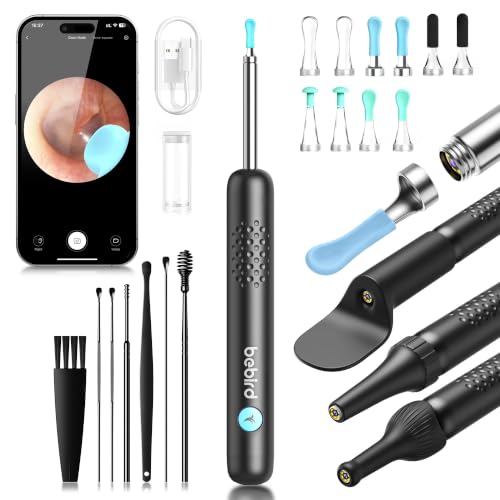
BEBIRD R1 1080P Ear Cleaner offers a 1080P camera, six LEDs and WiFi connection to the BEBIRD app, with photo and video capture described at 20 frames per second. It comes with 10 replacement tips and a silicone three-piece set. The maker identifies a wide-angle view and a 3-megapixel lens, making the camera a lower-resolution alternative to JEGOAT’s 1296P option. Choose it if app-based video capture matters more than a flexible probe or a larger tip assortment. Its maker does not establish a lens waterproof rating, so avoid assuming it can be rinsed or immersed.
Bottom line: Choose this if you want the described app video-capture features.
How to choose an earwax removal app camera
Choose an ear camera by matching the phone connection, attachment style and handling limits to your needs. WiFi phone viewing is described for several models here, but an app name or supported operating system is only useful if it matches your phone; confirm that compatibility before ordering when it matters. Camera resolution is one comparison point, not a measure of medical accuracy. The kits range from HD to 1296P and include different numbers and kinds of tips. A stopper, silicone cover or flexible tube may affect handling, but none makes it safe to push a tool deep into the canal. Earwax normally moves outward on its own, so routine scraping is unnecessary for many people. If wax is causing symptoms, a clinician can check whether wax is the cause before removal.
Ear canal safety and insertion limits
Keep ear cameras and scoops at the canal opening, because the canal skin and eardrum can be injured by even a small tool inserted too far. A typical adult ear canal is about 1 inch long, but its curve and diameter differ; a camera view does not reliably show how close the tip is to the eardrum. Do not use an ear tool with ear tubes, a known or suspected perforated eardrum, or recent ear surgery unless a clinician specifically approves it. Stop if you feel pain, dizziness or bleeding. Sudden hearing loss, drainage, or persistent pain warrants medical care rather than further cleaning. Avoid using any attachment on a child’s ear at home; children’s canals are smaller and are best assessed by a pediatric clinician.
Camera and attachment types compared
Choose by the feature that changes handling, rather than assuming more tips means safer cleaning. Silicone covers can cushion a scoop edge, while a flexible tube is intended to follow a curved path; neither removes the need for shallow, gentle use. A rigid camera with multiple spoons may offer more attachment choices, while tweezers add a different grasping tool. Waterproof ratings describe resistance under defined test conditions, not permission to submerge a powered device or clean its electronics under running water. Check the maker’s care instructions before washing any part.
| Need | Feature to prioritize | Trade-off |
|---|---|---|
| Phone viewing | WiFi and compatible app | Phone and app compatibility must match |
| Curved path | Flexible camera tube | Does not make deep insertion safe |
| Covered scoop | Fitted silicone cover | Cover must remain securely attached |
| Grasping tool | Tweezers attachment | Requires especially careful shallow handling |
When earwax needs professional care
Seek clinical advice instead of using a camera tool when ear symptoms are new, severe or unexplained. Earwax is protective and usually migrates outward, so digging can compact it against the eardrum rather than clear it. People with diabetes, weakened immune systems, ear tubes, prior eardrum damage or ear surgery should ask a clinician about safe removal methods before using drops or instruments. A clinician may use irrigation, suction or manual removal depending on the eardrum and medical history; irrigation is not appropriate for every ear. Do not use home irrigation if you have pain, drainage, a history of perforation or tubes. A camera image alone cannot diagnose infection or determine whether wax is blocking hearing.
Frequently Asked Questions
Can an ear camera remove earwax safely at home?
An ear camera can show a view, but inserting a scoop or tweezer can scratch the canal or injure the eardrum. Keep tools at the opening, and seek care for pain, bleeding or drainage.
How far can I insert an ear camera?
Keep the camera tip at the canal entrance rather than aiming for the eardrum; an adult canal is about 1 inch long and curves. Stop immediately if you feel pain or dizziness.
Can I use an earwax camera on a child?
Do not insert an ear camera or scoop into a child’s ear at home. Children have smaller canals, so have a pediatric clinician assess symptoms or suspected wax buildup.
Should I use an ear camera with ear tubes?
Avoid ear cameras, scoops and home irrigation when ear tubes are present unless the treating clinician approves them. Tubes and prior eardrum problems change which removal methods are appropriate.
Does an IP67 ear camera mean I can wash it?
IP67 indicates a defined level of dust protection and temporary water immersion resistance, not that every component can be washed or submerged. Follow the maker’s cleaning directions and keep the charging or phone-connected parts dry.