
K18 RF GS Detector: Models Compared by Detection

For the named K18 RF GS detector, K18 RF GS Detector is the direct match, with an advertised 1 MHz–6.5 GHz range and magnetic GPS detection. Choose a different model if you want a specific alarm option or a compact travel-oriented design; these alternatives describe related detector types, not the exact named model.
We earn a commission if you buy through links on this page. As an Amazon Associate I earn from qualifying purchases. Products are compared on manufacturer specifications, not hands-on testing.
- Best overall: K18 RF GS Detector – It is the direct K18 RF GS match and gives a RF range plus magnetic GPS detection.
- Best for vibration alerts: HawkSpy K18 Detector – It offers sound and vibration alarm modes.
- Best for adjustable scanning: SALAN K18S – It features adjustable sensitivity and combines infrared, RF and magnetic sensing.
| Product | Best for | Detection methods | Shop |
|---|---|---|---|
| K18 RF GS Detector | Direct K18 match | RF, magnetic GPS | Check Price on Amazon |
| 6-in-1 Hidden Camera Detector | Infrared camera checks | RF, magnetic GPS, infrared | Check Price on Amazon |
| HawkSpy K18 Detector | Vibration alerts | RF, GPS, infrared | Check Price on Amazon |
| SALAN K18S | Sensitivity adjustment | RF, magnetic, infrared | Check Price on Amazon |
| JMDHKK Hidden Camera Detector | Multi-mode scanning | RF, magnetic, infrared | Check Price on Amazon |
K18 RF GS Detector and Related Detectors
Compare the direct K18 match with related scanners by their advertised frequency range and detection methods.
K18 RF GS Detector

The K18 RF GS detector is the direct match, with a RF detection range and automatic frequency-band adjustment. Its maker also says the high-gain antenna covers 1–8 GHz and that signal indicators become louder as the detector approaches a device; the product is also described as detecting strong magnetic GPS devices in standby mode. A claimed 24 to 35 hours of continuous operation may suit longer trips. RF scanning can alert to active signals, but it cannot establish that a signal is a surveillance device, and silent or inactive equipment may not be detected.
Bottom line: Choose this model if you want the named K18 with a RF range and magnetic GPS sensing.
6-in-1 Hidden Camera Detector

Infrared detection is the distinguishing feature here: the manufacturer says this detector can look for hidden cameras with night-vision capability, alongside RF scanning and magnetic GPS sensing. That combination suits someone who wants more than wireless-signal scanning in rentals, hotels or vehicles. Infrared locating is not a guarantee that every camera will be found; camera placement and operating state can affect what a scan reveals.
Bottom line: Pick it if infrared camera locating matters more than a published RF range.
HawkSpy K18 Detector

Selectable sound and vibration alerts distinguish the HawkSpy K18 from the direct K18 RF GS match, making it useful when audible alerts could disturb others. Its maker says it detects hidden cameras, wireless eavesdropping devices and GPS trackers, and describes enhanced LED infrared detection. At 3.94 by 2.17 by 0.79 inches, it is compact for carrying between rooms or on trips. An alarm helps guide a search but cannot identify a signal’s source by itself.
Bottom line: Choose it if vibration alerts matter more than a RF range.
SALAN K18S
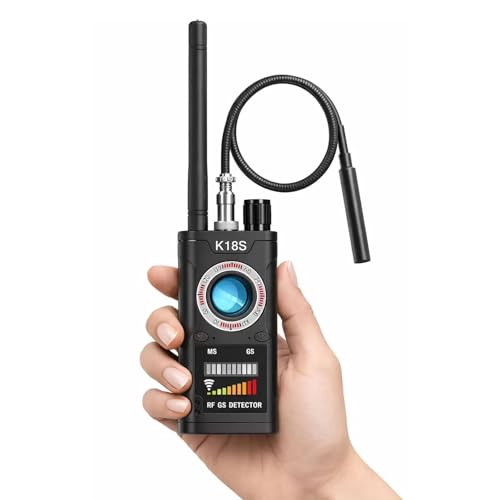
Adjustable sensitivity makes the SALAN K18S the option for searches where you want to change scanning strength by environment. Its feature set combines infrared lens locating, wireless signal scanning and magnetic sensing, and its maker positions the compact design for travel and business trips. Sensitivity adjustment can help manage clutter from nearby signals, but it does not make an alert conclusive evidence of a hidden device.
Bottom line: Choose it if adjustable sensitivity is more useful to you than a RF range.
JMDHKK Hidden Camera Detector

Infrared laser scanning and automatic infrared detection distinguish the JMDHKK from the direct K18 match, which emphasizes RF coverage and magnetic GPS detection. The manufacturer also describes adjustable sensitivity, wireless-signal detection and magnetic-field detection, making this a broad multi-mode option for travel, vehicle or office searches. Magnetic sensing focuses on magnetic trackers and does not establish that every GPS tracker will be found; device placement and magnetic strength matter.
Bottom line: Pick it if you want infrared scanning alongside adjustable RF and magnetic sensing.
How RF bug detectors work
RF detectors respond to radio-frequency energy, so they are most useful when a suspected device is transmitting. The K18 RF GS is advertised for 1 MHz–6.5 GHz detection, while its maker separately describes a 1–8 GHz high-gain antenna; those figures do not mean every signal in the span can be identified by type. A stronger reading can help guide a closer search, but nearby Wi-Fi routers, phones and Bluetooth devices can also raise signal levels. For a quieter sweep, reduce your own wireless activity where practical, then move slowly and recheck any strong reading from another position. Treat an alert as a prompt to inspect, not proof of surveillance.
Choosing between RF, infrared and magnetic sensing
Choose the sensing mode based on the device you are trying to find: RF scanning detects radio energy, infrared methods seek camera lenses or night-vision emitters, and magnetic sensing looks for a nearby magnetic field. A camera that is not transmitting may evade RF scanning, while a magnetic-field search does not locate every tracker design. Infrared lens locating can help inspect surfaces, but angle, distance and concealment affect what is visible. The models here combine modes differently, so select a detector with the method that matches your concern rather than assuming that more modes guarantee complete coverage. A measured decision rule is simple: if you need to verify coverage above 6.5 GHz, confirm the model’s usable RF range before ordering.
How to scan a room without confusing signals
Scan one small area at a time and keep the detector orientation and distance consistent; moving systematically makes a changing signal easier to interpret. First note the baseline in the room, then check strong readings near likely hiding places such as outlets, lamps and furniture seams. RF alerts can come from ordinary electronics, so repeat the sweep with nearby devices turned off when feasible and compare the reading. For magnetic scanning, search close to objects rather than expecting a distant signal, since magnetic detection is a near-field check. Never dismantle electrical fixtures or disturb wiring to investigate an alert; use a qualified professional if inspection would expose live components.
What a detector alert can and cannot tell you
A detector alert indicates a signal or field worth checking; it does not identify the device or prove malicious monitoring. RF units may miss equipment that is switched off, recording locally or transmitting outside the detector’s coverage, and a magnetic sensor may miss a tracker without a detectable magnetic field. Multiple nearby wireless devices also make false leads possible. Confirm a suspicious result with a second pass and direct visual inspection, without touching unfamiliar equipment or entering restricted spaces. If you find a device in a private rental or workplace, document its location and seek appropriate local support rather than relying on a scanner result alone.
Frequently Asked Questions
Can an RF detector find a camera that is turned off?
Usually, an RF detector needs a device to transmit before it can register its radio signal. A camera that is powered off or recording locally may not produce a detectable transmission.
Does magnetic GPS detection find every tracker?
No; magnetic detection is aimed at trackers that create a detectable magnetic field. A tracker without that field may not trigger this sensing method, and close-range searching is important.
What does a louder K18 signal indicator mean?
The K18 maker says the signal indicators become louder as the detector gets closer to spy devices.
Should I turn off Wi-Fi before scanning a room?
Reducing your own wireless activity can make a scan easier to interpret, because phones and routers also emit RF signals. Compare the room’s baseline before and after switching off devices you control.
Can infrared scanning locate every hidden camera?
No; infrared locating depends on the camera’s features, operating state and visibility from the scan angle. Treat it as one inspection method rather than a guarantee that a room is clear.