
Bird View Car 360 Systems Compared by Fit and Features

For most cars, Weivision 1080P 360 Surround System is the clearest fit because it is designed for vehicles up to 22 feet and records four 1080P camera channels. Choose Weivision Universal 360 Bird View System if you want a system described as universal and can accommodate drilled mirror holes; larger commercial vehicles need a different setup.
We earn a commission if you buy through links on this page. As an Amazon Associate I earn from qualifying purchases. Products are compared on manufacturer specifications, not hands-on testing.
- Best overall: Weivision 1080P 360 Surround System – Designed for vehicles up to 22 feet, with four-channel 1080P recording and a 32GB maximum.
- Best for panoramic monitoring: Weivision Universal 360 Bird View System – Offers IP69-rated cameras, night vision and shock-sensor parking monitoring.
- Best for AI features: BY-J 1080P AI 360 Surround System – Adds AI detection and recognition alongside four-channel HD recording.
| Product | Best for | Camera resolution | Recording storage limit | Vehicle fit | Shop |
|---|---|---|---|---|---|
| Weivision 1080P 360 Surround System | Cars under 22 feet | 1080P, 4-channel | 32GB | Vehicles up to 22 ft | Check Price on Amazon |
| Weivision Universal 360 Bird View System | Waterproof cameras | — | — | Most cars; excludes long vehicles | Check Price on Amazon |
| BY-J 1080P AI 360 Surround System | AI monitoring | 1080P, 4-channel | 128GB USB | Car, SUV or van | Check Price on Amazon |
| 360° Panoramic Bird View Car System | Flexible storage | — | 16–512GB USB | Cars, SUVs or trucks | Check Price on Amazon |
Bird view car 360 camera systems
Compare vehicle fit, recording limits and camera features before choosing a surround-view setup.
Weivision 1080P 360 Surround System
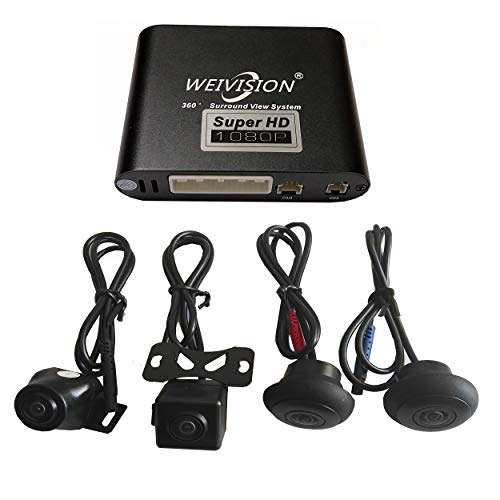
For cars under 22 feet, this Weivision system pairs four 1080P camera inputs with a maximum recording capacity of 32GB. The maker says it supports cycle recording and 1080P video output, and describes the cameras as 190-degree fisheye models with a horizontal viewing angle above 170 degrees. It is intended for parking, turns and blind-spot visibility. The 32GB ceiling is a meaningful constraint if you want longer recordings; confirm that capacity suits your recording needs before choosing it.
Bottom line: Pick this for a car under 22 feet when four-channel 1080P recording is the priority.
Weivision Universal 360 Bird View System

Unlike the more explicitly sized options, this Weivision system is described as universal for most cars, with long vehicles such as buses excluded. Its four cameras have viewing angles above 170 degrees and an IP69 waterproof rating; night vision and automatic image mosaicking are also among its features. The maker says it records MP4 video and supports shock-sensor parking monitoring. Installation is a significant consideration: fitting the side cameras requires drilling a 20 mm hole in each side mirror, and the maker recommends professional installation.
Bottom line: Choose this if your car fits the broad stated range and mirror drilling is acceptable.
BY-J 1080P AI 360 Surround System

AI detection distinguishes this BY-J system from the other car-oriented choices: the maker says it can recognize vehicles and pedestrians, trigger a panoramic view and send smart alerts. It also combines four-channel HD recording, loop recording and a USB storage limit of 128GB with a HiSilicon Hi3520V600 processor. The system is described for cars, SUVs and vans, and includes AI distance measurement. Buyers who want a simpler surround-view camera setup may not need its extra detection features; verify that the AI functions match your intended use.
Bottom line: Choose this when AI detection and USB recording capacity matter to your setup.
360° Panoramic Bird View Car System

Flexible USB storage is the standout here: the system is described as compatible with 16GB to 512GB drives using FAT32 formatting. It supports four-in-one HD recording with H.265 compression, and the maker lists AHD, TVI, CVI, HDMI, VGA and CVBS output options. The broad output selection may suit buyers matching a camera system to existing display equipment, while the vehicle fit includes cars, SUVs and trucks. Check that your chosen USB drive meets the format and size range before relying on it for recording.
Bottom line: Pick this when you need a wide USB capacity range or multiple video output formats.
How a 360 bird view camera system works
A surround-view system combines views from cameras mounted around the vehicle into a bird’s-eye display. Four-camera kits typically use front, rear and side views; the displayed overhead image is a stitched composite, not a view from a camera above the car. Camera placement and calibration determine how well the image aligns around the vehicle, so ask how calibration is performed and whether it is included in installation. Treat the screen as a parking aid, not a replacement for mirrors or direct checks: lenses can be blocked, and stitched edges can distort distances. A practical rule is to pause and check outside the vehicle whenever an obstacle is close to a bumper or tire.
Check vehicle fit before choosing a system
Vehicle dimensions and installation points decide whether a 360 camera kit is suitable. Compare the maximum vehicle length with your car’s overall length, not its wheelbase; a kit’s camera cable reach and display compatibility also need to suit the installation. The four cameras must be mounted with useful views and securely routed wiring, while mirror-mounted side cameras may require drilling. A system described as universal does not guarantee a plug-and-play fit. If your car is longer than 22 feet, do not assume a kit with that stated limit will cover it; look for a system expressly intended for the vehicle’s size and body style. Professional installation can be important when mounting requires body or mirror modifications.
Compare camera recording and storage limits
Resolution, recording channels and storage capacity answer different questions: resolution affects recorded image detail, channels indicate how many camera feeds are recorded, and storage determines how much footage can be kept before cycling. A four-channel system records four inputs, but that alone does not establish how long the footage lasts. For a rough planning check, 32GB is half the capacity of 64GB and one quarter of 128GB; actual recording time depends on bitrate, compression and whether recording is continuous. H.265 compression can reduce file size compared with less efficient encoding at similar quality, but actual savings depend on settings and scene detail. Choose storage against the capacity limit and format each system supports.
| Buyer priority | What to compare | Practical choice rule |
|---|---|---|
| Vehicle fit | Maximum vehicle length and intended body type | Use a size ceiling only if your car is within it |
| Recorded detail | Camera resolution and channel count | Check both; channel count is not resolution |
| Longer recording | Storage limit and compression format | Favor a supported capacity that meets your retention need |
Installation and calibration mistakes to avoid
Camera alignment is essential because a bird’s-eye view depends on combining several separate images. Mount cameras at the intended positions, keep each lens clear, and calibrate on a level surface using the system’s required process; an uneven surface can skew the stitched boundary. Avoid judging clearance from a single screen image when a curb or obstacle sits near the vehicle’s edge, where stitching can bend or shift objects. Check cable routing before panels are closed, especially around moving mirrors and doors. If installation involves drilling, wiring into vehicle power, or changing mirror parts, use a qualified installer and confirm the work will not interfere with airbags or other vehicle systems.
Frequently Asked Questions
Does a bird view camera show a true overhead image?
No; the overhead display is a composite stitched from cameras mounted around the vehicle. Perspective and stitching can distort objects near image seams, so use direct checks for close obstacles.
How many cameras does a 360 car system usually use?
Most surround-view kits use four cameras: front, rear and one on each side. Camera coverage and placement vary, so check that all four views suit the vehicle.
Can a 360 camera system replace car mirrors?
No; a camera display should be an added parking aid, not a substitute for mirrors or checking surroundings directly. A blocked or poorly calibrated lens can leave gaps in the view.
How often should surround-view cameras be checked?
Check camera lenses whenever dirt, snow or water may obscure them, and recheck alignment after a camera or mirror is moved. A changed or shifted stitched boundary is a reason to recalibrate.
Will a 360 bird view system record while parked?
Some systems support parking monitoring, but recording behavior depends on the specific kit and its power setup. Confirm how parking mode is triggered and how the system handles vehicle battery power before installation.