
Klutz LEGO Gear Bots: Kits Compared by Build

Klutz LEGO Gear Bots is the closest match for builders who want to make eight physics-driven creatures with LEGO Technic bricks and papercraft. Choose Klutz LEGO Gear Bots for that exact project; Klutz LEGO Gear Bots with Invisible Ink adds an invisible-ink activity book, while the other kits focus on different LEGO builds.
We earn a commission if you buy through links on this page. As an Amazon Associate I earn from qualifying purchases. Products are compared on manufacturer specifications, not hands-on testing.
- Best overall: Klutz LEGO Gear Bots – The kit specifically builds eight physics-driven kinetic creatures.
- Best for secret activities: Klutz LEGO Gear Bots with Invisible Ink – It pairs eight moving-machine builds with an invisible-ink activity book.
- Best for racing: Klutz LEGO Race Cars – Its 124 bricks make ten race-car designs, with two cars built at a time.
| Product | Best for | Builds | Included pieces | Book or guide | Shop |
|---|---|---|---|---|---|
| Klutz LEGO Gear Bots | Kinetic creatures | 8 creatures | LEGO Technic bricks and papercraft | 64-page book | Check Price on Amazon |
| Klutz LEGO Gear Bots with Invisible Ink | Secret-message fans | 8 machine versions | 62 LEGO elements | Invisible-ink activity book | Check Price on Amazon |
| Klutz LEGO Race Cars | Race-car builders | 10 car designs | 124 bricks | 64-page instruction book | Check Price on Amazon |
| LEGO Gadgets | Papercraft gadgets | Gadgets | 58 LEGO elements | 6 papercraft sheets | Check Price on Amazon |
| LEGO Gravity Drop | Marble-run builders | 18-inch marble maze | Up to 159 LEGO elements | 20+ contraptions | Check Price on Amazon |
Klutz LEGO Gear Bots and Related Kits
Compare the projects and included components to find the build that fits your interests.
Klutz LEGO Gear Bots

Klutz LEGO Gear Bots is the direct match for builders looking for LEGO Gear Bots: it makes eight physics-driven kinetic creatures from LEGO Technic bricks and papercraft. The 64-page book combines step-by-step building instructions with STEM material on axles, cams, cranks, and engineering in everyday machines. The kit includes the LEGO elements needed for its builds, so it suits a child or adult who wants one focused mechanical project rather than a variety of unrelated activities. Its scope is eight creature designs; choose a different kit if race cars or a larger marble-run tower is the goal.
Bottom line: Pick this for eight moving creature builds and an introduction to basic mechanical systems.
Klutz LEGO Gear Bots with Invisible Ink
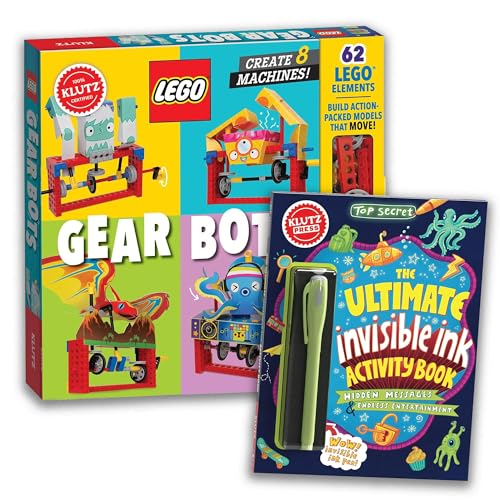
Klutz LEGO Gear Bots with Invisible Ink keeps the Gear Bots moving-machine theme but adds an invisible-ink activity book and pen for secret messages and covert missions. It includes 62 LEGO elements for eight versions of moving machines built with gears, wheels, and other LEGO elements; the set makes one machine at a time. That extra paper activity makes this a better fit for someone who wants a mechanical build plus a separate secret-message project. The included book is not the same as the 64-page STEM instruction book in Klutz LEGO Gear Bots, so choose Klutz LEGO Gear Bots if learning about axles, cams, and cranks is the priority.
Bottom line: Choose this if invisible-ink activities matter as much as the moving build.
Klutz LEGO Race Cars

Klutz LEGO Race Cars trades the kinetic creatures for race cars: its 64-page instruction book guides builders through ten designs, with two cars built at a time. The 124 bricks support color variations and mix-and-match combinations, making this a fit for children who want to build, customize, and race small vehicles rather than explore gear-driven creatures. It is still a Klutz LEGO STEM activity kit, but the project is about car designs and playful experimentation, not the axles, cams, and cranks covered by Gear Bots. Choose it when the car-building theme is the deciding factor.
Bottom line: Pick this for varied race-car designs and the option to mix colors and pieces.
LEGO Gadgets

LEGO Gadgets is the related Klutz LEGO Gadgets activity kit, supplied with 58 LEGO elements and six papercraft sheets. Its broad make-and-experiment theme suits someone interested in creative gadget projects, rather than a specific set of eight creatures or ten race cars. The specifications do not identify a project count or a detailed instruction-book format, so this is harder to compare by build sequence than the other kits. Pick it when the gadget-and-papercraft concept is the draw; choose Gear Bots for a defined set of moving creature builds.
Bottom line: Choose this for a general gadget project with LEGO pieces and papercraft.
LEGO Gravity Drop

LEGO Gravity Drop shifts the focus to gravity-powered construction: it makes an 18-inch marble maze tower with wooden balls, LEGO Technic elements, and sturdy chipboard. Its convertible pegboard tower can be customized and expanded using up to 159 included LEGO elements, and the kit adds more than 20 interactive contraptions plus five extra projects. This is the strongest fit among these alternatives for a builder who wants a larger tower-and-marble project rather than small moving creatures. The project is centered on a single tower, so choose a different kit for multiple creature or car designs.
Bottom line: Pick this for a customizable marble-run tower and related contraptions.
How to choose a Klutz LEGO Gear Bots kit
Choose by the central project: Gear Bots builds eight kinetic creatures, while nearby Klutz kits focus on cars, gadgets, or a marble tower. For moving creatures and mechanical concepts, choose Klutz LEGO Gear Bots; for the same general moving-machine theme plus invisible ink, consider Klutz LEGO Gear Bots with Invisible Ink. Choose Klutz LEGO Race Cars if ten race-car designs sound more appealing, LEGO Gadgets for gadget-making with papercraft, or LEGO Gravity Drop for an 18-inch marble maze tower. A quick decision rule is to pick Klutz LEGO Gear Bots when learning about axles, cams, and cranks is the goal; pick LEGO Gravity Drop when a tower-based marble project is the goal. These kits are not interchangeable builds, even though they share LEGO-based creative activity.
| Build goal | Choose |
|---|---|
| Eight moving creatures | Klutz LEGO Gear Bots |
| Moving machine plus secret messages | Klutz LEGO Gear Bots with Invisible Ink |
| Ten race-car designs | Klutz LEGO Race Cars |
| Gadgets and papercraft | LEGO Gadgets |
| Marble tower project | LEGO Gravity Drop |
What makes a LEGO gear bot move
Gears transfer rotation between parts, while axles support rotating components and cranks turn rotary movement into a push-pull action. Cams also convert rotation into repeated movement by pushing a follower as their uneven edge turns. Those mechanisms are useful concepts in everyday machines, which is why the Gear Bots book covers axles, cams, and cranks alongside the build instructions. Build on a clear, level surface so loose elements stay easy to find, and keep small components away from children under 3 because small parts can be a choking hazard. Mechanical builds reward careful alignment: a gear or axle that is not seated correctly can stop a model from moving freely.
How Gear Bots compares with related Klutz kits
Gear Bots is a defined creature-building set, whereas the neighboring projects change both the mechanism and the finished object. Klutz LEGO Gear Bots uses LEGO Technic bricks and papercraft for eight physics-driven creatures. Klutz LEGO Gear Bots with Invisible Ink keeps the moving-machine idea but adds an invisible-ink book, while Klutz LEGO Race Cars shifts to building and racing cars. LEGO Gadgets emphasizes gadgets and papercraft; LEGO Gravity Drop combines gravity, a pegboard tower, wooden balls, and LEGO Technic elements. The difference matters if a child has a particular interest: a car fan may spend more time with the race-car project, while a builder drawn to a taller marble structure may prefer the tower kit. Compare the pieces and build counts before choosing, rather than assuming every kit has the same instructions or components.
Keeping small LEGO builds manageable
Sort pieces before starting and work through the steps in order; small mechanical models are easier to troubleshoot when parts remain organized. LEGO Technic builds depend on aligned axles and freely turning gears, so stop and correct binding rather than forcing a component. For kits with papercraft, keep paper pieces flat and away from drinks to reduce accidental bending or staining. Store the completed models and loose elements together so a missing small part does not interrupt the next build. An adult should supervise younger builders when small pieces are in use, especially around children under 3, for whom small parts pose a choking hazard. The multi-project sets make one design at a time, so plan to finish and disassemble or set aside each build before beginning another.
Frequently Asked Questions
What age is LEGO Gear Bots intended for?
The LEGO Gear Bots kit is identified for ages 8–12. Younger children may need adult help with small components and careful mechanical assembly; keep the pieces away from children under 3 because they pose a choking hazard.
How many Gear Bots can you build at once?
The Gear Bots projects are described as eight creature builds, but the related Gear Bots set with invisible ink explicitly makes one machine at a time. Set aside space for the current build and its loose pieces before starting.
What do cams and cranks do in a LEGO model?
A crank converts rotation into a push-pull movement, and a cam uses an uneven rotating edge to move a follower repeatedly. Axles support rotating parts, so alignment matters if the mechanism binds.
Are LEGO Gear Bots and LEGO Gadgets the same kit?
No; Gear Bots centers on eight physics-driven creatures and mechanical ideas such as axles, cams, and cranks. LEGO Gadgets is a separate make-and-experiment activity kit with 58 LEGO elements and six papercraft sheets.
What should I do if a gear bot does not move freely?
Check that the axles and gears are seated and aligned, then turn the mechanism gently again. Forcing a bound gear can strain or dislodge parts; small Technic elements should also be kept away from children under 3.