
Knife and Spoon Holder: 3 Countertop Styles Compared

For a clearly sorted knife and spoon holder, Black Wooden 3-Compartment Holder stands out because its three compartments are labeled for spoons, forks, and knives. Choose RedCall Stainless Steel Knife Holder or Stainless Steel 3-in-1 Holder instead if you want a dedicated knife section alongside a utensil bucket; both drawer and general-purpose utensil organizers are a different fit.
We earn a commission if you buy through links on this page. As an Amazon Associate I earn from qualifying purchases. Products are compared on manufacturer specifications, not hands-on testing.
- Best overall: Black Wooden 3-Compartment Holder – Three labeled compartments keep spoons, forks, and knives sorted separately.
- Best for combined storage: Stainless Steel 3-in-1 Holder – A stainless steel organizer combines a knife section and utensil caddy.
- Best for knife capacity: RedCall Stainless Steel Knife Holder – Its knife holder is designed to accommodate up to 12 knives.
| Product | Best for | Storage layout | Capacity | Dimensions | Shop |
|---|---|---|---|---|---|
| Black Wooden 3-Compartment Holder | Labeled sorting | 3 labeled compartments | — | 4.3 × 4.3 × 3.4 in. | Check Price on Amazon |
| Stainless Steel 3-in-1 Holder | Combined storage | Knife section and utensil caddy | 10–12 knives | 9 × 8.5 × 4 in. | Check Price on Amazon |
| RedCall Stainless Steel Knife Holder | Knife capacity | Knife block and utensil bucket | Up to 12 knives | 4.4 × 8.9 × 9.3 in. | Check Price on Amazon |
Knife and Spoon Holders
Compare these countertop organizers by how they separate knives from spoons and other utensils.
Black Wooden 3-Compartment Holder

For simple, labeled sorting, this black wooden holder has separate compartments marked for spoons, forks, and knives. Its compact footprint is about 4.3 by 4.3 inches, with a height of about 3.4 inches. Hollowed side slots allow airflow, and the smooth surface is designed for wiping clean. The maker positions it as a countertop organizer for cutlery and cooking tools. Its three-part layout is useful when you want quick visual sorting, but it does not provide a dedicated knife block or a knife capacity; choose another style if you need those features.
Bottom line: Choose this if labeled compartments matter more than a dedicated knife block.
Stainless Steel 3-in-1 Holder

For storing knives and loose utensils together, this stainless steel organizer combines a knife section with a large utensil caddy. Its footprint is 9 by 8.5 inches and it stands 4 inches tall. The maker says the knife section holds 10 to 12 knives and describes a weighted base with nonslip tabs. That combination suits cooks who want one centralized counter organizer rather than separate containers. The broad footprint takes more counter space than a small divided caddy, and the knife capacity does not tell you whether every blade shape will fit, so match the slots to your knives.
Bottom line: Choose this for a combined knife section and utensil caddy.
RedCall Stainless Steel Knife Holder
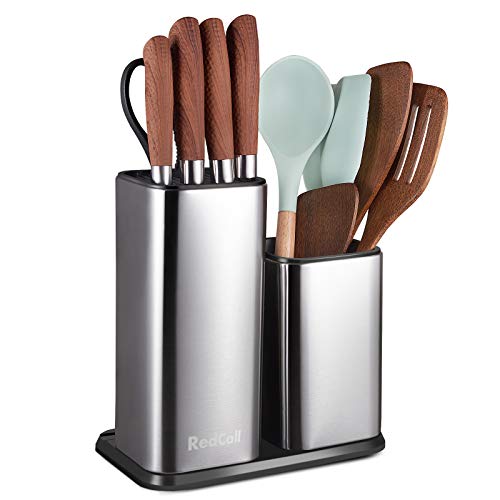
For a taller, dedicated knife holder paired with a utensil bucket, this stainless steel set separates knives from cooking tools. It measures 4.4 inches long, 8.85 inches wide, and 9.3 inches tall. The maker says the knife holder can fit up to 12 knives and includes a slot for kitchen shears; the finish is brushed metal. This layout suits counters with enough vertical clearance and buyers who want knives apart from spoons. Its height is greater than the other countertop styles here, so check the space beneath cabinets before choosing it.
Bottom line: Choose this if knife capacity and separate utensil storage are priorities.
How to Choose a Knife and Spoon Holder
Choose a holder by deciding whether you need separate labeled compartments or a dedicated knife section. Divided caddies make loose spoons and forks easy to sort; knife blocks separate sharp blades from utensils and may organize them by slot. A combined holder saves you from using two containers, but takes counter space as a single footprint. Measure the usable area and the clearance beneath cabinets before selecting a tall model. As a practical rule, if the holder will sit under a cabinet with less than 10 inches of clearance, avoid a 9.3-inch-tall design unless you have room to lift it out. Consider how many knives you actually store and whether you also need room for shears.
Countertop Knife Storage and Blade Safety
Store knives clean and dry, with blades secured so they cannot slide out or make contact with hands during retrieval. A dedicated block keeps blades separated, while a general-purpose caddy may leave them grouped with spoons; do not assume an open compartment protects cutting edges. Put knives point-down only if the holder is designed for that orientation and the blades cannot reach through its base. Keep the holder stable and away from counter edges, especially in homes with children. A weighted or nonslip base can help resist movement, but it does not make a knife holder childproof. For knives that do not fit securely, use a blade guard or a properly sized storage slot instead.
Measure the Counter Footprint Before Buying
Measure the counter area in inches, including space needed to reach around the holder, rather than relying on its height alone. A holder that is roughly 9 inches wide and deep occupies about 76 square inches; a caddy around 4 inches wide and deep uses about 16 square inches. Tall designs also need vertical clearance to lift out or remove knives safely. Check that handles do not project into a walkway or over a counter edge. If your counter area is narrow, a compact divided caddy may fit more easily; if you need a larger knife capacity, reserve a stable, unobstructed area for a broader organizer. Keep wet dishes and splashes away from stored knives.
Frequently Asked Questions
How should knives sit in a countertop holder?
Use the orientation intended by the holder, and make sure blades cannot slip through or become exposed where hands reach. Store knives clean and dry; if a blade does not fit securely, use a blade guard or another storage method.
How much counter space does a knife holder need?
Measure its full width and depth, then leave enough room to grasp handles and remove knives safely. A 9-by-8.5-inch holder covers about 76.5 square inches before allowing for access space.
Can spoons share a holder with kitchen knives?
They can if the organizer has separate sections that keep utensils from crowding the blades. Avoid placing loose utensils over exposed knife edges, and remove knives by their handles.
How do I keep a wooden utensil holder clean?
Wipe the surface with a damp cloth and dry it promptly; avoid leaving water pooled in compartments. Keeping stored utensils dry also helps limit moisture buildup.
What should I check before storing kitchen shears?
Check whether the holder has a slot wide and deep enough for the shears and their handles. Keep the blades closed when stored, and do not force them into a knife slot that does not fit.