
LabCharge Ionic Air Purifiers: 3 Models Compared

LabCharge Ionic Purifier, 5-Pack suits shoppers choosing among these LabCharge ionic air purifiers because its 250-square-foot coverage matches the other options and its pack contains five units. Choose LabCharge Negative-Ion Air Ionizer, 8 instead if you want the product name to specify negative-ion operation; choose a fan-and-filter purifier if you need a physical filter to capture particles.
The product names call these units HEPA purifiers, but their features describe filterless ionization; verify whether a physical filter is included before ordering.
We earn a commission if you buy through links on this page. As an Amazon Associate I earn from qualifying purchases. Products are compared on manufacturer specifications, not hands-on testing.
- Best overall: LabCharge Ionic Purifier, 5-Pack – It has the same 250-square-foot coverage as the other options and comes as a five-unit pack.
- Best for ionizer clarity: LabCharge Negative-Ion Air Ionizer, 8 – Its product name explicitly identifies it as a negative-ion, filterless purifier.
- Best for four-unit packs: LabCharge Ionic Purifier, 4-Pack – It pairs stated 250-square-foot coverage with a four-unit pack.
| Product | Best for | Pack size | Shop |
|---|---|---|---|
| LabCharge Ionic Purifier, 5-Pack | Five-unit pack | 5 units | Check Price on Amazon |
| LabCharge Negative-Ion Air Ionizer, 8 | Negative-ion wording | 8 (as named) | Check Price on Amazon |
| LabCharge Ionic Purifier, 4-Pack | Four-unit pack | 4 units | Check Price on Amazon |
LabCharge Ionic Air Purifiers
These options share the same coverage and dimensions, so compare their pack counts and wording about ionization.
LabCharge Ionic Purifier, 5-Pack

The five-unit pack is the distinguishing point here; the room coverage and compact dimensions match the other LabCharge options. The product is described as a filterless ionic purifier for bedrooms, offices, and kitchens, with no filter replacement required. It may suit someone who wants several plug-in units rather than a single fan-and-filter appliance. Its title also says “HEPA,” while its maker says filterless, so verify whether a physical filter is included if particle capture is your priority.
Bottom line: Pick this if you want five compact ionic units with coverage of 250 square feet each.
LabCharge Negative-Ion Air Ionizer, 8
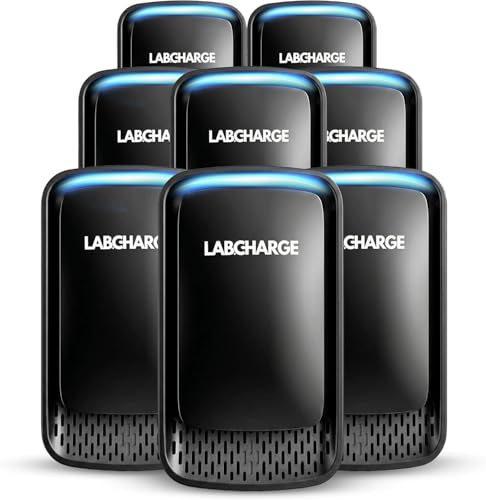
The negative-ion wording makes this option the clearest match for shoppers specifically seeking an ionizer; its coverage and dimensions are otherwise the same as the other LabCharge models. The product name identifies it as a plug-in, filterless device, and its maker says it has no fan or motor. That design is distinct from a purifier that pulls room air through a filter. The “8” appears in the product name, but the fields do not clarify what it represents, so confirm the pack quantity if that affects your choice.
Bottom line: Choose this if negative-ion operation is the feature you want and you can confirm the pack quantity.
LabCharge Ionic Purifier, 4-Pack

The four-unit pack separates this option from the other LabCharge choices; it shares their 250-square-foot coverage and compact black design. Its maker describes high-density ions, quiet operation, and a filterless setup intended for use in rooms such as bedrooms or offices. This may suit a buyer who wants multiple units but does not need the five-unit count of LabCharge Ionic Purifier, 5-Pack. The HEPA wording in its name conflicts with the filterless description, so it is not the clearest choice for anyone who specifically needs a physical HEPA filter.
Bottom line: Pick this if a four-unit pack fits your needs and filterless ionic operation is acceptable.
How ionic air purifiers differ from HEPA filters
Ionic purifiers and HEPA-filter units handle airborne particles in different ways. Ionizers charge particles so they can settle on surfaces or collect on an oppositely charged plate; a HEPA filter physically captures particles as air passes through it. A true HEPA filter is rated to capture at least 99.97% of particles 0.3 microns in size, while an ionizer does not provide that same filter rating. Ionizers may also produce ozone, a lung irritant; the amount depends on the device and operating conditions. For a room where particle removal is the priority, choose a fan-and-filter unit with a clear clean-air delivery rate (CADR) rather than assuming “HEPA” in a product name means a filter is present.
Choosing coverage for a room
Choose purifier capacity by room area and air changes per hour, not by room area alone. For an 8-foot ceiling, the common sizing shortcut for smoke is a smoke CADR of at least two-thirds of the room’s square footage; higher ceilings need more capacity. A purifier sized for 250 square feet may be undersized for a larger open room or a space with high ceilings. Fan-and-filter models publish CADR values, which let buyers compare particle-cleaning speed; an ionic device’s coverage claim is not a CADR value. Measure the room’s length and width, multiply them for square footage, and choose a rated unit with capacity at least that large.
| Need | What to compare | Useful rule |
|---|---|---|
| Filterless ionization | Ionizer design and ozone emissions | Check for an independent ozone certification |
| Measured particle removal | True HEPA filtration and CADR | For 8-foot ceilings, target smoke CADR at least ⅔ of room area |
Safety considerations for ionizers
Ozone is the main safety issue to assess with ionizing air cleaners. Ozone generators intentionally make ozone, and some ionizers can emit it as a byproduct; ozone can irritate airways, so do not treat a fresh or “clean” smell as proof of safe air. California’s air-cleaner regulation limits ozone emissions from covered indoor air-cleaning devices to 0.050 parts per million, and CARB-certified devices are tested against that limit. Certification does not establish that an ionizer removes particles as effectively as a HEPA purifier. If someone in the home has asthma or another respiratory sensitivity, favor a mechanical filter model with a published CADR and avoid devices that intentionally generate ozone.
What to check before buying a plug-in purifier
Check the operating design, rated room coverage, and whether the device uses a physical filter. Plug-in dimensions can matter: a device that blocks a neighboring outlet or sits behind furniture may not fit the intended spot. Air cleaners work best with unobstructed airflow, so leave space around an intake or outlet rather than placing a purifier behind curtains or under a bed. For this set, the coverage and dimensions are the same across the three exact-fit choices, while pack count and wording differ. The inconsistent HEPA and filterless claims make the filter question especially important if you are buying specifically for mechanical particle capture.
Frequently Asked Questions
Do ionic air purifiers remove particles from the air?
Ionic purifiers charge airborne particles so they can settle onto surfaces or collect on a plate, rather than trapping them in a HEPA filter. They may therefore leave settled particles on furniture and floors for later cleaning.
How large a room can a 250-square-foot purifier cover?
A 250-square-foot coverage claim is a starting point, not a universal cleaning rate. With an 8-foot ceiling, compare a smoke CADR of about 167 cubic feet per minute or higher for that area, and account for higher ceilings or heavy pollution.
Can an air ionizer produce ozone indoors?
Yes, some ionizers emit ozone as a byproduct, while ozone generators are designed to produce it. California’s limit for covered indoor air cleaners is 0.050 parts per million, so look for applicable independent ozone certification.
What does a true HEPA filter capture?
A true HEPA filter is rated to capture at least 99.97% of particles 0.3 microns in size as air passes through it. That filtration rating is different from an ionizer’s particle-charging action.
Where should a plug-in air purifier sit in a room?
Place an air purifier where its air path is unobstructed, not behind curtains or furniture. Leave roughly 1 to 2 feet of open space around a fan-and-filter model’s intake and outlet when the room layout allows.