
Leather Glue for Car Seats: 5 Options Compared

For most car-seat repairs, 120 ml Leather Adhesive with Brush is the best fit because its maker describes a flexible bond and includes a brush and applicator stick for controlled placement. Choose a different option if you need a smaller bottle or precision tips; these products differ in container size and application tools.
Leather adhesive bonds separated material, but a repair must also tolerate movement and cabin temperature changes. Confirm the adhesive’s automotive interior temperature rating before ordering.
We earn a commission if you buy through links on this page. As an Amazon Associate I earn from qualifying purchases. Products are compared on manufacturer specifications, not hands-on testing.
- Best overall: 120 ml Leather Adhesive with Brush – A flexible bond plus a brush and applicator stick suits controlled placement on upholstery.
- Best for larger repairs: 130 ml Leather Cement – Its 130 ml container is the largest volume among these options.
- Best for precision tips: Y’allCanDiy Cyanoacrylate Leather Glue – The package includes three precision applicator tips.
| Product | Best for | Container size | Application tool | Bond claim | Shop |
|---|---|---|---|---|---|
| 120 ml Leather Adhesive with Brush | Controlled application | 120 ml | Brush and stick | Flexible | Check Price on Amazon |
| 130 ml Leather Cement | Larger repair areas | 130 ml | — | Flexible | Check Price on Amazon |
| 1.23 oz Clear Leather Glue | Small visible repairs | 1.23 oz | — | Flexible | Check Price on Amazon |
| Cerca de Leather Glue, 2 oz | Narrow seam placement | 2 oz | Small outlet | Flexible | Check Price on Amazon |
| Y’allCanDiy Cyanoacrylate Leather Glue | Tip-controlled placement | — | Three precision tips | Waterproof | Check Price on Amazon |
Leather Glue for Car Seats
Match the adhesive’s flexibility and application method to the size and location of the seat repair.
120 ml Leather Adhesive with Brush

120 ml Leather Adhesive with Brush stands out for its included brush and applicator stick, which give you more control when placing adhesive along a seam or peeled edge. The maker says its bond stays flexible after curing and is suitable for leather, PU, and fabric, making it relevant to mixed-material seat repairs. At 120 ml, it is a larger container than the 1.23 oz option. Its limitation is that the maker provides no automotive temperature rating here, so confirm that rating if the seat will face hot cabin conditions.
Bottom line: Choose this if careful adhesive placement matters more than having the largest container.
130 ml Leather Cement
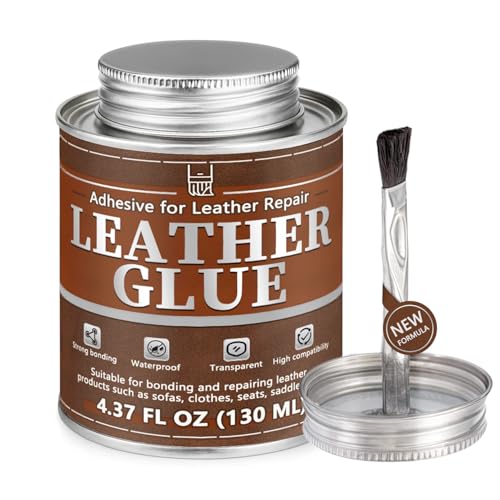
130 ml Leather Cement offers the largest volume in this group at 130 ml, which may suit a broader repair or multiple jobs. The maker describes the adhesive as clear, waterproof, and flexible, and names car seats, sofas, and saddles among its uses. That flexibility matters where upholstery bends as people get in and out. Confirm its automotive temperature rating before choosing it for a seat.
Bottom line: Choose this for a larger repair when you can provide your own suitable applicator.
1.23 oz Clear Leather Glue

1.23 oz Clear Leather Glue is the smallest container by volume, making it a sensible size for a small tear or a limited area of peeling. The maker says it dries clear, sets in seconds, and remains flexible and waterproof, qualities intended to support visible repairs on seats and other leather goods. The compact amount is also its main limitation: it is less suited to a large upholstery job than the 120 ml and 130 ml choices.
Bottom line: Choose this for a small, localized repair where a clear finish is important.
Cerca de Leather Glue, 2 oz

Cerca de Leather Glue, 2 oz differs through its hose container and tiny glue outlet, a setup intended for depositing adhesive into narrow areas. The maker says the clear bond is waterproof and flexible, and lists leather, suede, rubber, neoprene, and canvas as compatible materials. That range may help when a seat repair involves more than one material. The 2 oz amount is modest beside the larger milliliter containers, and the specifications do not describe a separate brush for spreading adhesive across a broad surface. Verify temperature suitability for automotive cabin use.
Bottom line: Choose this when a narrow outlet is more useful than a brush or larger container.
Y’allCanDiy Cyanoacrylate Leather Glue

Y’allCanDiy Cyanoacrylate Leather Glue is the only option identified as cyanoacrylate glue, and it includes three precision applicator tips for controlled placement. The maker says it bonds quickly and is intended for leather goods including car seats and upholstery. Cyanoacrylate typically cures to a less flexible bond than upholstery cement, so it may be a poor match for a seat area that repeatedly bends or stretches. Check the cure and temperature ratings for the intended repair.
Bottom line: Choose this for a small, precisely placed repair only when a less-flexible bond suits the location.
How to choose leather glue for a car seat
For a seat repair, prioritize flexibility and automotive temperature suitability before clear color or fast setting. Seat covers flex with occupants, while a parked cabin can become much hotter than the outdoor air; an adhesive without a suitable interior temperature rating may soften or fail. Match the application method to the defect: a brush helps spread glue along an edge, while a narrow outlet or precision tip can help keep adhesive inside a small seam. For a repair wider than a few inches, container volume and an even application matter more than a pinpoint nozzle. Before buying, confirm the adhesive’s temperature rating for automotive interiors.
| Repair need | Useful adhesive trait | Application style |
|---|---|---|
| Loose seam | Flexible bond | Narrow outlet or tip |
| Peeling edge | Flexible bond | Brush or controlled bead |
| Broad separated area | Flexible bond and adequate volume | Even spread over the contact area |
Preparing leather and upholstery for bonding
Clean, dry contact surfaces give adhesive a better chance to bond than dusty, oily, or damp surfaces. Let recently cleaned upholstery dry fully, and remove loose debris without enlarging a tear. Test adhesive on a hidden spot first if color transfer or a change in surface appearance would be a problem; a clear formula can still leave a visible raised bead. Keep adhesive on the surfaces being joined rather than saturating foam beneath the seat cover, because excess glue can make the repair stiff and visible. Work with ventilation and avoid skin or eye contact, especially with cyanoacrylate adhesives, which can bond skin rapidly.
Applying adhesive to a seat seam or peeled edge
For a seam or peeled edge, apply a thin, even amount to the surfaces that will touch rather than flooding the opening. Press the materials together in alignment and keep them from shifting through the adhesive’s cure period; the specifications do not give a shared cure time, so do not assume every formula’s “fast-setting” claim means the seat is ready for use. If the seat cover is torn through rather than merely separated at a seam, adhesive alone may not bridge the gap reliably. Avoid gluing across an airbag seam or any marked deployment area, where an obstruction could interfere with restraint-system operation.
Common mistakes with car-seat leather glue
The most common mistake is choosing by waterproof or clear claims alone and overlooking flexibility and heat suitability. A cabin-facing repair needs an adhesive appropriate to automotive interior temperature swings, while a rigid bond can crack when the seat bends. Another mistake is using too much glue: excess can seep out, discolor the surface, or create a hard spot against the seat cover. Avoid loading or flexing the repair before it has cured, and do not apply any adhesive across seams associated with side airbags. Keep the container closed between uses and store it away from children, heat, and ignition sources according to the product’s safety label.
Frequently Asked Questions
Can leather glue fix a torn car seat?
Leather adhesive is most suitable for joining separated edges or a peeled layer, not replacing missing material. If the tear leaves a gap, a backing patch may be needed to support the joint.
How long should car-seat glue cure?
Cure times vary by adhesive and application thickness, and these products do not share one stated time. Keep the seat unloaded until the adhesive’s full cure time has passed, rather than relying only on a quick-set claim.
Will leather glue hold in a hot car?
Only an adhesive rated for the temperature range of automotive interiors should be relied on in a hot cabin. Confirm that rating before buying because heat can affect an adhesive bond.
Is cyanoacrylate glue flexible on leather?
Cyanoacrylate typically cures less flexibly than upholstery cement, so it is a weaker match for areas that bend repeatedly. Reserve it for small repairs where the joint does not need substantial movement.
Should I apply leather glue to wet upholstery?
No; bonding surfaces should be clean and dry before adhesive is applied. Moisture or oily residue can interfere with contact and make a repair less reliable.