
Left-Handed Baitcaster Reels Compared by Gear Ratio

For a versatile starting point, choose KastKing Spartacus II Left-Hand Reel: its 7.2:1 gear ratio, 17.6-pound maximum drag and 6-ounce weight balance speed, control and a light setup. Pick a different reel if you need faster line pickup, more maximum drag or a heavier graphite-body option.
We earn a commission if you buy through links on this page. As an Amazon Associate I earn from qualifying purchases. Products are compared on manufacturer specifications, not hands-on testing.
- Best overall: KastKing Spartacus II Left-Hand Reel – Its 7.2:1 ratio and 6-ounce weight provide a practical balance for general use.
- Best for fast retrieves: Piscifun Torrent II Left-Hand 8.1:1 – The 8.1:1 gear ratio is the highest among these left-hand options.
- Best for adjustable braking: KastKing Lethal Blaze Left-Hand 7.3:1 – Its 11-setting magnetic brake offers the largest brake-setting range.
| Product | Best for | Gear ratio | Max drag | Weight | Shop |
|---|---|---|---|---|---|
| KastKing Spartacus II Left-Hand Reel | Balanced all-around use | 7.2:1 | 17.6 lb | 6 oz | Check Price on Amazon |
| Piscifun Torrent II Left-Hand 8.1:1 | Fast line pickup | 8.1:1 | 20 lb | 6.75 oz | Check Price on Amazon |
| KastKing Lethal Blaze Left-Hand 7.3:1 | Brake adjustment range | 7.3:1 | 15.4 lb | 7 oz | Check Price on Amazon |
| Abu Garcia Max SX Left-Hand | Brass-gear design | 6.8:1 | — | 9.9 oz | Check Price on Amazon |
Left Handed Baitcaster Reels
Compare the retrieve ratio, drag rating and weight to choose a reel that fits your fishing approach.
KastKing Spartacus II Left-Hand Reel

At 6 ounces, this is the lightest of the left-hand reels with a drag rating here, while its 7.2:1 ratio sits between the slower retrieve of the Max SX and the faster Torrent II. The Spartacus II has a graphite frame, a 5-button magnetic brake and a 7+1 bearing count. KastKing says its four-disc carbon-fiber drag reaches 17.6 pounds and its line guide reduces friction. Anglers wanting a quick, light setup can consider it for a range of lure presentations. Its gear ratio is slower than the Torrent II’s, so it may not suit someone prioritizing the fastest line pickup.
Bottom line: Choose this if you want a light reel with a middle-range retrieve ratio.
Piscifun Torrent II Left-Hand 8.1:1

The Torrent II has the fastest gear ratio among these left-hand choices at 8.1:1, making it the option to consider when quickly taking up slack matters. It weighs 6.75 ounces and features an aluminum main gear, brass pinion gear, EVA handle knobs and an externally adjustable magnetic brake. Piscifun says its maximum drag is 20 pounds. The higher ratio trades away some retrieve leverage compared with a slower reel, so anglers who prioritize a slower, more controlled presentation may prefer another ratio.
Bottom line: Pick this when quick line pickup is more important than a slower retrieve.
KastKing Lethal Blaze Left-Hand 7.3:1

The Lethal Blaze distinguishes itself with an 11-setting magnetic brake, giving anglers more stated brake positions than the 5-button system on the Spartacus II. Its 7-ounce low-profile reel has a glass-fiber-infused nylon frame and an aluminum spool. KastKing says the maximum drag is 15.4 pounds and describes the reel for freshwater and inshore fishing. That drag rating is lower than the maximums for the Spartacus II and Torrent II, so anglers who expect to use more drag pressure should compare those models. The 7.3:1 ratio is close to the Spartacus II’s 7.2:1.
Bottom line: Choose this if you want an 11-setting magnetic brake for casting adjustments.
Abu Garcia Max SX Left-Hand
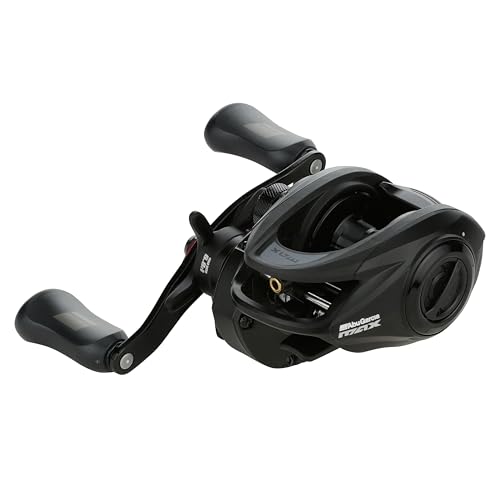
The Max SX is the slowest-geared and heaviest left-hand option in this group, at 6.8:1 and about 9.9 ounces. It pairs a graphite body and sideplates with a brass Duragear gear, a Power Disk drag system and a 7+1 stainless-steel bearing system. Abu Garcia gives a recovery rate of 28 inches per crank turn and describes its MagTrax brake as adjustable. The reel specifications do not provide a maximum drag figure, which may matter to anglers comparing drag ratings directly. Its heavier build may also be less appealing for a setup where low reel weight is the priority.
Bottom line: Pick this if you prefer a brass-gear reel and do not prioritize low weight.
How to Choose a Left-Handed Baitcaster Reel
Choose a left-handed baitcaster by matching retrieve speed to your lure presentation, then check weight and drag. A gear ratio such as 7.2:1 means the spool turns 7.2 times for each handle turn; it is not a fixed line-retrieval distance because spool diameter and line fill affect pickup. Higher ratios take up slack faster, while lower ratios provide a slower retrieve. For a light setup, compare reel weights directly: a difference of 3 ounces becomes noticeable over repeated casting. Treat maximum drag as a rating, not a target setting; set drag lower than the line’s breaking strength to reduce the risk of a break-off.
| Need | What to prioritize |
|---|---|
| Fast slack pickup | Higher gear ratio |
| Lower setup weight | Fewer ounces |
| More drag headroom | Higher stated maximum drag |
What Left-Hand Retrieve Means
A left-hand baitcaster is cranked with the left-hand while the right hand can remain on the rod. Retrieve hand does not determine casting-hand preference: anglers may cast with either hand, then turn the reel handle with the left. If you currently switch a rod between hands after a right-hand cast, a left-hand retrieve can remove that extra movement. Before ordering, confirm the reel’s handle side, especially when a product family offers both retrieve orientations. Gear ratio describes spool rotations per handle turn, not whether the reel is right- or left-handed.
How to Set Baitcaster Brakes
Use the magnetic brake and spool-tension control together to manage spool overrun, which creates backlash when the spool spins faster than line leaves it. Start with stronger braking and reduce it gradually as casting control improves; wind and lure weight change how much braking a cast needs. A simple check is to hold the rod level with the lure hanging, disengage the spool and adjust tension until the lure falls steadily without the spool continuing to spin after it lands. Avoid forcing a very light lure on a heavy baitcasting setup: lighter lures generally require a rod and reel matched to their weight.
Match the Reel to Rod and Line
Match a baitcaster to a rod rated for the lure weights and line types you plan to cast; those ratings are usually printed near the rod handle. Braided line is thinner than monofilament at a comparable breaking strength, so it can increase line capacity but may dig into a tightly packed spool under heavy pressure. Fill the spool evenly and leave a small gap below its rim rather than winding line flush to the edge, which can cause overruns. Check that the reel seat clamps securely and that the rod guides suit your line. Keep hooks covered during transport and handle trebles carefully to avoid punctures.
Frequently Asked Questions
Does a left-hand baitcaster crank with the left-hand?
Yes, a left-hand retrieve places the handle on the left side for cranking with that hand. It does not dictate which hand you use to cast.
What does a 7.2:1 baitcaster gear ratio mean?
The spool rotates 7.2 times for one complete handle turn. Actual line pickup per turn varies with spool diameter and how much line remains on the spool.
How do I reduce backlash on a baitcaster?
Increase braking and spool tension, then loosen them in small steps as you gain control. Wind and lure weight affect spool overrun, so re-adjust when either changes substantially.
Should I fill a baitcaster spool to the rim?
No; leave a small gap below the spool rim rather than winding line flush to the edge. A full-to-the-edge spool can make overruns more likely, especially when the spool is poorly controlled.
Can I use braided line on a baitcaster?
Yes, but braid can dig into a tightly packed spool under heavy pressure. Wind it evenly and match line strength to the rod, reel and fishing conditions.