
Leveling Casters for Workbench: 5 Sets Compared

W B D WEIBIDA 100F Nylon Set is the best fit for most workbenches when the 6,600-pound set capacity is the deciding factor. Leveling casters pair wheels for moving equipment with pads that lower to support it in place.
Choose a 2,200-pound set instead if its capacity better matches your loaded bench; before ordering, confirm the mounting pattern and usable lift range fit your bench.
We earn a commission if you buy through links on this page. As an Amazon Associate I earn from qualifying purchases. Products are compared on manufacturer specifications, not hands-on testing.
- Best overall: W B D WEIBIDA 100F Nylon Set – Its 6,600-pound set capacity is higher than the 2,200-pound ratings of the other sets.
- Best for aluminum base: Nefish 60F Aluminum-Base Set – It combines an aluminum-base with NBR rubber padding.
- Best for compact footprint: HOLKIE TD60 Ratchet Set – Its size is 2.87 by 2.87 inches.
| Product | Best for | Set capacity | Wheel type | Base or pad | Shop |
|---|---|---|---|---|---|
| W B D WEIBIDA 100F Nylon Set | Higher stated capacity | 6,600 lb | Nylon | Leveling feet | Check Price on Amazon |
| Nefish 60F Aluminum-Base Set | Aluminum-base | 2,200 lb | — | Aluminum and NBR | Check Price on Amazon |
| FIZAR 60F Set | Swivel mobility | 2,200 lb | 360-degree swivel | Aluminum and NBR | Check Price on Amazon |
| HOLKIE TD60 Ratchet Set | Compact mounting area | 2,200 lb | — | — | Check Price on Amazon |
| Heavy Duty Ratchet Set | Basic ratchet adjustment | 2,200 lb | — | — | Check Price on Amazon |
Leveling Casters for Workbench
Compare the set capacities and construction details to narrow down the right caster style for your bench.
W B D WEIBIDA 100F Nylon Set

W B D WEIBIDA 100F Nylon Set stands apart with a 6,600-pound set capacity, compared with 2,200-pound ratings for several other options here. The set has nylon wheels and leveling feet, with a ratchet arm for raising or lowering the support platform. The maker says the design lets users move heavy equipment and then fix it in place with the feet. This may suit a loaded workbench that needs both mobility and stable support. The 6,600-pound rating is a maker claim for the set; check that your bench, tools, mounting points and floor are compatible before relying on it.
Bottom line: Choose this set when its higher stated capacity and nylon wheels suit your workbench.
Nefish 60F Aluminum-Base Set

The maker gives a 2,200-pound capacity for the set and describes a ratchet arm for adjusting support height. Its dimensions are listed as 6.1 inches high, 3.7 inches long and 8.3 inches wide. Confirm the mounting fit and lift range for your bench before choosing this set.
Bottom line: Choose this set if an aluminum-base and NBR padding suit your setup.
FIZAR 60F Set

FIZAR 60F Set is the option here that specifically identifies 360-degree swivel casters, along with an aluminum-alloy base and NBR rubber pads. The maker rates the four-piece set for 2,200 pounds and describes an ergonomic ratchet handle for adjusting the retractable supports. That combination suits a workbench that must turn in tight spaces before being steadied on its pads. The rating is for the set, not an individual caster.
Bottom line: Choose this set when swivel maneuvering and an aluminum-and-NBR base matter.
HOLKIE TD60 Ratchet Set

The set name gives a 2,200-pound total capacity and identifies a ratchet-handle design with adjustable leveling pads. That makes it relevant when a workbench needs to roll for repositioning and then rest on supports. Its footprint can help with a preliminary space check, but it is not necessarily the mounting-hole pattern. Verify the actual attachment layout against your bench before installation.
Bottom line: Choose this set when its compact footprint and stated capacity suit the bench.
Heavy Duty Ratchet Set
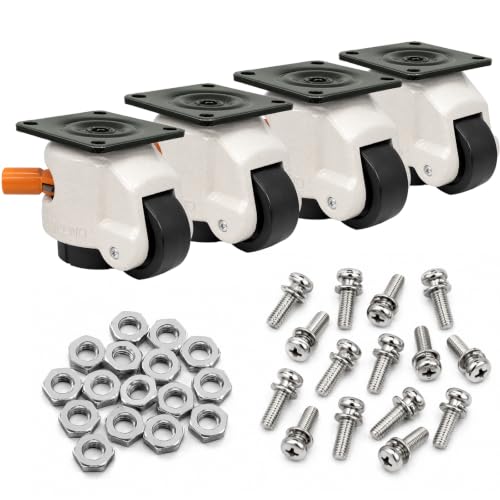
Heavy Duty Ratchet Set focuses on a simple combination of retractable pads and a ratchet handle, without the distinctive material or wheel information given for some alternatives. The product name gives a 2,200-pound total capacity, and its maker says the ratchet adjusts the support pads without additional tools. The maker describes the set as allowing equipment to roll and then be held by the lowered pads.
Bottom line: Choose this set for ratchet-adjusted retractable pads and a 2,200-pound stated rating.
How to choose leveling casters for a workbench
Choose leveling casters by comparing the fully loaded workbench weight with the set’s total capacity, then check whether the wheel and pad arrangement suits the floor and movement path. Count the bench, tools, stored materials, and anything that stays on top while the bench rolls. The sets here have stated total capacities of 2,200 or 6,600 pounds; those figures apply to the set, not to each caster. Do not select a set whose capacity is below the loaded weight.
Consider how the bench moves through the shop. Swivel wheels help redirect a bench in a narrow aisle, while lowering the pads transfers support from the wheels to the floor. A ratchet handle adjusts pad height, so leave room to operate it beside walls, shelves, or neighboring equipment. A high capacity cannot compensate for a weak bench frame or an unsuitable floor.
| Workbench need | What to compare |
|---|---|
| Loaded bench weight | Total set capacity |
| Frequent turns | Swivel function and turning clearance |
| Stationary support | Pad construction and usable adjustment |
Mounting fit and clearance
Measure the bench’s mounting area and hole spacing before choosing a caster; a caster’s outside footprint is not necessarily its mounting-hole pattern. Also measure the available vertical space and the clearance around the ratchet arm, because a handle can be difficult to operate when a bench sits close to a wall or cabinet. The HOLKIE set gives a 2.87-by-2.87-inch size, but that dimension alone does not establish hole spacing.
Use a simple fit rule: if the caster plate is wider than the bench’s mounting surface, do not assume the overhang is safe; confirm the attachment can be supported across its full plate. Check lift range against obstacles under the bench and the height you need to level. Since mounting patterns and lift ranges are not supplied consistently across these sets, confirm those measurements with the seller before ordering.
Leveling pads, wheels, and shop floors
Leveling caster assemblies combine a rolling wheel with a support pad that can be lowered after repositioning. The wheel makes movement possible; the lowered pad helps hold the equipment in place. For a working bench, raise the pads clear of the floor before rolling, then lower them once the bench is where it belongs. Do not move a loaded bench with a pad dragging across the floor.
Floor condition affects both mobility and support: cracks, debris, and abrupt thresholds can catch small wheels, while a soft or uneven surface can make a narrow pad settle unevenly. Clear the route and move heavy benches slowly, keeping hands and feet out from beneath the frame. Use the pads as intended for stationary support rather than treating the caster wheels as a substitute for a stable work surface.
Capacity and stability checks
Capacity is a set-level limit in the product names here, so compare the complete loaded bench against the total rating rather than dividing it casually into a per-wheel allowance. Uneven loading can place more force on one corner, and a floor slope or soft spot can further affect stability. Keep heavy tools low and centered where practical, and do not exceed the set capacity.
Before work begins, lower each pad until the bench is steady and check for rocking by applying gentle pressure at the work surface. Reposition the bench if a pad sits on debris or an unstable floor section.
Frequently Asked Questions
How much weight can leveling casters support?
The sets in this comparison are rated for either 2,200 or 6,600 pounds total. Compare that set capacity with the fully loaded workbench, rather than treating the number as a rating for each caster.
Do leveling casters keep a workbench from rolling?
The leveling pads are intended to support the bench after it has been moved, while the wheels provide mobility. Lower the pads to support the bench before working; do not rely on wheel brakes or a level floor as a substitute for stable support.
How do I check whether casters fit my workbench?
Measure the available mounting area and compare it with the caster mounting plate and hole pattern. Also check clearance for the ratchet handle and the vertical lift range; those dimensions determine whether the assembly can attach and adjust without hitting the bench or nearby objects.
Are swivel casters useful on a workbench?
Swivel casters let the bench change direction without first turning the whole bench around. They are useful in tight spaces, but measure the turning clearance with the bench loaded because the work surface and stored tools need room as well.
Should I move a workbench with its pads lowered?
Raise the leveling pads clear of the floor before rolling the bench, then lower them again once it is positioned. Moving with pads dragging can interfere with rolling and place unintended stress on the supports; keep people clear of a loaded bench while repositioning.