
Liqui Moly Lifter Additive: 3 Options Compared

Liqui Moly Hydraulic Lifter Additive 300 mL (8367) is the best fit for most shoppers seeking a Liqui Moly lifter additive because its 300 mL formula is specified for turbocharged vehicles and catalytic converters.
We earn a commission if you buy through links on this page. As an Amazon Associate I earn from qualifying purchases. Products are compared on manufacturer specifications, not hands-on testing.
- Best overall: Liqui Moly Hydraulic Lifter Additive 300 mL (8367) – The 300 mL formula is identified as suitable for turbocharged vehicles and vehicles with catalytic converters.
- Best for diesel engines: Liqui Moly Hydro-Stößel-Additiv 300 mL (1009) – Its use includes petrol and diesel engines with and without diesel particle filters.
- Best for a two-pack: Liqui Moly Hydraulic Lifter Additive 2-Pack (20004) – The package is identified as two units of hydraulic lifter additive.
| Product | Best for | Volume | Package | Stated compatibility | Shop |
|---|---|---|---|---|---|
| Liqui Moly Hydraulic Lifter Additive 300 mL (8367) | Turbo vehicles | 300 mL | 1 bottle | Turbocharged vehicles; catalytic converters | Check Price on Amazon |
| Liqui Moly Hydro-Stößel-Additiv 300 mL (1009) | Diesel engines | 300 mL | 1 bottle | Petrol and diesel; with or without DPF | Check Price on Amazon |
| Liqui Moly Hydraulic Lifter Additive 2-Pack (20004) | Two-bottle pack | — | 2 bottles | — | Check Price on Amazon |
Liqui Moly Lifter Additives Compared
Compare the product size, package format and specified engine compatibility before choosing an additive.
Liqui Moly Hydraulic Lifter Additive 300 mL (8367)

Liqui Moly Hydraulic Lifter Additive 300 mL (8367) is the option here that explicitly names turbocharged vehicles and catalytic converters as suitable applications. The 300 mL additive is intended to improve oil lubrication, clean valve bores and reduce engine noise caused by hydraulic tappets; the maker also gives it a 60°C flash point. This is a reasonable match when those compatibility notes fit your vehicle and you want a single bottle. Its limitation is that the use notes do not specify engine oil capacity or dosage, so confirm the required amount for your engine before adding it.
Bottom line: Choose this if your vehicle has a turbocharger or catalytic converter and the package’s use directions fit your engine.
Liqui Moly Hydro-Stößel-Additiv 300 mL (1009)
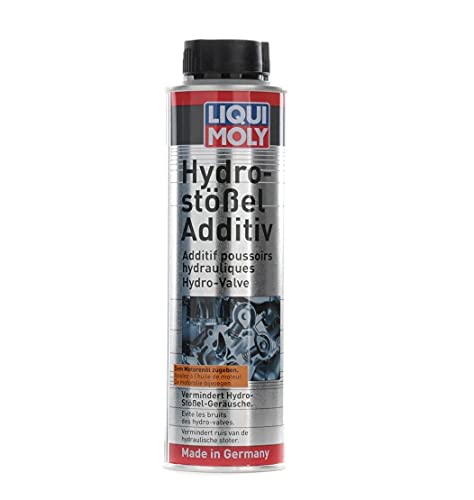
Liqui Moly Hydro-Stößel-Additiv 300 mL (1009) is distinguished by its compatibility with petrol and diesel engines both with and without diesel particle filters. Its 300 mL formula is intended for commercially available motor oils, and the maker says it dampens noise from worn hydraulic lifters and supports tappet function. That broad engine wording makes it useful to compare when an emissions filter is part of the vehicle. The clear limitation is its wet-clutch warning: the maker excludes motorcycles with wet clutches, so this is not the choice for that application.
Bottom line: Choose this for a petrol or diesel engine with a diesel particle filter, but not a wet-clutch motorcycle.
Liqui Moly Hydraulic Lifter Additive 2-Pack (20004)
Liqui Moly Hydraulic Lifter Additive 2-Pack (20004) is the only option identified as a two-pack, which may suit someone who specifically wants two units rather than one bottle. Its name identifies it as Liqui Moly hydraulic lifter additive, but the product facts do not establish the volume per bottle, formula characteristics or engine compatibility. Those omissions matter because additive quantity and application need to match the engine and oil system. Treat this as a package-format choice only until you confirm the bottle size and the product’s directions for your vehicle.
Bottom line: Choose this only when the two-pack format is important and you can confirm bottle size and application.
How to choose a hydraulic lifter additive
Start with the exact engine application and the product’s dosing directions, not the name on the bottle. Hydraulic lifters, also called hydraulic tappets, use engine oil pressure to maintain valve-train clearance; oil condition, viscosity and a mechanical fault can also contribute to ticking. An additive cannot establish whether noise comes from a lifter, low oil level, incorrect oil viscosity or another component. Check the owner’s manual for the required oil specification and capacity before pouring in an additive. A practical decision rule is to skip any product whose application or dose you cannot verify for your engine. These products are additives, not substitutes for an oil change, diagnosis or repair when noise continues.
Compatibility with engine oil and emissions equipment
Compatibility language is useful only when it matches your vehicle’s actual setup. Liqui Moly Hydraulic Lifter Additive 300 mL (8367) calls out turbocharged vehicles and catalytic converters, while Liqui Moly Hydro-Stößel-Additiv 300 mL (1009) names petrol and diesel engines, including those with diesel particle filters. A diesel particle filter and catalytic converter are different emissions components, so do not treat one compatibility statement as proof of the other. Match the engine type and equipment, then verify the oil specification in the manual. The label “commercially available motor oils” for Liqui Moly Hydro-Stößel-Additiv 300 mL (1009) is broad, but it does not override the vehicle maker’s oil requirements. For any additive, use the product directions and avoid exceeding the engine’s oil-fill capacity.
What hydraulic lifter noise can mean
Hydraulic lifters rely on pressurized engine oil, so a ticking noise can have more than one cause. Low oil level, unsuitable viscosity, restricted oil flow, wear or a separate valve-train problem may produce similar symptoms. Check the dipstick on level ground according to the vehicle manual and confirm the oil grade before attributing noise to a lifter. A brief sound at startup and a persistent tick are not interchangeable diagnoses; ongoing noise, an oil-pressure warning or worsening engine behavior calls for prompt mechanical inspection. An additive marketed for tappet noise is not a repair guarantee, and it should not delay checking an oil-pressure problem.
Use additives without overfilling the crankcase
Engine oil capacity includes the oil already in the sump, so adding a full bottle without accounting for it can overfill the crankcase. Check both the product dosing directions and the vehicle’s capacity before pouring. Add the amount specified for the engine, then recheck the oil level using the manual’s procedure; do not exceed the marked range. Keep additives away from children and avoid skin or eye contact, since automotive fluids are not safe to ingest or handle casually. Dispose of unused additive and drained oil through an appropriate local collection program rather than pouring them into a drain or onto the ground.
Frequently Asked Questions
Can a lifter additive stop engine ticking?
A lifter additive may be marketed to reduce hydraulic tappet noise, but ticking can also come from oil level, oil pressure or mechanical wear. Persistent noise or an oil-pressure warning needs diagnosis rather than repeated additive use.
Can I use a lifter additive with synthetic oil?
Check the additive directions and your vehicle’s required oil specification before mixing products. Use only an amount that fits the engine’s capacity, because the additive contributes to the total oil volume.
Are hydraulic lifters and hydraulic tappets the same thing?
Yes, “hydraulic lifter” and “hydraulic tappet” are commonly used names for the oil-pressure-operated valve-train component that maintains clearance. The exact design and service requirements vary by engine.
How much lifter additive should I add to my engine?
Use the product directions together with the vehicle’s oil capacity; there is no single dose that applies to every engine. Account for the additive as part of the crankcase fill and keep the oil level within the manual’s specified range.
Can I use lifter additive in a motorcycle?
Avoid using an additive in a motorcycle with a wet clutch if its directions exclude that application. Wet clutches share engine oil in many motorcycles, so confirm compatibility with both the bike manual and additive directions.