
Liquid Glass Head Gasket Sealer: 5 Options Compared

Blue Magic Liquid Glass Metallic Seal-Up is the closest match for a liquid glass head gasket sealer because its formula combines liquid glass and copper to seal cooling systems. Choose another option if you need a product explicitly marketed for head-gasket repairs, a specified cylinder count, or a particular coolant compatibility claim.
Liquid glass sealers use silicate compounds that can harden at hot leak points; they are not a substitute for mechanical repair when a leak is severe or the engine cannot run safely.
We earn a commission if you buy through links on this page. As an Amazon Associate I earn from qualifying purchases. Products are compared on manufacturer specifications, not hands-on testing.
- Best overall: Blue Magic Liquid Glass Metallic Seal-Up – Its liquid glass and copper formula most directly matches the search.
- Best for coolant compatibility: Bar’s Leaks HG-1 Head Seal – Its maker says it works with all types of 50-50 mix coolant without flushing.
- Best for 8-cylinder engines: Steel Seal 8-Cylinder Head Gasket Fix – It is specifically identified for 8-cylinder engines.
| Product | Best for | Stated use | Size | Notable formula or compatibility | Shop |
|---|---|---|---|---|---|
| Blue Magic Liquid Glass Metallic Seal-Up | Liquid glass formula | Cooling system sealer | 22.8 oz | Liquid glass and copper | Check Price on Amazon |
| Bar’s Leaks HG-1 Head Seal | Coolant flexibility | Head and intake gasket leaks | Pack of 1 | All types of 50-50 mix coolant | Check Price on Amazon |
| Steel Seal 8-Cylinder Head Gasket Fix | Eight-cylinder engines | Head gasket crack repair | — | Pour-in repair | Check Price on Amazon |
| BlueDevil Head Gasket Sealer, 1 Quart | Gas or diesel | Head gasket and other leaks | 32 oz | No solid or particulate matter | Check Price on Amazon |
| K-Seal ST3501 Pour & Go, 16 oz | Small leak claims | Head gasket, head, and block leaks | 16 oz | Ceramic micro-fibres; all coolant types | Check Price on Amazon |
Liquid Glass Head Gasket Sealer Options
Compare the liquid glass formula with other pour-in sealers by intended use and stated compatibility.
Blue Magic Liquid Glass Metallic Seal-Up
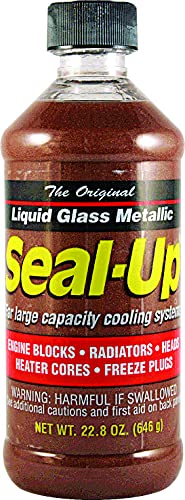
Blue Magic Liquid Glass Metallic Seal-Up is the only option here whose features specifically identify liquid glass, making it the closest fit for shoppers seeking that formula. It comes in a 22.8-ounce bottle and combines liquid glass with copper; the maker says the resulting copper-ceramic seal withstands up to 2,000°F. That claim describes the seal, not a guarantee that every head-gasket failure can be repaired. This is a better fit when the formula is the priority than when you need an explicitly stated cylinder count or coolant-type compatibility.
Bottom line: Choose this when a liquid glass and copper cooling-system sealer is your priority.
Bar’s Leaks HG-1 Head Seal

Bar’s Leaks HG-1 Head Seal is aimed directly at blown head and intake gasket leaks, warped or cracked heads, and blocks rather than being identified as a liquid glass formula. The maker says it is compatible with all types of 50-50 mix coolant and requires no flushing. Its candidate condition is useful when diagnosing fit: the vehicle should idle for 15 minutes without overheating or needing added coolant. That makes it a poor choice for an engine that cannot meet that condition; stop running an overheating engine and address the underlying problem first.
Bottom line: Pick this if broad 50-50 coolant compatibility is the deciding factor.
Steel Seal 8-Cylinder Head Gasket Fix

Steel Seal 8-Cylinder Head Gasket Fix stands out for its engine fit: it is intended for 8-cylinder engines and is presented as a do-it-yourself pour-in repair. The maker says it permanently seals a crack in the head gasket, but the features do not identify a liquid glass or copper formula. Its cylinder-specific scope makes it less suitable for buyers who cannot confirm an 8-cylinder engine, and it offers fewer stated compatibility details than some alternatives here. Confirm the engine’s cylinder count before choosing it.
Bottom line: Choose this only when the engine has eight cylinders and that stated fit matches.
BlueDevil Head Gasket Sealer, 1 Quart

BlueDevil Head Gasket Sealer, 1 Quart differentiates itself with a fit for both gasoline and diesel engines, plus claims covering heater cores and freeze plugs in addition to head gaskets and cracked or warped heads. Its 32-ounce bottle is larger than the 16-ounce option below. The maker describes it as a permanent seal and says it contains no solid or particulate matter; neither point means every leak is repairable with a pour-in product.
Bottom line: Pick this if gasoline-or-diesel compatibility and its broader stated leak range matter.
K-Seal ST3501 Pour & Go, 16 oz

K-Seal ST3501 Pour & Go, 16 oz is the only option here whose features give a maximum leak size: the maker says its ceramic micro-fibres seal holes and cracks up to 0.64 mm. The 16-ounce pour-and-go formula is also claimed to work with all types of coolant and a range of engine materials and heavy-duty machinery. That measured limit gives buyers a useful boundary, but a larger or pressurized leak may be beyond its scope.
Bottom line: Choose this when the maker’s 0.64 mm leak-size limit matches the problem.
How liquid glass head gasket sealer works
Liquid glass sealer relies on silicate compounds that can form a hard deposit when exposed to heat and escaping coolant at a leak path. The chemistry is different from mechanical head-gasket replacement: it aims to plug a path through the cooling system rather than restore clamping force or correct a warped surface. A sealer is a better candidate for a small coolant leak than for severe overheating, combustion pressure entering the coolant, or a major coolant loss. Never open a radiator or pressurized coolant reservoir while hot; coolant can cause serious burns. Let the engine cool fully before any cooling-system inspection, and stop running it if the temperature gauge rises into the danger zone.
How to choose a head gasket sealer by fit
Match the application before comparing formula claims. An 8-cylinder-only product is unsuitable if the engine has a different cylinder count, while a broad gasoline-and-diesel claim does not establish fit for every engine design. The maker’s 15-minute idle condition for Bar’s Leaks HG-1 Head Seal gives a measurable screening rule: if the vehicle cannot idle that long without overheating or needing coolant, do not treat that product as a fit. A car that loses coolant rapidly, mixes oil and coolant, or overheats repeatedly needs diagnosis rather than continued driving with sealant. Never choose a product based only on the word “permanent”; repairability depends on the leak’s location and severity.
Use this comparison as a starting point, then confirm the product’s engine and cooling-system fit:
| Need | Closest fit | Decision point |
|---|---|---|
| Liquid glass chemistry | Blue Magic Liquid Glass Metallic Seal-Up | Liquid glass and copper formula |
| 8-cylinder engine | Steel Seal 8-Cylinder Head Gasket Fix | Specified cylinder count |
| Broad coolant compatibility | Bar’s Leaks HG-1 Head Seal or K-Seal ST3501 Pour & Go, 16 oz | 50-50 mix claim vs. all coolant types claim |
| Small measured leak | K-Seal ST3501 Pour & Go, 16 oz | Maker claim up to 0.64 mm |
Coolant compatibility and leak severity
Coolant compatibility is not interchangeable across sealers: one maker may identify 50-50 mixtures, while another may claim compatibility with all coolant types. Check the product’s own wording against the coolant in the vehicle, and do not assume that one formula’s compatibility applies to another. Leak size and system pressure also matter. K-Seal ST3501 Pour & Go, 16 oz gives a maximum leak-size claim of 0.64 mm, while Bar’s Leaks HG-1 Head Seal uses the ability to idle for 15 minutes without overheating or adding coolant as a candidacy condition. Those are different screening measures, not proof that a product will fix every leak. A cooling system that cannot maintain temperature or coolant level should be diagnosed before a pour-in repair is attempted.
When a pour-in sealer is the wrong repair
A sealer is not a reliable substitute for mechanical repair when the engine is severely overheating, losing coolant quickly, or showing signs of internal fluid mixing. Continuing to drive an overheating engine can cause additional damage, even if a product claims a permanent seal. Stop the engine when the temperature warning appears and allow it to cool; do not remove a hot pressure cap. A shop can use cooling-system pressure and combustion-gas checks to help distinguish an external leak from a head-gasket breach. If the vehicle cannot idle safely, avoid running it merely to satisfy a product’s application condition. Sealer choice should follow an assessment of the leak, not replace one.
Frequently Asked Questions
What does liquid glass do in a head gasket sealer?
Liquid glass generally refers to silicate compounds that can harden at hot leak points in a cooling system. It is a sealing approach, not a method for repairing warped metal or replacing a failed gasket.
Can head gasket sealer work with any antifreeze?
No single compatibility claim applies to every sealer. For example, Bar’s Leaks HG-1 Head Seal claims compatibility with all types of 50-50 mix coolant, while K-Seal ST3501 Pour & Go, 16 oz claims compatibility with all coolant types; match the specific product claim to the coolant in the vehicle.
How large a crack can a head gasket sealer fix?
The answer depends on the formula and leak conditions. K-Seal ST3501 Pour & Go, 16 oz’s maker claims sealing for holes and cracks up to 0.64 mm, but that figure should not be assumed for other products.
Should I drive with a leaking head gasket?
Do not keep driving if the engine overheats or loses coolant rapidly. Pull over safely and shut it off, since continued operation while hot can cause further engine damage.
Can I open the radiator after using a sealer?
Only open a radiator or pressurized coolant reservoir after the engine has cooled fully. Hot coolant and trapped pressure can cause severe burns, regardless of whether a sealer has been added.