
Master Airbrush Model G22: 3 Configurations Compared

For a standalone Master Airbrush Model G22 with a 0.3 mm tip and 1/3 oz gravity cup, choose Master Airbrush G22 0.3 mm; Master Airbrush G222 G22 Pro Set adds two alternative nozzle setups, while Master Airbrush G22 Compressor Kit includes a compressor.
Choose another configuration if you need compressor hardware in the same kit or want three nozzle sizes for different spray work.
We earn a commission if you buy through links on this page. As an Amazon Associate I earn from qualifying purchases. Products are compared on manufacturer specifications, not hands-on testing.
- Best overall: Master Airbrush G22 0.3 mm – The G22 airbrush has a 0.3 mm tip and 1/3 oz gravity cup without extra kit components.
- Best with compressor: Master Airbrush G22 Compressor Kit – Includes a 1/5 HP compressor, air filter, water trap, pressure regulator and hose.
- Best for nozzle range: Master Airbrush G222 G22 Pro Set – Includes 0.2, 0.3 and 0.5 mm nozzle setups, a hose and quick disconnect.
| Product | Best for | Nozzle options | Included equipment | Shop |
|---|---|---|---|---|
| Master Airbrush G22 0.3 mm | Standalone airbrush | 0.3 mm | Airbrush only | Check Price on Amazon |
| Master Airbrush G22 Compressor Kit | Airbrush and compressor | 0.3 mm | 1/5 HP compressor, hose | Check Price on Amazon |
| Master Airbrush G222 G22 Pro Set | Multiple nozzle sizes | 0.2, 0.3, 0.5 mm | 6 ft hose, quick disconnect | Check Price on Amazon |
Master Airbrush Model G22 Options
Compare the standalone airbrush, compressor kit and multi-nozzle set by the equipment each includes.
Master Airbrush G22 0.3 mm
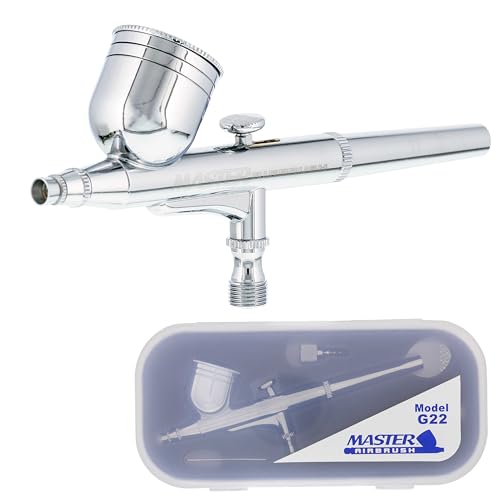
Master Airbrush G22 0.3 mm is the standalone G22 choice: it provides a 0.3 mm needle and nozzle with a 1/3 oz gravity-feed cup, without a compressor or extra nozzle sets in the package. Master Airbrush says the dual-action airbrush can handle hairline detail, overall spraying and backgrounds up to 1-1/2 inches wide. Its uses include model painting, graphics, crafts, fine art and cake decorating. The limitation is that the package is the airbrush gun only, so choose another configuration if you need compressor hardware or additional nozzles together.
Bottom line: Choose this if you already have compatible air supply and want the basic G22 setup.
Master Airbrush G22 Compressor Kit

Master Airbrush G22 Compressor Kit pairs the G22’s 0.3 mm tip and 1/3 oz gravity cup with a 1/5 HP compressor, hose, air filter, water trap, pressure regulator and holder for two airbrushes. That bundled air-supply hardware distinguishes it from the standalone gun. The maker describes this setup as suitable for crafts, auto graphics, temporary tattoos, cake decorating and fine art, among other uses. The tradeoff is a single 0.3 mm nozzle setup; choose a multi-nozzle configuration if you want alternate tip sizes for different spray patterns.
Bottom line: Choose this if you need a G22 and compressor components in one kit.
Master Airbrush G222 G22 Pro Set

Master Airbrush G222 G22 Pro Set stands out for its three nozzle setups: 0.2, 0.3 and 0.5 mm needles, fluid tips and air caps, alongside the G22 body and 1/3 oz gravity cup. It also includes a 6-foot braided hose with 1/8-inch fittings and a quick disconnect with an air-flow control valve. Master Airbrush says the different setups cover extra-fine detail through backgrounds up to 2 inches wide. Unlike the compressor kit, the package adds a hose and nozzle choices rather than a compressor, so it suits buyers who already have air supply.
Bottom line: Choose this if changing nozzle sizes matters more than bundling a compressor.
How to choose a G22 setup
Choose by the equipment you need and the spray range you expect: a standalone airbrush, an airbrush-and-compressor kit, or a set with three nozzle sizes address different needs. A dual-action airbrush uses trigger movement to control air and paint separately; gravity feed moves paint from a cup above the nozzle. A 0.2 mm setup is suited to finer detail, while a 0.5 mm setup can support broader spray; paint viscosity and air pressure also affect the result. For a single general-purpose setup, the 0.3 mm tip is the common middle option among these configurations. If you already own an air source, avoid buying bundled compressor hardware you do not need; if not, confirm the compressor kit’s fittings match your hose and workspace.
What nozzle size changes
Nozzle size changes how much paint can pass through and influences the practical balance between detail and coverage. As a starting rule, choose 0.2 mm when fine lines and small areas are the priority, 0.3 mm for mixed general work, and 0.5 mm when broader coverage matters. These are not guarantees of line width: paint consistency, needle condition, distance and air pressure change the spray. Thin paint only as its manufacturer recommends, and strain paint if particles could clog a fine nozzle. Clean the nozzle and paint path between colors, especially before paint dries. A smaller setup can clog more readily with paint that contains pigment or additives that are too thick for the nozzle.
Airbrush paint and compressor fit
Match paint to both the airbrush and the surface, because acrylic, enamel and other media can require different thinning and cleanup methods. Water-based acrylics commonly clean with water before drying, while solvent-based paints may require a compatible solvent; check the paint label for the correct reducer and cleaning method. Use ventilation and suitable respiratory protection when spraying, particularly with solvent-bearing products, and keep spray away from food even when decorating cakes. Compressor compatibility is about the air connection and controllable pressure, not just motor power; confirm that the compressor, hose and fittings connect before starting a project. Place the compressor on a stable surface with airflow around it.
Common G22 setup mistakes
Common problems include dried paint in the nozzle, poorly thinned paint and forcing a needle into place. Flush the paint path when changing colors and clean it after each session; dried residue can restrict flow and damage small parts during aggressive cleaning. Handle needles carefully because a bent tip can disrupt the spray pattern. Start by testing the paint flow on scrap material and adjust trigger movement, distance and pressure before working on a finished model or other surface. For cake decorating, use only edible colorants intended for food and keep the airbrush dedicated to food use; paint residue from craft applications must not contact food.
Frequently Asked Questions
What does dual action mean on an airbrush?
A dual-action trigger controls air and paint separately: pressing releases air, and pulling back increases paint flow. Practice both movements on scrap material to control the spray without flooding a small area.
Is a 0.3 mm nozzle good for model painting?
A 0.3 mm setup is a practical general-purpose choice for mixed detail and coverage. For especially fine lines, a 0.2 mm setup may suit better, while broader spraying may call for 0.5 mm; paint thickness affects the result.
How much paint fits in a 1/3 oz cup?
A 1/3 oz cup holds about 10 milliliters. That is a small paint reservoir, so larger projects may require refilling during the job.
How should I clean an airbrush after acrylic paint?
Flush water-based acrylic paint from the paint path before it dries, then clean the cup and nozzle using a cleaner compatible with the paint. Avoid forcing or bending the needle while removing residue.
Can I use a G22 without a compressor?
An airbrush needs a source of compressed air to spray. The standalone gun does not include a compressor, while the compressor kit configuration includes a 1/5 HP unit; check hose and fitting compatibility with any air source you already own.