
Safe Cut Can Opener: 5 Models Compared by Design

The GoodCook Safe-Cut Can Opener suits most buyers who want a lid held for hands-free disposal; its cutting wheel also stays clear of food. Choose another design if you prefer built-in lid pliers or want a stainless-steel construction.
We earn a commission if you buy through links on this page. As an Amazon Associate I earn from qualifying purchases. Products are compared on manufacturer specifications, not hands-on testing.
- Best overall: GoodCook Safe-Cut Can Opener – Holds the cut lid until release, so you do not need to handle it for disposal.
- Best for lid removal: OXO Good Grips Smooth Edge – Built-in pliers let you lift the lid without touching it.
- Best for an ergonomic grip: Safety Manual Side-Cut Opener – A thick turning knob and soft silicone handle are designed for leverage.
| Product | Best for | Construction | Length | Weight | Shop |
|---|---|---|---|---|---|
| GoodCook Safe-Cut Can Opener | Hands-free lid disposal | Chrome | 9 in | 0.25 lb | Check Price on Amazon |
| OXO Good Grips Smooth Edge | Pliers lid removal | Stainless steel | 4.5 in | 0.44 lb | Check Price on Amazon |
| Safety Manual Side-Cut Opener | Leverage and grip | Stainless steel | 8.86 in | 0.38 lb | Check Price on Amazon |
| Bellemain Ergonomic Can Opener | Bottle opener function | Stainless steel | 1.9 in | 0.41 lb | Check Price on Amazon |
| PAKITNER Safe Cut Can Opener | Portable handling | Stainless steel | 8.9 in | 0.31 lb | Check Price on Amazon |
Safe cut can openers
Choose among lid-handling designs, grip styles, and body materials to match how you open and discard cans.
GoodCook Safe-Cut Can Opener

The GoodCook Safe-Cut stands apart by holding the cut lid until you pivot the handle to release it, avoiding direct contact during disposal. Its cutting wheel does not touch food, and the clean edge is intended to let the lid rest on the can for short-term leftover storage. The manual opener has a chrome construction and measures 9 inches long. Choose it if lid handling is your main concern; buyers who want stainless steel or integrated pliers may prefer another design.
Bottom line: Pick this if you want to release the lid into the trash without touching it.
OXO Good Grips Smooth Edge

The OXO Good Grips differs with built-in pliers that lift the lid, rather than a handle-release mechanism. Its hardened stainless-steel cutting wheel cuts along the can side without contacting contents, and the design leaves smooth edges on the lid and can. Oversized side-wind controls and soft-grip handles are intended to ease operation; it is dishwasher safe. Its 4.5-inch length is shorter than the GoodCook and PAKITNER models. Choose it for plier-style lid handling, but verify that its handle shape suits your grip.
Bottom line: Choose this if built-in pliers and dishwasher-safe construction matter to you.
Safety Manual Side-Cut Opener

This side-cut opener emphasizes a large turning knob and a soft silicone, nonslip handle for leverage. Its blade is designed to stay away from food, while the side-cut is intended to leave smooth edges and let a lid sit back on the can. The stainless-steel opener measures 8.86 inches long. The feature set focuses on grip and cutting rather than a specified lid-release tool, so buyers who want built-in pliers or a lid held for disposal should compare those mechanisms before choosing.
Bottom line: Pick this when a larger knob and nonslip handle are your priorities.
Bellemain Ergonomic Can Opener

Bellemain is the only model here described as a multifunctional can and bottle opener, giving it an additional kitchen task beyond can opening. It has a stainless-steel build and a non-slip handle designed to turn easily, with a compact stated length of 1.9 inches. Its safe-cut feature is meant to leave smooth edges. The measurements may reflect a compact body rather than the full handle span, so confirm the opener’s dimensions and fit in your drawer if storage space is tight.
Bottom line: Choose it if you want a can opener that also opens bottles.
PAKITNER Safe Cut Can Opener
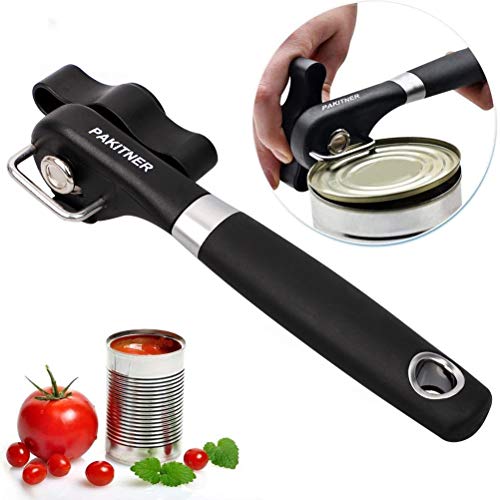
The PAKITNER combines an 8.9-inch length with a 0.31-pound weight, making it the lightest of the longer-handled models in this group. Its food-grade stainless-steel blade and easy-turn knob are designed for smooth side cutting, and the handle is described as ergonomic. A smooth cut is intended to avoid jagged edges. The features do not include a lid-holding or plier mechanism, so someone prioritizing hands-free lid disposal may prefer a model with a described lid-release feature.
Bottom line: Pick this if you want a light, long-handled manual side cutter.
How to choose a safe cut can opener
Start with how the opener manages the cut lid: some hold it for release, while others use pliers or simply leave it on the can. Safe-cut side openers sever the can at the rim rather than cutting through the top, so the lid edge is generally smoother than a conventional top-cut edge. Grip matters too: large knobs and nonslip handles can give more leverage when turning. For buyers concerned about hand cuts, prioritize a lid-removal feature that avoids pinching the cut edge, and keep the detached lid away from children.
Use this decision guide to match the opening and disposal task to a design.
| Need | Design to seek |
|---|---|
| No-touch disposal | Lid-holding handle release |
| Lifting lid off can | Built-in lid pliers |
| More turning leverage | Large knob and nonslip grip |
| Extra bottle-opening task | Can-and-bottle opener |
Safe-cut side cutting and sharp edges
A safe-cut opener generally cuts the side seam below the rim, leaving the lid and can with smoother edges than a top-cut opener, but “smooth” does not mean harmless. Handle the removed lid by its broad center rather than dragging fingers along its perimeter, and discard it promptly if it will not be reused. The cutting wheel should track around the outside wall; if the opener slips or leaves a jagged section, stop and reposition rather than forcing the crank. Keep open cans and cut lids away from children, and do not treat a smooth edge as a child-safe edge.
Side cutting can help keep the blade away from food, but clean the opener after use according to its care directions and dry metal parts before storage to limit residue and corrosion.
Grip, leverage, and fit at the can rim
A wide turning knob and a nonslip handle can make rotation easier, especially when a small knob is hard to grasp. Clamp the opener squarely to the rim before turning; a crooked start can make the wheel slip or leave an uneven cut. Can diameters and rim shapes vary, so an opener’s advertised ability to handle round or oval cans does not guarantee every can will fit. If it fails to engage securely on the rim, do not force it. Check the handle span and clamp position against your hand size and the storage space available.
For safer use, keep the can on a stable counter and rotate the knob with the other hand clear of the lid path. Stop if the tool shifts or the can begins to tip.
Cleaning and storing a manual safe-cut opener
Food residue around the cutting wheel can collect even when the wheel does not touch the contents directly. Wipe the wheel and clamp area after each use, then dry metal surfaces before putting the tool away; trapped moisture can encourage corrosion. A dishwasher-safe claim applies to the OXO model in this group, but it should not be generalized to other openers. Store a detached lid separately from food unless its design allows it to rest securely, and use any re-covered can for short-term refrigeration rather than as an airtight container.
Check the tool periodically for a loose handle, a wheel that no longer turns freely, or a damaged clamp. Replace an opener that cannot grip the rim securely or leaves ragged cuts.
Frequently Asked Questions
Do safe cut can openers keep the blade out of food?
Many side-cut models place the cutting wheel against the outside of the can, away from the contents. Keep the opener aligned to the rim so the wheel stays on the can wall.
Can you put the lid back on a cut can?
A side-cut lid may rest on the can for short-term storage, but it is not an airtight seal. Refrigerate leftovers promptly and transfer them to a sealed container for longer storage.
Are smooth-edge can lids safe to handle?
Smooth-edge lids can still have a sharp perimeter, so avoid running fingers around the edge. Keep discarded lids away from children and pets.
How do you stop a can opener from slipping?
Seat the clamp squarely on the rim before turning and keep the can on a stable surface. If the wheel slips or the can shifts, stop and reposition rather than forcing the crank.
Can a side-cut opener open oval cans?
Some side-cut designs are made for round and oval cans, but rim shapes can differ. If the clamp will not engage securely, do not force it.