
Men’s UA Surge 4 Running Shoes: Sizes Compared

Men’s UA Surge 4 running shoes are the same neutral shoe across these options, so choose Under Armour Charged Surge 4, Academy Blue, 8.5 through Under Armour Charged Surge 4, Black/Anthracite, 9 by your usual size and preferred color. The shoe has an 8 mm offset; runners who need a stability-focused shoe should consider a different type.
We earn a commission if you buy through links on this page. As an Amazon Associate I earn from qualifying purchases. Products are compared on manufacturer specifications, not hands-on testing.
- For size 8.5: Under Armour Charged Surge 4, Academy Blue, 8.5 – Academy blue colorway in size 8.5.
- For size 13: Under Armour Charged Surge 4, White, 13 – White colorway in size 13.
- For size 14: Under Armour Charged Surge 4, Black, 14 – Black colorway in size 14.
- For size 10.5: Under Armour Charged Surge 4, Gray, 10.5 – Gray colorway in size 10.5.
| Product | Best for | Size | Color | Shop |
|---|---|---|---|---|
| Under Armour Charged Surge 4, Academy Blue, 8.5 | Size 8.5 | 8.5 | Academy/Academy/White | Check Price on Amazon |
| Under Armour Charged Surge 4, White, 13 | Size 13 | 13 | White/Halo Gray/Black | Check Price on Amazon |
| Under Armour Charged Surge 4, Black, 14 | Size 14 | 14 | Black/Black/Black | Check Price on Amazon |
| Under Armour Charged Surge 4, Gray, 10.5 | Size 10.5 | 10.5 | Steel/Mod Gray/White | Check Price on Amazon |
| Under Armour Charged Surge 4, Black/Anthracite, 9 | Size 9 | 9 | Black/Anthracite/White | Check Price on Amazon |
Men’s UA Surge 4 Running Shoes
These options share the same shoe features and differ by size and colorway.
Under Armour Charged Surge 4, Academy Blue, 8.5

Among these five variants, Under Armour Charged Surge 4, Academy Blue, 8.5 is the Academy blue option in size 8.5. The shoe pairs a breathable mesh upper with synthetic overlays and uses Charged Cushioning in the midsole; its 10.05 oz. weight and 8 mm offset are shared with the other sizes. The Deluxe Comfort System sockliner molds to the foot for step-in comfort, while the rubber outsole is built for traction and flexible toe-off. It is intended for neutral runners seeking a balance of flexibility and cushioning. Choose another size if 8.5 does not leave enough room at the toes.
Bottom line: Choose this option if size 8.5 fits and you want the Academy blue colorway.
Under Armour Charged Surge 4, White, 13

The white colorway in size 13 makes Under Armour Charged Surge 4, White, 13 the size-specific choice among these options. Its neutral setup combines a Charged Cushioning midsole with a rubber outsole that has flexible areas for toe-off; the shoe weighs 10.05 oz. and has an 8 mm offset. A mesh upper with synthetic overlays adds structure, and the ankle collar has extra cushioning. This is a match for a runner whose measured fit calls for size 13 and who prefers white with gray and black accents. The size is the key limitation: color preference alone is not a reason to choose a shoe that fits too short or too wide.
Bottom line: Pick this one when size 13 is your fit and the white colorway suits you.
Under Armour Charged Surge 4, Black, 14
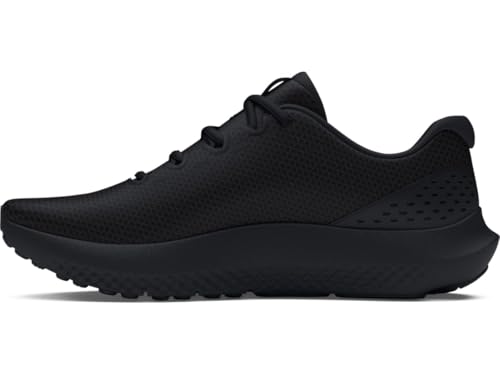
Under Armour Charged Surge 4, Black, 14 is the size 14 choice, with an all-black colorway that distinguishes it from the other variants. Its shared construction includes a breathable mesh upper, synthetic support overlays, and a sockliner designed to mold to the foot. Underfoot, Charged Cushioning and an 8 mm offset are paired with a durable rubber outsole. The 10.05 oz. weight is the shoe specification across the options. This variant suits neutral runners who need size 14; it is not a substitute for a stability shoe if your running needs call for added guidance. Check that the shoe feels secure without pinching before committing to a size.
Bottom line: Choose this option if you need size 14 and prefer an all-black shoe.
Under Armour Charged Surge 4, Gray, 10.5

Under Armour Charged Surge 4, Gray, 10.5 stands out as the gray colorway in size 10.5, with steel and white accents. Its mesh upper is paired with synthetic overlays for structure, and the ankle collar receives additional cushioning. The midsole uses Charged Cushioning, while the rubber outsole is designed for traction and flexibility at toe-off. At 10.05 oz. with an 8 mm offset, it shares the same core specifications as the other color and size choices. The fit is suited to neutral runners looking for balanced flexibility and cushioning. Runners who need a different size should prioritize fit over the gray finish.
Bottom line: Select this variant if size 10.5 fits and you want gray with white accents.
Under Armour Charged Surge 4, Black/Anthracite, 9

Under Armour Charged Surge 4, Black/Anthracite, 9 offers size 9 in black, anthracite, and white, rather than the all-black finish of another option. Its 8 mm offset and 10.05 oz. weight match the other variants, and the neutral design is aimed at runners seeking a balance of flexibility and cushioning. The upper uses breathable mesh with synthetic overlays; below it, Charged Cushioning sits above a rubber outsole with flexible toe-off zones. The sockliner molds to the foot for step-in comfort. This choice makes sense when size 9 is right for you. It does not offer a different ride or support category from the other sizes.
Bottom line: Choose this variant if size 9 fits and you prefer the black, anthracite, and white palette.
How to choose men’s UA Surge 4 running shoes
Choose by fit first, because these options share the same 8 mm offset, neutral design, and 10.05 oz. shoe weight. Running shoes generally need about a thumb’s width of space—roughly 0.5 inch—between the longest toe and the front of the shoe, with the heel held securely and no pressure across the forefoot. Feet often swell during a run, so check fit later in the day or after activity rather than relying only on a morning try-on. The sizes range from 8.5 to 14, but the options do not cover every half size. If you fall between sizes, compare the fit on both feet and choose the one that leaves toe room without heel slip.
What an 8 mm offset means for running shoes
An 8 mm offset is the difference in height between the heel and forefoot, not the amount of cushioning. The Surge 4 pairs that offset with a neutral design and Charged Cushioning, so the offset alone cannot tell you whether the shoe will feel right. Runners who already use neutral shoes can compare its drop with their current pair; a change in drop can alter how loading feels, especially during a transition. Make changes gradually rather than switching abruptly for long runs. The shoe’s 10.05 oz. specification is a separate measure from offset. For runners who need motion-control guidance, a neutral shoe may not match their support preference, regardless of its cushioning.
How to check running shoe fit at home
A properly fitting running shoe leaves about 0.5 inch of space ahead of the longest toe and holds the heel without rubbing. Try it on with the socks you expect to run in, lace it snugly, and stand as well as walk in it; the foot spreads under load, so sitting alone is a poor fit check. Compare both feet because one may be longer or wider, and use the larger foot to judge toe room. The Surge 4 options here are regular stated sizes, not different widths. Stop if the forefoot feels compressed or toes meet the front when walking downhill. A colorway should not outweigh a fit problem.
| Buyer need | Decision |
|---|---|
| Right length and width | Prioritize secure heel hold and about 0.5 inch of toe room |
| Neutral cushioning | Consider the Surge 4’s neutral design and Charged Cushioning |
| Stability-focused support | Look for a stability shoe rather than choosing by color |
Neutral and stability running shoes compared
Neutral shoes are designed for runners who do not want added stability guidance, while stability shoes include features intended to guide foot motion. The Surge 4 is identified as neutral and is intended for runners seeking a balance of flexibility and cushioning. A common mistake is choosing a shoe based only on a single gait label or the 8 mm offset; comfort, fit, and the support feel you prefer also matter. If you already run comfortably in neutral shoes, this category may be familiar. If a clinician has advised a specific shoe type, use that guidance when comparing categories. Neither neutral nor stability describes a universal best choice for every runner.
Frequently Asked Questions
How much toe room should running shoes have?
Aim for about 0.5 inch between your longest toe and the shoe front. Check while standing, since the foot spreads under body weight.
What does an 8 mm running shoe drop mean?
An 8 mm drop means the heel is 8 mm higher than the forefoot. It describes heel-to-toe height difference, not midsole cushioning thickness.
Are neutral running shoes right for every runner?
No; neutral shoes suit runners who do not want added stability guidance. If you need a stability-focused design, compare that category instead of choosing by color or offset.
When should I try on running shoes for fit?
Try them later in the day or after activity, when feet may be more swollen than first thing in the morning. Leave about 0.5 inch at the toe and check both feet.
Should running shoes feel tight across the forefoot?
No; the forefoot should not feel pinched, and the heel should stay secure. Check the fit with running socks and allow about 0.5 inch of space ahead of the longest toe.