
MOTOPOWER MP69033 OBD2 Scanner Compared by Features

The MOTOPOWER MP69033 OBD2 scanner is the closest match for a general-purpose code reader, with a 2.8-inch display and support for nine OBD2 protocols. Choose a different model if battery and alternator checks or specific O2 and EVAP tests matter more.
OBD2 scanners connect to a vehicle’s diagnostic port to read engine-related trouble codes; they do not replace a mechanic’s diagnosis.
We earn a commission if you buy through links on this page. As an Amazon Associate I earn from qualifying purchases. Products are compared on manufacturer specifications, not hands-on testing.
- Best overall: MOTOPOWER MP69033 – Combines a built-in code lookup with live data, freeze frame and nine-protocol support.
- Best for battery checks: MOTOPOWER MP69033 Pro – Adds battery and alternator testing to the code-reader functions.
- Best for O2 and EVAP tests: ANCEL AD410 – Includes O2 sensor and EVAP tests among its OBD2 functions.
| Product | Best for | Supported vehicles | Diagnostic functions | Shop |
|---|---|---|---|---|
| MOTOPOWER MP69033 | Everyday code reading | 1996+ US; 2000+ EU/Asian | Read/erase, live data, freeze frame | Check Price on Amazon |
| MOTOPOWER MP69033 Pro | Battery testing | — | Read/erase, live data | Check Price on Amazon |
| ANCEL AD310 | Basic engine diagnosis | 1996+ OBD2 vehicles | Read/clear, live data, freeze frame | Check Price on Amazon |
| ANCEL AD410 | Additional OBD2 tests | 1996+ OBD2 vehicles | Read/clear, O2, EVAP, live data | Check Price on Amazon |
MOTOPOWER MP69033 OBD2 Scanner and Alternatives
Compare the scanners by vehicle compatibility and the diagnostic checks each one supports.
MOTOPOWER MP69033

The MP69033 combines nine-protocol support with a 2.8-inch LCD, making it the broadest match here for a basic OBD2 code reader. Its functions include reading and erasing codes, freeze-frame data, I/M readiness, vehicle information, live data and a built-in DTC lookup library. MOTOPOWER says it supports most US-based vehicles from 1996 and EU-based and Asian vehicles from 2000, plus newer OBD2 and CAN vehicles. The six-language menu adds flexibility. It does not include the battery and alternator checks offered by the Pro model.
Bottom line: Pick this if you want a code reader with broad protocol support and a larger screen.
MOTOPOWER MP69033 Pro

The MP69033 Pro adds battery and alternator testing with real-time monitoring to the core code-reader functions, a useful distinction for drivers who want to check charging-system concerns as well as engine codes. Its functions also include freeze-frame data, I/M readiness, live data and a built-in DTC lookup library.
Bottom line: Choose it when battery and alternator checks are a priority alongside code reading.
ANCEL AD310
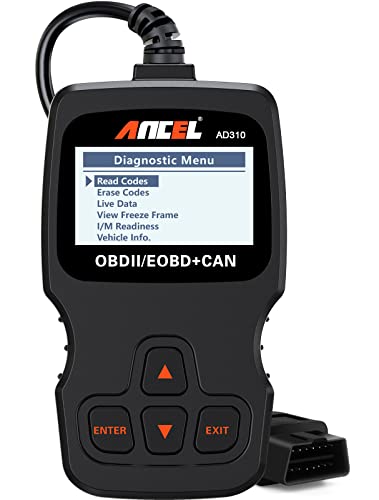
The ANCEL AD310 is a related engine-code reader rather than a MOTOPOWER model, and it emphasizes straightforward emissions-system diagnosis. Its capabilities include reading and clearing codes, live and hard-memory data, freeze-frame information, I/M readiness and vehicle information. ANCEL says the scanner has a 2.5-foot cable with thick, flexible insulation, which can help when the diagnostic port is not immediately beside the driver. The functions focus on engine and emissions diagnostics; they do not include the battery testing of the MP69033 Pro.
Bottom line: Consider it for core engine-code and emissions-monitor checks.
ANCEL AD410

The ANCEL AD410 differs from the MOTOPOWER scanners by explicitly including O2 sensor and EVAP tests alongside common engine-code functions. It also supports reading and clearing codes, live data, freeze-frame data, I/M readiness, vehicle information and MIL status; its built-in lookup contains 42,000+ DTC entries. ANCEL presents it for everyday drivers and DIY users seeking engine-light information. The maker does not identify a display size or cable length, so this model is less useful to compare on screen layout or reach.
Bottom line: Pick it if O2 sensor and EVAP checks are important to your diagnostic routine.
How to choose an OBD2 scanner
Choose an OBD2 scanner by matching its functions to the warning or maintenance question you need to investigate. Basic code readers retrieve engine trouble codes and may show a definition; live data and freeze-frame readings add operating context, while I/M readiness indicates whether emissions monitors have completed their checks. For broader checks, look specifically for functions such as O2 sensor, EVAP, or battery testing rather than assuming every scanner includes them.
Vehicle compatibility is a separate decision from functions. OBD2 became required for light-duty vehicles sold in the US beginning with model year 1996, but import-market year coverage and supported protocols can differ. If your vehicle is outside the year range, confirm compatibility before ordering; a connector that fits does not guarantee every diagnostic function will work.
What OBD2 scanner functions tell you
Read and clear functions retrieve diagnostic trouble codes and can turn off the check-engine light after codes are cleared, but clearing a code does not repair its cause. Freeze-frame data captures engine conditions around a fault, while live data shows changing sensor readings as the vehicle runs. Use the code as a starting point and investigate the underlying issue before clearing it.
I/M readiness checks emissions-monitor status, which matters before an inspection: clearing codes or disconnecting a battery can reset monitors, and the vehicle may need a drive cycle before they complete. O2 sensor and EVAP tests are additional functions, not guaranteed on every reader. Battery and alternator testing is also distinct from standard engine-code scanning, so choose a unit that names those tests if you need them.
OBD2 scanner types compared
Basic readers focus on engine codes and emissions readiness; enhanced readers add more data or system-specific tests. The functions named for each scanner are a better guide than labels such as “enhanced,” which are not a universal feature standard.
| Need | Function to look for | Example in this group |
|---|---|---|
| Find an engine fault | Code reading and definitions | MP69033 built-in DTC lookup |
| Check emissions readiness | I/M readiness | MP69033, AD310 and AD410 |
| Investigate sensor or vapor-system faults | O2 and EVAP tests | AD410 |
| Check charging concerns | Battery and alternator testing | MP69033 Pro |
Using a code reader safely
Connect a scanner with the ignition off unless its instructions specify otherwise, then follow its prompts; avoid distracting yourself with live readings while driving. Keep hands, cables and the scanner away from hot engine parts and moving belts or fans when checking under the hood. A fault code points to a monitored condition, not automatically to a failed part, so do not replace components based on a code alone.
Before an emissions inspection, check readiness status rather than clearing codes to hide a warning. A recently reset vehicle can have incomplete monitors even when the check-engine light is off. If the light flashes or the engine runs roughly, stop driving when safe and arrange diagnosis promptly, since continued operation can worsen damage.
Frequently Asked Questions
Will an OBD2 scanner work on my car?
Most US-market light-duty cars and trucks from model year 1996 onward use OBD2, but a scanner must also support the vehicle’s protocol. Check the model’s coverage for older vehicles and imports before relying on it.
Does clearing a code fix the check-engine light?
No, clearing a code removes stored diagnostic information but does not fix the condition that triggered it. If the fault remains, the light can return, and cleared emissions monitors may need a drive cycle to become ready again.
What does I/M readiness mean on a scanner?
I/M readiness shows whether the vehicle’s emissions monitors have completed their self-checks. A reset from clearing codes or disconnecting the battery can leave monitors incomplete until the vehicle completes the needed driving conditions.
Can a basic OBD2 scanner diagnose ABS problems?
Not necessarily: standard OBD2 readers generally focus on engine and emissions diagnostics, while ABS requires scanner support for that system. Choose a tool that explicitly names ABS coverage if you need to diagnose an ABS warning.
What is freeze-frame data on an OBD2 reader?
Freeze-frame data is a snapshot of vehicle operating conditions recorded around a fault, such as engine speed or temperature when available.