
Philips Hover HD Amplified Antenna: Models Compared

Philips Hover Amplified HD Antenna is the closest match for a Philips Hover HD amplified antenna because it combines the top-of-TV mount with an amplifier and a claimed range up to 50 miles. Choose a different model if you want wall or tabletop placement, adjustable dipoles, or a longer coax cable.
Indoor TV antennas receive free over-the-air broadcasts, but actual channel reception depends on the broadcast towers, terrain and obstructions between the towers and your home.
We earn a commission if you buy through links on this page. As an Amazon Associate I earn from qualifying purchases. Products are compared on manufacturer specifications, not hands-on testing.
- Best overall: Philips Hover Amplified HD Antenna – The Philips model combines the requested hover mount, built-in amplifier and 4G/5G LTE filter.
- Best for flexible placement: GE Hover Amplified HD Antenna – It can sit on a TV, wall or tabletop and swivels horizontally.
- Best for adjustable dipoles: Philips Rabbit Ears Indoor Antenna – Its loop and 15-inch extendable dipoles allow antenna-position adjustments.
| Product | Best for | Claimed range | Amplifier | Mounting style | Shop |
|---|---|---|---|---|---|
| Philips Hover Amplified HD Antenna | Philips hover match | Up to 50 miles | Built in | Top of TV | Check Price on Amazon |
| GE Hover Amplified HD Antenna | Flexible mounting | 55+ miles | Integrated | TV, wall, tabletop | Check Price on Amazon |
| UltraPro Hover Digital TV Antenna | Simple hover setup | Up to 40 miles | Not indicated | Top of TV | Check Price on Amazon |
| Philips Rabbit Ears Indoor Antenna | Adjustable dipoles | Up to 30 miles | Not indicated | Tabletop | Check Price on Amazon |
| Indoor 360-Degree TV Antenna | Long cable reach | — | — | Indoor/outdoor | Check Price on Amazon |
Philips Hover HD Amplified Antenna Options
Compare the closest hover-style matches with other indoor antenna designs by range claims, amplification and placement.
Philips Hover Amplified HD Antenna

The Philips model is the direct match for a hover-style amplified antenna, with a top-of-TV design and a built-in amplifier. Philips says its TruAmp technology and 4G/5G LTE filter help with reception, and gives the antenna a range claim of up to 50 miles. It supports VHF and UHF broadcasts and 4K and 8K televisions. The package also includes a coax cable and AC adapter. Choose it when the TV-top placement and Philips branding matter; the fixed mount is less flexible than an antenna that can also sit on a table or wall.
Bottom line: Choose this if you want the Philips hover-style mount and integrated amplifier.
GE Hover Amplified HD Antenna

The GE model stands apart with more placement options than a TV-top-only design: it can mount on a TV or wall, or sit on a nearby tabletop. GE claims a 55+ mile range and says its PureAmp amplifier includes a 4G/5G LTE filter. The antenna receives VHF and UHF and swivels horizontally; it is also described as compatible with ATSC 3.0 broadcasts where available. A 5-foot coax cable is included. Pick it if a wall or tabletop position suits the room better, but its 5-foot cable may limit placement farther from the television.
Bottom line: Choose this if flexible mounting matters more than the Philips-specific design.
UltraPro Hover Digital TV Antenna

The UltraPro keeps the hover-style top-of-TV placement but has a lower claimed range than the amplified Philips and GE options. The manufacturer gives it a range of up to 40 miles and says it receives VHF and UHF signals; it supports 4K and 8K televisions and swivels horizontally. Its compact design suits a setup where a discreet TV-top antenna is the priority. The product name does not identify an amplifier, so buyers who specifically want an amplified model should compare it with the Philips or GE option instead.
Bottom line: Choose this for a compact hover antenna when its range claim suits your location.
Philips Rabbit Ears Indoor Antenna
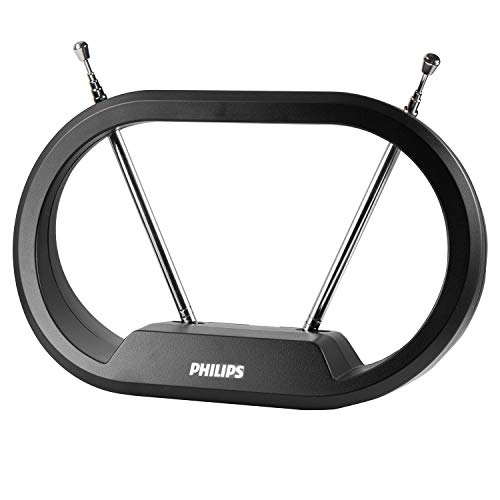
The Philips rabbit-ears model differs from the hover antennas by using a tabletop loop and extendable dipoles rather than mounting on the TV. Philips gives it a range claim of up to 30 miles and says it receives VHF and UHF broadcasts. Its dipoles extend 15 inches, allowing position adjustments, and a 4-foot coaxial cable is included. This is a useful alternative if you want to move and tune the antenna on a flat surface. It is not the right fit if a top-of-TV mount or built-in amplifier is essential.
Bottom line: Choose this if adjustable dipoles and tabletop placement fit your setup.
Indoor 360-Degree TV Antenna

The generic antenna is distinguished by its included 13-foot coaxial cable and claimed 360-degree reception, rather than a hover-style mount. Its maker says it supports 4K and 1080p formats and mentions indoor/outdoor use, but gives no numeric range claim. That makes it a possible option when cable reach is the main constraint, though the maker does not establish how its range compares with the other models. Confirm the antenna’s mounting requirements and compatibility with your intended location before choosing it.
Bottom line: Choose this if a 13-foot cable is useful and you do not need the Philips hover design.
How to choose a Philips Hover HD antenna
Start with placement and reception conditions, not the largest range claim. Indoor antenna range claims are not a guarantee of channels: buildings, hills, trees and distance from broadcast towers can all affect reception. VHF and UHF are different broadcast bands, so an antenna that receives both can be useful when local stations use different bands. A built-in amplifier boosts the signal received at the antenna, but it cannot restore a signal blocked by a major obstruction. If the TV is far from a usable window or tower direction, test the location before relying on an indoor antenna.
For the requested Philips top-of-TV amplified design, Philips Hover Amplified HD Antenna is the direct fit. If placement flexibility matters more, GE Hover Amplified HD Antenna also offers wall and tabletop positions. Treat each maker’s range as a claimed maximum, not as a reception radius that applies equally in every home.
Where to place an indoor TV antenna
A higher position near a window is a sensible first placement because walls and dense building materials can weaken broadcast signals. Keep the antenna away from metal objects and large electronics when possible, and try different sides of the room if channels are missing. A measurable decision rule is to place the antenna near a window rather than behind a television or inside a cabinet when those are the available choices; then compare channel reception after moving it.
VHF and UHF signals may respond differently to antenna orientation, so small position changes can matter. After each move, run the television’s channel scan again; a scan records channels the tuner can receive at that location. The Philips hover design fixes the antenna at the TV, while the GE option can be placed on a wall or tabletop if that position is better for reception.
Hover antennas and rabbit-ear antennas compared
Hover antennas attach at the top of a television, while rabbit-ear models use a separate tabletop base and adjustable elements. That difference affects where the antenna can be positioned: a TV-top mount is tidy, but a separate tabletop antenna can be moved independently of the screen. Extendable dipoles can be adjusted for reception, while a compact fixed design has fewer positioning changes.
The table compares the antenna styles and range claims in this group; range figures are manufacturer claims, not a guarantee of the channels available at a particular address.
| Style | Placement | Claimed range |
|---|---|---|
| Philips hover amplified | Top of TV | Up to 50 miles |
| GE hover amplified | TV, wall or tabletop | 55+ miles |
| Philips rabbit ears | Tabletop | Up to 30 miles |
How to improve reception after setup
Rescan channels after changing antenna position, since a TV tuner does not automatically search for newly receivable stations in every setup. Move the antenna a few feet at a time and compare which channels appear; changing height or window exposure can be more useful than simply choosing a model with a larger range claim. Avoid placing an indoor antenna inside a closed cabinet, where the surrounding material can interfere with reception.
Amplification is not a cure for weak or obstructed signals, and very strong nearby signals can also complicate reception. If a channel drops out, try a new location and scan again before assuming the antenna itself is defective. Keep the coaxial cable connection secure and avoid sharp bends in the cable while arranging the television area.
Frequently Asked Questions
Does a 50-mile antenna reach every station within 50 miles?
No; the range is a manufacturer claim, not a guaranteed radius. Terrain, buildings, tower direction and antenna placement affect which stations arrive clearly.
Do indoor TV antennas receive both VHF and UHF?
Some do, including the Philips hover model in this comparison. VHF and UHF are separate broadcast bands, so check that an antenna supports the bands used by the stations you want.
Should I rescan channels after moving an antenna?
Yes; run the television’s channel scan after repositioning the antenna so the tuner searches at the new location. If reception changes, try another nearby spot and scan again.
Can an amplifier fix reception blocked by a wall?
An amplifier boosts the signal reaching the antenna system, but it cannot remove an obstruction between the antenna and a broadcast tower. Try a higher or window-side position before relying on amplification.
Is a hover antenna better than rabbit ears?
Neither style is universally better; the choice depends on placement and adjustment needs. A hover antenna mounts on a TV, while rabbit ears sit separately and may have adjustable dipoles.