
Shock Wave Therapy Machines for Home Use Compared

For home shock wave therapy, Electric Shockwave Machine, 8 Heads is the closest fit for most buyers because it combines seven radial heads, a focused head, and 10 modes. Choose ST100 Portable ESWT Machine instead if adjustable pressure and frequency ranges matter more; home devices are not a substitute for a clinician’s assessment.
Shock wave therapy devices deliver pressure pulses through an applicator, but radial and focused systems differ in how energy is delivered. Confirm safe use for your condition with a qualified clinician before using a home device.
We earn a commission if you buy through links on this page. As an Amazon Associate I earn from qualifying purchases. Products are compared on manufacturer specifications, not hands-on testing.
- Best overall: Electric Shockwave Machine, 8 Heads – Seven radial heads, a focused head, and 10 preset modes provide multiple treatment options.
- Best for adjustable output: ST100 Portable ESWT Machine – Offers 1–8 BAR pressure and 1–21 Hz frequency adjustment.
- Best for a large touchscreen: Focused Shockwave Machine, 8-Inch Screen – Specifies an 8-inch touchscreen and 10 regular modes.
| Product | Best for | Treatment heads | Controls or output | Size and weight | Shop |
|---|---|---|---|---|---|
| Electric Shockwave Machine, 8 Heads | Head variety | 7 radial, 1 focused | Touchscreen; 10 modes | 16 × 13 × 4 in; 8 lb | Check Price on Amazon |
| Focused Shockwave Machine, 8-Inch Screen | Large touchscreen | — | 8-in touchscreen; 10 modes | 16 × 13 × 4 in; 8 lb | Check Price on Amazon |
| EKVILI Portable Shockwave Machine, 7 Heads | Overheat shutdown | 7 massage heads | Touch interface; auto shutdown | 12.6 × 3.9 × 15 in; 8.8 lb | Check Price on Amazon |
| Portable Silent Shockwave Machine | Silent operation | — | Silent shockwave; controls — | — | Check Price on Amazon |
| ST100 Portable ESWT Machine | Output adjustment | — | 1–8 BAR; 1–21 Hz | — | Check Price on Amazon |
Shock Wave Therapy Machines for Home Use
Compare the treatment heads, controls, and physical dimensions to find a device that fits your intended use.
Electric Shockwave Machine, 8 Heads

The eight-head setup distinguishes this machine: it includes seven radial heads and one focused head, while its 10 modes cover body areas such as shoulders, elbows, and knees. The touchscreen also allows custom settings. The maker describes it as a home-use device for targeting different areas, including deeper tissues. Its size is 16 × 13 × 4 inches and it weighs 8 pounds, so it is a benchtop-style choice rather than a small handheld unit. The product name contains awkward wording, so confirm the exact model and included heads before ordering.
Bottom line: Choose this if you want both radial and focused heads in one machine.
Focused Shockwave Machine, 8-Inch Screen

The 8-inch touchscreen is the clearest distinguishing feature of this machine, alongside its 10 regular modes and option to save custom settings. The maker describes it as a focused shockwave device for home use and lists applications for muscle, joint, and back areas. Its dimensions and weight match a larger tabletop device: 16 × 13 × 4 inches and 8 pounds. The feature set also includes claims about erectile dysfunction and inflammation; those are not a reason to self-treat. Ask a qualified clinician whether shock wave therapy is appropriate for your specific condition.
Bottom line: Pick this if a clearly specified large touchscreen is your priority.
EKVILI Portable Shockwave Machine, 7 Heads

The automatic shutdown on heat buildup sets this machine apart from the other options. It has seven massage heads and a touch interface, and the maker describes it for body massage and shockwave application across a range of muscle and joint areas. At 12.6 × 3.9 × 15 inches and about 8.8 pounds, it is still a substantial device despite the portable label.
Bottom line: Consider it if the heat-triggered shutdown feature is important to you.
Portable Silent Shockwave Machine

The maker’s silent operation distinguishes this device, which is presented as a portable machine for home use and salon settings. It describes a pressure pulse that rises rapidly and then decreases gradually, and combines massage with physical therapy functions. The product name also calls it an ultrasound therapy machine, so confirm the device type and included applicator before choosing it for shock wave therapy.
Bottom line: Choose it only if silent operation is the priority and you confirm the device type.
ST100 Portable ESWT Machine
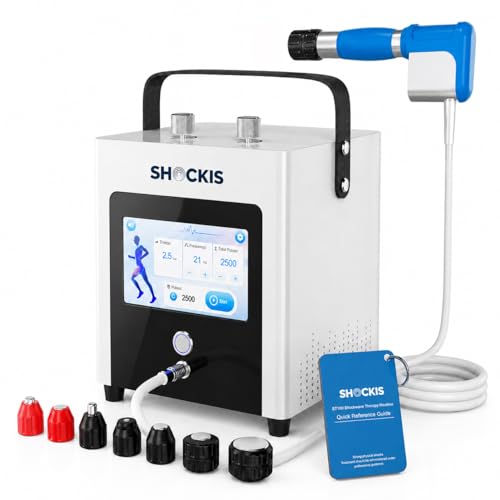
The ST100 stands out by giving numerical output ranges: adjustable pressure from 1 to 8 BAR and frequency from 1 to 21 Hz, with 0.1 BAR adjustment steps. The maker describes it for home and professional settings and for targeted soft-tissue use. Those ranges give a more concrete basis for comparing settings than a mode count alone, but BAR and frequency do not by themselves establish how much energy reaches a particular tissue. Confirm the device’s application and appropriate settings with a clinician, especially if you are unfamiliar with shockwave therapy.
Bottom line: Choose this if you want pressure and frequency ranges you can compare.
How to choose a home shock wave machine
Start with the treatment head and output controls, not the number of preset programs. Radial devices deliver pressure from an applicator at the skin surface and disperse it outward; focused systems concentrate energy at a chosen depth, so the two are not interchangeable. A product listing that uses both terms should specify which applicator is included. Compare pressure and frequency only when the manufacturer gives units, and do not treat a higher number as proof of better results. If you cannot identify the head type or the device’s output settings, pause and verify those points before ordering. Ask a clinician whether the device is suitable for your condition and body area.
Radial and focused shock wave devices
Radial and focused shock wave devices differ in energy delivery and intended targeting. Radial pressure disperses from the applicator, while focused waves concentrate energy at a selected depth; the treatment area and device design affect which is appropriate. A head count alone does not reveal whether the heads are radial, focused, or merely different sizes. Use the maker’s exact head description as your comparison rule: if a particular type is essential, choose a model that identifies it explicitly. The machine names here use overlapping terminology, so verify that the delivered therapy matches the type your clinician recommends rather than relying on broad labels such as “deep tissue.”
Safety checks before home use
Get clinician guidance before using a shock wave device on a painful or injured area, since device output and treatment suitability vary by condition and body site. Do not treat the product’s home-use wording as a safety clearance, and do not use a machine to self-treat erectile dysfunction or another medical condition. Pressure and frequency controls are not dosing instructions; settings need to match the intended treatment and the device’s applicator. Stop if use causes unexpected pain, bruising, numbness, or worsening symptoms and seek medical advice. For a machine with a heat shutoff, remember that an automatic shutdown is a device feature, not proof that every session or user is safe.
Compare machines by the need they meet
Match the deciding feature to your actual requirement: explicitly named heads, a screen size, an output range, or an operating feature. The table separates documented distinctions from fields that cannot be compared here. A dash means the feature is not established by the specifications; do not infer equivalence from missing values. When two devices use different control descriptions, a mode count cannot be directly compared with pressure and frequency ranges. Confirm compatibility with clinician guidance before focusing on convenience features.
| Need | Compare | Decision rule |
|---|---|---|
| Radial and focused heads | Electric Shockwave Machine, 8 Heads | Choose when both head types are needed. |
| Output ranges | ST100 Portable ESWT Machine | Choose when numerical pressure and frequency settings matter. |
| Large touchscreen | Focused Shockwave Machine, 8-Inch Screen | Choose when an 8-inch screen is a priority. |
| Silent operation | Portable Silent Shockwave Machine | Verify the device type before choosing. |
| Heat-triggered shutdown | EKVILI Portable Shockwave Machine, 7 Heads | Choose for this specific feature, not as a safety guarantee. |
Frequently Asked Questions
What is the difference between radial and focused shock wave therapy?
Radial pressure disperses outward from the applicator, while focused waves concentrate energy at a selected depth. The appropriate type depends on the treatment area and clinician guidance.
Can I use a shock wave machine at home safely?
Home use is not automatically safe for every person or condition. Ask a qualified clinician about suitability and settings before applying shock waves, particularly to an injured or painful area.
Does a higher BAR setting mean stronger treatment?
BAR measures pressure, but it does not alone describe how much energy reaches tissue. Applicator design, frequency, and treatment technique also matter, so do not select a setting based on BAR alone.
How many shock wave therapy sessions are usually needed?
There is no single session count that applies to every condition or device. A clinician should set the schedule based on the treatment goal, response, and the machine’s intended use.
Can I use home shock wave therapy for erectile dysfunction?
Do not self-treat erectile dysfunction with a home shock wave machine. Seek medical advice to discuss causes and appropriate treatment options.