
Pool Filter Pressure Gauge Replacement: 4 Models Compared

SENCTRL 0–60 PSI Gauge is a straightforward pool filter pressure gauge replacement with a 0–60 PSI range, 2-inch dial and 1/4-inch NPT lower mount. Choose another option if you need an accuracy figure, a different case material or a dual PSI/bar scale.
A pool filter pressure gauge measures pressure in the filter system; a rising reading can help signal when cleaning or backwashing is due. Confirm the thread and mount orientation match your filter or valve before ordering.
We earn a commission if you buy through links on this page. As an Amazon Associate I earn from qualifying purchases. Products are compared on manufacturer specifications, not hands-on testing.
- Best overall: SENCTRL 0–60 PSI Gauge – It combines a 0–60 PSI range, 2-inch dial, 1/4-inch NPT lower mount and clean-filter indicator.
- Best for stated accuracy: AetralYB 60 PSI Gauge – Its accuracy is ±2% of full scale, and it has a 2-inch dial and stainless steel case.
- Best for dual units: UHARBOUR 60 PSI Dual-Scale Gauge – Its dial uses PSI and bar scales, and its accuracy is ±2.5%.
| Product | Best for | Accuracy | Scale | Case | Shop |
|---|---|---|---|---|---|
| SENCTRL 0–60 PSI Gauge | Simple replacement | — | 0–60 PSI | Stainless steel | Check Price on Amazon |
| AetralYB 60 PSI Gauge | Stated accuracy | ±2% FS | 0–60 PSI | Stainless steel | Check Price on Amazon |
| UHARBOUR 60 PSI Dual-Scale Gauge | PSI and bar | ±2.5% | PSI and bar | — | Check Price on Amazon |
| MEASUREMAN 60 PSI Gauge | Plastic case | ±3-2-3% | PSI and bar | Plastic | Check Price on Amazon |
Pool filter pressure gauge replacement options
Compare the mount, scale and construction before choosing a replacement gauge.
SENCTRL 0–60 PSI Gauge

SENCTRL 0–60 PSI Gauge pairs a 2-inch dial and 1/4-inch NPT lower mount with a rotating clean-filter indicator, making it a direct match for buyers who want those features together. The 304 stainless steel case and brass and stainless steel wetted parts suit pressure measurement with water or oil, according to the maker; the gauge is also described as IP67 waterproof. Its 0–60 PSI range is the key fit check: compare it with the range on the gauge being replaced.
Bottom line: Choose this if you want a 2-inch dial with a clean-filter indicator.
AetralYB 60 PSI Gauge

AetralYB 60 PSI Gauge stands out for giving an accuracy of ±2% of full scale, alongside its 2-inch dial and 1/4-inch NPT bottom mount. The maker also describes an IP67 waterproof stainless steel case and a clean-filter indicator line. That combination suits buyers who want an accuracy figure as well as a visual cleaning reference. The range is 60 PSI; check the replacement gauge’s units and pressure range against the system’s requirements, rather than assuming that all filter gauges use an identical scale. The tolerance is a maker claim, not an independent measurement.
Bottom line: Pick this if a stated ±2% full-scale accuracy matters to you.
UHARBOUR 60 PSI Dual-Scale Gauge

UHARBOUR 60 PSI Dual-Scale Gauge differs with a dual PSI/bar scale and a stated ±2.5% accuracy, so it suits buyers who want pressure in either unit on the dial. Its 2-inch face, 1/4-inch NPT center bottom mount and movable start/clean bezel are specified for pool, spa and aquarium filter pressure measurement. The maker says the gauge complies with ASME B40.100. Case material is not included in the product facts here, which may matter if you need a particular enclosure. Confirm the bottom-mount thread and dial orientation will fit the installed filter assembly.
Bottom line: Choose this if you want both PSI and bar readings.
MEASUREMAN 60 PSI Gauge
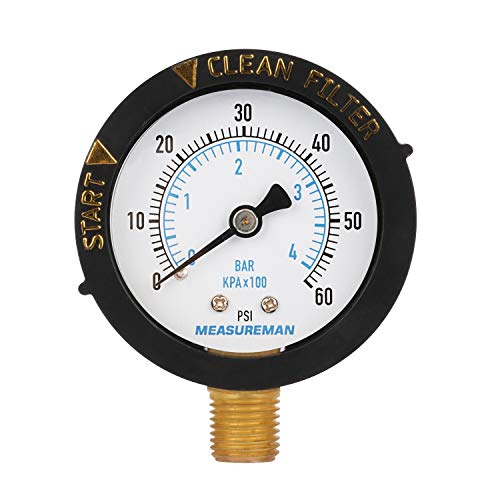
MEASUREMAN 60 PSI Gauge is the option with a plastic case and a dual PSI/bar scale; its 2-inch dial and 1/4-inch NPT lower mount suit standard bottom-mount replacement needs. The gauge includes a twist bezel with start and clean-filter markings and brass wetted parts. The accuracy is ±3-2-3%, a notation that is less straightforward to interpret than a single tolerance, so verify whether it meets your needs before choosing it for precision readings. Its 0–60 PSI range is broadly suited to filter pressure monitoring, but match both range and mount to the existing gauge.
Bottom line: Pick this if a plastic case and dual-unit scale suit your setup.
How to choose a pool filter pressure gauge
Match the connection, pressure range and mount orientation first; a gauge that screws in but reads the wrong range is not a useful replacement. These options use 1/4-inch NPT bottom or lower mounts and ranges topping out at 60 PSI, but their accuracy claims and cases differ. A 2-inch dial is common among the options here, not a guarantee of compatibility with every filter head. Check whether your current gauge enters from the bottom or side and whether its threads are 1/4-inch NPT. If the old face has both PSI and bar markings, choose a dual-scale replacement if you need to preserve that reading convention. Do not force mismatched threads; cross-threading can damage the port or create a leak.
When to clean or backwash a pool filter
Use the clean-filter pressure as the reference point, not a universal PSI number: after cleaning or backwashing, record the stable gauge reading with the pump running normally. A common rule of thumb is to clean when pressure rises about 8–10 PSI above that baseline, but the filter maker’s threshold takes priority because filter type and plumbing affect readings. A rotating indicator or marked bezel helps you remember the starting point; it does not measure whether flow is adequate by itself. Pressure that stays high after cleaning, drops unexpectedly, or fluctuates can point to a separate flow or equipment issue. Never open a pressurized filter just to inspect a gauge.
Replacing a pool filter pressure gauge safely
Switch off the pump and relieve filter pressure before removing a gauge; opening a pressurized filter can release water or parts forcefully. Follow the filter maker’s procedure for shutting down and venting the system, then remove the old gauge without twisting or stressing the filter body. Apply thread sealant suitable for the connection if required by the equipment maker, and start the replacement by hand to avoid cross-threading. Tighten only enough to seal; excessive force can damage a port. Restart the system with the air relief open as directed for the filter, and check for leaks as it reaches operating pressure. Stop and correct any leak before leaving the pump running.
Understanding gauge accuracy and scales
A 60 PSI full-scale gauge with a ±2% FS accuracy claim corresponds to ±1.2 PSI across its range; ±2.5% FS corresponds to ±1.5 PSI. These calculations explain the tolerance notation, but the claims come from makers and do not establish how a gauge will perform after wear or damage. Dual PSI/bar dials allow a reading in either unit; 1 bar is about 14.5 PSI. Avoid comparing readings from gauges with different scales as if their smallest dial divisions mean the same precision. For routine pool maintenance, the trend from a consistent clean-filter baseline is usually more useful than trying to interpret a small single-reading difference.
Frequently Asked Questions
What pressure rise means a pool filter needs cleaning?
A common rule is to clean or backwash when pressure is about 8–10 PSI above the clean-filter baseline. Record the baseline after service; use the filter maker’s threshold if it differs.
How do I know whether a gauge is bottom mount?
A bottom-mount gauge has its threaded connection beneath the dial, rather than coming out the back or side. Check the existing gauge orientation and thread size; these replacement options specify a 1/4-inch NPT lower or bottom connection.
Can I replace a pool gauge while the pump is running?
No. Switch off the pump and relieve system pressure before removing a gauge, since pressurized water or air can escape forcefully. Restart and vent the filter only as directed by its maker.
What does ±2% full-scale accuracy mean on a 60 PSI gauge?
It means the tolerance is ±1.2 PSI across a 60 PSI full scale. It is a maker’s accuracy claim, not a guarantee of calibration over the gauge’s service life.
Should a pool pressure gauge show zero when the pump is off?
With the system depressurized, a gauge should return close to zero; a persistent offset can indicate a damaged or stuck gauge. Confirm pressure is actually relieved before treating a nonzero reading as a gauge fault.