
Pressing Combs for Black Hair: 4 Models Compared

NICEMOVIC Ceramic Hot Comb is the clearest match for pressing natural Black hair because it is specifically described for natural Black hair and offers three heat levels. Choose a different model if you need a dual-voltage option for travel or more precise temperature adjustment.
An electric pressing comb uses heated teeth to smooth hair close to the roots; because hot tools can burn skin, work in small sections and keep the comb away from the scalp.
We earn a commission if you buy through links on this page. As an Amazon Associate I earn from qualifying purchases. Products are compared on manufacturer specifications, not hands-on testing.
- Best overall: NICEMOVIC Ceramic Hot Comb – It is specifically described for natural Black hair and has three selectable heat levels.
- Best for fine temperature control: 12-Setting Hot Comb – Its 12 settings span 250°F to 450°F.
- Best for travel: DAN Technology Dual-Voltage 450°F Comb – It has dual-voltage and a maximum temperature of 450°F.
| Product | Best for | Temperature control | Dual voltage | Length | Shop |
|---|---|---|---|---|---|
| NICEMOVIC Ceramic Hot Comb | Natural Black hair | 3 settings: 320°F, 360°F, 450°F | — | — | Check Price on Amazon |
| 12-Setting Hot Comb | Fine heat control | 12 settings: 250°F–450°F | 100–240V | — | Check Price on Amazon |
| DAN Technology Dual-Voltage 450°F Comb | Travel styling | High/low switch; up to 450°F | Yes | 11.8 in | Check Price on Amazon |
| DAN Technology Compact Dual-Voltage Comb | Compact storage | High/low switch | Yes | 11 in | Check Price on Amazon |
Pressing Combs for Black Hair
Compare heat controls and travel features to choose a comb that suits your hair and styling routine.
NICEMOVIC Ceramic Hot Comb

NICEMOVIC Ceramic Hot Comb is the only comb in this group explicitly described for natural Black hair, alongside beards and wigs. Its three heat settings are 320°F, 360°F, and 450°F, giving a few broad choices rather than fine temperature steps. The maker says it heats in 20–30 seconds and recommends the lower setting for soft hair, the middle for normal hair, and the highest for thick, hard hair. That range suits buyers who want simple controls. Its limitation is the 90°F gap between the first and second levels, which may matter if you need smaller adjustments.
Bottom line: Pick this if you want a straightforward comb specifically described for natural Black hair.
12-Setting Hot Comb

12-Setting Hot Comb offers the widest range of heat choices here, with an LCD display and 12 settings from 250°F to 450°F. The maker groups 250°F–300°F for soft hair, 320°F–375°F for normal hair, and 395°F–445°F for coarse hair. It is also described for straightening hair, beards, and wigs. Those incremental choices can help buyers avoid jumping directly from a low setting to the maximum. The limitation is that the temperature bands do not account for every setting in the full range, so use the displayed temperature and adjust cautiously rather than assuming a particular setting suits everyone.
Bottom line: Choose this if you want more temperature choices and a display.
DAN Technology Dual-Voltage 450°F Comb

DAN Technology Dual-Voltage 450°F Comb combines a 450°F maximum with dual-voltage, making it the clearest fit for travelers who need a comb that can accommodate different mains voltages. Its 11.8-inch length and 0.4-pound weight are useful dimensions to compare when packing. The maker says its ceramic-coated comb distributes heat evenly and describes the teeth as infused with argan oil, keratin, and tourmaline. A high/low switch offers fewer choices than models with multiple temperature settings, so this is less suited to someone seeking close control over heat. Verify that the plug and outlet are compatible at your destination.
Bottom line: Pick this for dual-voltage travel and a 450°F maximum.
DAN Technology Compact Dual-Voltage Comb
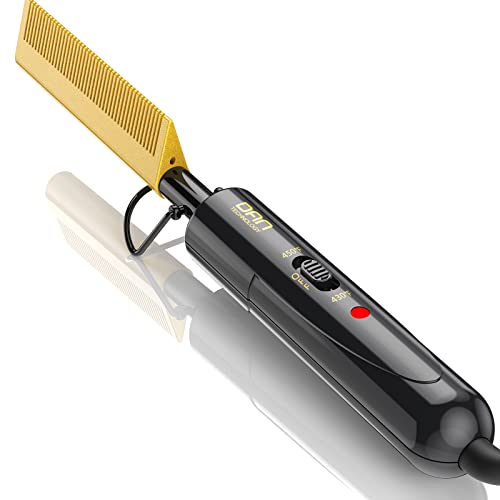
DAN Technology Compact Dual-Voltage Comb is the compact option, measuring 11 inches long and weighing 0.4 pound, with a dual-voltage design and a high/low switch. Its small size is intended to make storage and travel easier. The maker says the ceramic and tourmaline technology helps reduce static and frizz; the features also mention a swivel cord and an anti-scald bracket. Those features may suit someone who wants a simple comb that packs away easily. The limitation is the two-position heat control, which gives less adjustment than a model with several temperature settings.
Bottom line: Choose this if compact dimensions and dual-voltage matter more than precise heat adjustment.
How to choose a pressing comb for Black hair
Start with temperature control, then match the comb to the hair section and task. Fine or fragile hair generally calls for a lower heat setting, while coarse or tightly textured hair may need more heat; use the lowest temperature that smooths a small test section. A comb with multiple settings allows smaller adjustments than a high/low switch. Ceramic-coated teeth are common on electric hot combs and are intended to spread heat along the comb, but coating does not remove burn risk. For root smoothing, use small, clean sections and make deliberate passes rather than repeatedly heating the same area. If you need a specific maximum temperature or voltage, compare those specifications before choosing; the controls and travel features differ among these models.
Temperature and safe use
Keep a hot comb moving and avoid letting heated teeth touch the scalp, ears, or neck. Hair should be fully dry before using an electric straightening tool; wet hair can heat unevenly and increase the chance of damage. Start at a lower setting, test a small section, and increase only if needed. The models here reach as high as 450°F, a temperature that can cause burns on contact. Place a hot tool on a heat-resistant surface, use its stand or bracket when provided, and let it cool before storage. Do not assume a particular temperature is safe for every head of hair: strand condition, chemical processing, and section thickness affect how much heat is appropriate.
Dual-voltage and travel fit
Dual-voltage tools are designed to operate across different electrical supply voltages, but voltage compatibility does not guarantee that a plug fits a destination outlet. Check the local supply and plug shape before travel, and use a suitable plug adapter where needed. A voltage converter is not automatically required for a dual-voltage appliance, but confirm whether the tool accepts the local voltage before connecting it. Compact size and cord design also affect packing and use around a hotel vanity. The dual-voltage models in this comparison are DAN Technology Compact Dual-Voltage Comb and DAN Technology Dual-Voltage 450°F Comb; their heat controls differ, so choose based on temperature flexibility as well as travel needs.
Hot comb types and controls compared
Electric pressing combs vary most in how they set heat and how easily they travel. A two-position switch is simple but offers limited adjustment, while multiple temperature steps can make it easier to choose a lower starting point. Dual-voltage matters for international travel, but outlet shape remains a separate concern. Use this comparison as a control-selection guide rather than assuming one setting works for every hair type.
| Need | Useful feature | Tradeoff |
|---|---|---|
| Simple operation | High/low switch | Fewer heat choices |
| More adjustment | Multiple temperature settings | Requires choosing a suitable level |
| International travel | Dual-voltage | Plug compatibility still matters |
For a first pass, prioritize adjustability if heat sensitivity is a concern; prioritize voltage compatibility if the comb will be used abroad.
Frequently Asked Questions
Can I use a hot pressing comb on damp hair?
No; use an electric pressing comb only on fully dry hair. Water can heat rapidly under a hot tool and increase the risk of uneven heating and damage.
What temperature should I use on natural Black hair?
Start at the lowest setting that smooths a small test section, rather than automatically selecting the maximum. Hair condition and strand thickness matter, and these models range up to 450°F.
How do I keep a hot comb from burning my scalp?
Keep the heated teeth from touching skin and work in small sections with controlled passes. A comb reaching 450°F can burn on contact, so set it on a heat-resistant surface between sections.
Does dual-voltage mean I can plug it in anywhere?
No; dual-voltage addresses electrical supply voltage, not plug shape. Check the destination voltage and outlet type, and use a compatible plug adapter if needed.
How often should I pass a pressing comb over one section?
Use as few deliberate passes as needed to smooth the section, and avoid repeatedly heating the same hair. Smaller sections and the lowest effective temperature can reduce unnecessary heat exposure.