
Elbow Wraps for Lifting: 4 Models Compared

For most lifters, DMoose 40-Inch Elbow Wraps is the versatile choice because its 40-inch cotton-elastic wrap offers adjustable compression and a one-hand wrapping loop. Choose PR Personal Record 36-Inch Elbow Wraps instead if you want a stiffer, more rigid feel, or Prime Beast Hybrid Elbow Wraps, Large if you prefer a sleeve combined with an adjustable wrap.
Weightlifting elbow wraps are straps wound around the joint to add adjustable compression during pressing; they are not a substitute for sound technique or medical care.
We earn a commission if you buy through links on this page. As an Amazon Associate I earn from qualifying purchases. Products are compared on manufacturer specifications, not hands-on testing.
- Best overall: DMoose 40-Inch Elbow Wraps – Its 40-inch length, cotton-elastic blend, and one-hand loop make adjustments straightforward.
- Best for rigid support: PR Personal Record 36-Inch Elbow Wraps – The 36-inch wrap is specifically made with a stiff, heavy-duty construction.
- Best for hybrid support: Prime Beast Hybrid Elbow Wraps, Large – A compression sleeve sits under an adjustable outer wrap.
| Product | Best for | Length | Support style | Material | Shop |
|---|---|---|---|---|---|
| DMoose 40-Inch Elbow Wraps | Adjustable wrapping | 40 in | Adjustable strap | Cotton-elastic blend | Check Price on Amazon |
| Gymreapers 40-Inch Elbow Wraps | Flexible pressing support | 40 in | Adjustable strap | Polyester and elastic | Check Price on Amazon |
| PR Personal Record 36-Inch Elbow Wraps | Rigid pressing support | 36 in | Stiff adjustable wrap | — | Check Price on Amazon |
| Prime Beast Hybrid Elbow Wraps, Large | Sleeve-wrap combination | — | Sleeve with outer wrap | — | Check Price on Amazon |
Elbow Wraps for Lifting Compared
Compare wrap length, construction, and adjustability to match support to your pressing routine.
DMoose 40-Inch Elbow Wraps
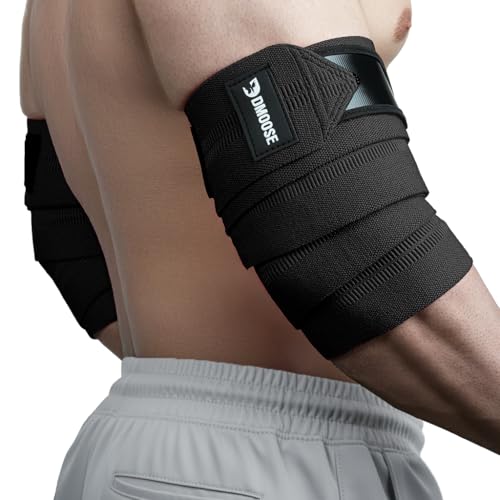
At 40 inches, this pair offers more wrap length than the 36-inch alternative, while its cotton-elastic blend is designed for breathability and flexibility. The one-hand wrapping loop and hook-and-loop closure support quick tension changes between sets, making it a practical match for lifters who adjust compression by exercise. DMoose says the design is 20% more flexible and has reinforced stitching. The main tradeoff is that this is a wrap rather than a sleeve: lifters who want continuous coverage between sets may prefer a hybrid style.
Bottom line: Pick this pair if you want a longer adjustable strap with a one-hand wrapping loop.
Gymreapers 40-Inch Elbow Wraps

Gymreapers pairs a 40-inch strap with polyester and elastic, giving it the same basic length as DMoose 40-Inch Elbow Wraps but a different material blend. The wrap is intended for bench press, dumbbell press, and other pushing movements, and its hook-and-loop closure includes an added strap to help secure the fit. Its specifications emphasize compression and joint support rather than fabric breathability or a sleeve-style design. Lifters who specifically want a cotton-elastic blend or a one-hand wrapping loop should consider another style.
Bottom line: Choose this pair for a 40-inch polyester-elastic wrap with an added securing strap.
PR Personal Record 36-Inch Elbow Wraps

The defining difference here is stiffness: this 36-inch wrap is built for a rigid, locked-in feel rather than a softer, more flexible wrap. Its tension is adjustable, so lifters can tune compression for bench press, overhead press, dips, and other pressing work. The product name identifies Larry Wheels, and the construction is positioned for heavy strength training. The tradeoff is its deliberately stiff feel, which can be a poor match for anyone who prioritizes flexible movement or wants a sleeve under the support.
Bottom line: Pick this option if you want a short, stiff wrap for demanding pressing sessions.
Prime Beast Hybrid Elbow Wraps, Large

This is the only hybrid in the group: a compression sleeve paired with an adjustable outer wrap. The sleeve provides coverage while the outer layer lets lifters tighten support for a heavy set and loosen it between sets without removing the sleeve. That combination suits someone who wants more than a strap alone and prefers not to rewrap from bare skin. Its size is Large, so buyers should confirm that size matches their arm before ordering. Lifters who want a simple standalone wrap may find the sleeve layer unnecessary.
Bottom line: Choose this hybrid if you want sleeve coverage plus adjustable tension.
How to choose elbow wraps for lifting
Choose elbow wraps by matching stiffness and adjustability to the lift, not by assuming tighter is always better. Flexible wraps allow more adjustment during a workout, while a rigid wrap can feel more locked in under heavy pressing. A sleeve-wrap hybrid keeps sleeve coverage in place and adds an adjustable outer layer. Use only enough tension to feel supported while keeping normal circulation and comfortable movement; loosen or remove a wrap if you notice numbness, tingling, or pain.
Length is another practical distinction: these options run 36 or 40 inches, and a longer strap offers more material for winding around the joint. Prioritize the construction you can position consistently, since uneven wrapping can create pressure points.
Wraps, sleeves, and hybrid support
A wrap uses a long strap that winds around the elbow, a sleeve slides over the joint, and a hybrid combines both approaches. Wraps allow tension to change with each application; sleeves provide an already-positioned layer without winding a strap around the arm. Hybrid support is useful when a lifter wants sleeve coverage plus a tightening layer for working sets.
Use this distinction to narrow the type before comparing fabric or closure. Elbow wraps are not the same as wrist wraps, and a knee wrap is not sized or applied as an elbow strap. Match the item to the joint and follow any competition rules that apply; powerlifting federations can set equipment and wrap requirements, so verify the specific federation rulebook before competing.
How to wrap elbows for pressing
Wrap the elbow with steady, overlapping turns rather than pulling a narrow band tightly into one crease. Center the support around the joint, keep the strap flat, and secure the closure so it stays in place through the movement. A hook-and-loop closure makes tension adjustment easier, but the wrap should not restrict hand circulation or cause pins and needles.
Keep wrapping tension consistent from side to side, then test a light warm-up set before adding load. If the wrap slides, bunches, or creates sharp pressure, remove it and reposition rather than tightening harder. Persistent elbow pain warrants stopping the provoking exercise and seeking qualified clinical advice; support gear does not diagnose or treat an injury.
When to loosen or remove elbow wraps
Loosen an elbow wrap between sets if compression feels excessive, and remove it immediately for numbness, tingling, color change, or worsening pain. A wrap should support a training choice, not mask symptoms or force a painful range of motion. Users with a current injury, circulation condition, or post-surgical restriction should get personalized guidance before using compression gear.
Check hook-and-loop surfaces and seams regularly, and stop using a wrap if the closure no longer holds or the fabric tears. Sweat and repeated washing can affect elastic and closures; use the care method on the garment label because materials and construction differ. Store wraps dry so they do not remain damp between sessions.
Frequently Asked Questions
How long should elbow wraps be for lifting?
These options measure 36 or 40 inches. A 40-inch wrap gives more material for winding, while the shorter 36-inch design is explicitly stiff; choose based on how much overlap and tension you want.
Should elbow wraps feel very tight?
No; wraps should feel supportive without numbness, tingling, or impaired hand circulation. Loosen or remove one immediately if those symptoms occur.
Can I wear elbow wraps for every workout?
Elbow wraps are intended here for pressing movements such as bench or overhead press, rather than required for every exercise. Use them when adjustable joint compression serves the session, and train without them when they are not needed.
Are elbow wraps and elbow sleeves the same?
No; a wrap is wound around the joint to adjust tension, while a sleeve slides over the elbow and provides a positioned layer. A hybrid design combines a sleeve with an outer wrap.
Can elbow wraps fix elbow pain?
No; compression gear is not a treatment for an injury. Stop movements that worsen pain, and seek qualified medical guidance for persistent symptoms or a diagnosed condition.