
Progressive Readers With Clear Top: 3 Models Compared

V.W.E. Men Rectangular Progressive Readers suits most people seeking progressive readers with a clear, zero-power top because its upper lens is explicitly non-magnified and its bottom has 2.00 reading power. Choose another option if you need a different strength, an intermediate zone, or computer-distance power rather than clear distance vision.
We earn a commission if you buy through links on this page. As an Amazon Associate I earn from qualifying purchases. Products are compared on manufacturer specifications, not hands-on testing.
- Best overall: V.W.E. Men Rectangular Progressive Readers – The top is non-magnified, and the bottom provides 2.00 reading power.
- Best for intermediate vision: V.W.E. Women Marble Print Progressive Readers – Its lens has zero-power distance at the top and a gentle intermediate zone.
- Best for a 2.25 strength: V.W.E. Women Marble Print Z121 – The tortoise frame is paired with clear upper lenses and 2.25 reading power.
| Product | Best for | Reading power | Frame measurements | Shop |
|---|---|---|---|---|
| V.W.E. Men Rectangular Progressive Readers | Clear distance top | 2.00 | 139 mm wide; 54 mm lens; 18 mm bridge | Check Price on Amazon |
| V.W.E. Women Marble Print Progressive Readers | Intermediate transition | 1.50 | Medium fit; measurements unavailable | Check Price on Amazon |
| V.W.E. Women Marble Print Z121 | 2.25 reading power | 2.25 | 137 mm frame width | Check Price on Amazon |
Progressive Readers With Clear Top
Compare upper-lens power, reading strength and frame fit before choosing a pair.
V.W.E. Men Rectangular Progressive Readers

V.W.E. Men Rectangular Progressive Readers is the straightforward option for readers who want an explicitly clear upper lens: the top is non-magnified, with 2.00 power at the bottom and a smooth transition between. The rectangular matte-black frame measures 139 mm across, with 54 mm lenses, an 18 mm bridge and 145 mm temples. Its lightweight frame and scratch-resistant lenses suit daily reading and general wear. The limitation is its single 2.00 strength and non-spring hinges, which may not suit someone seeking another magnification or spring-hinge flexibility.
Bottom line: Choose this if a zero-power top and 2.00 reading zone match your needs.
V.W.E. Women Marble Print Progressive Readers
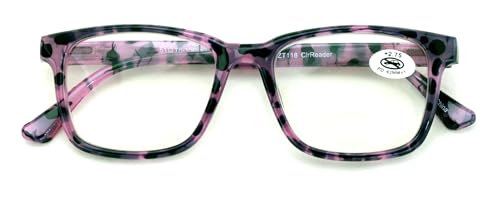
V.W.E. Women Marble Print Progressive Readers differs by spelling out three zones: zero-power distance at the top, a gentle intermediate area, and 1.50 reading power below. That makes it a better match for someone who wants screen or craft-range vision between distance and close reading. The lightweight square frame has a purple marble print, and the lenses have an anti-scratch hard coat. The fit is described as medium, but shoppers who need exact frame dimensions should confirm the fit before ordering; the specifications give no measurements.
Bottom line: Pick this for an intermediate zone and 1.50 reading strength.
V.W.E. Women Marble Print Z121

V.W.E. Women Marble Print Z121 is the higher-strength V.W.E. choice here, with 2.25 reading power and clear upper lenses that gradually transition toward the reading area. Its tortoise marble-print square frame measures 137 mm wide, a useful fit clue for comparing against glasses that already sit comfortably. The no-line design avoids a visible bifocal segment, and the frame is characterized as lightweight with smooth edges. The trade-off is that the input gives no lens width, bridge or temple measurements, so width alone cannot establish a complete fit.
Bottom line: Choose this when 2.25 power and a 137 mm frame width fit your preferences.
How to choose progressive readers with clear top
Start with upper-lens power: a true clear-top reader has zero magnification above the gradual transition, while some computer progressives use a powered upper zone. Then match the bottom power to the reading strength you already use; the products here span 1.50 to 2.50. Intermediate zones matter if you alternate between a book and a screen, but the transition does not make a lens suitable for every distance. If you require clear distance vision, avoid a design whose upper lens is around half the ordered strength. Do not assume a general progressive reader is suitable for driving: use prescription distance correction and professional advice for road vision.
Frame measurements and fit
Frame width is only one fit measurement; lens width, bridge width and temple length also affect comfort and positioning. A 139 mm frame can fit differently from a 137 mm frame if its bridge or temples differ. For an existing pair that fits well, compare the numbers printed inside its temple, commonly shown as lens width, bridge width and temple length in millimeters. Lens position matters too: a progressive design needs the intended zones aligned with your eyes, so a frame that slides down can make the transition harder to use. Pick frames that sit securely without pinching, and verify all dimensions when fit precision matters.
Clear-top readers versus computer progressives
Clear-top readers and computer progressives serve different distance ranges. A zero-power upper zone preserves unaided distance viewing through that portion, while a powered top trades that for more useful focus at intermediate desk distances. Use this quick distinction when choosing:
| Need | Lens feature | Decision |
|---|---|---|
| Clear upper view | Zero-power top | Choose a true clear-top design |
| Work across a desk | Powered top and intermediate zone | Choose only if the upper power suits your vision |
A 3-foot range is a near-work target, not evidence of clear vision at longer distances. Match the lens type to the actual task rather than treating all seamless multifocals as interchangeable.
Safe use and lens care
Reading glasses are not a substitute for an eye exam or prescription lenses when distance vision is blurry; sudden vision changes, eye pain or persistent headaches call for professional care. Progressive zones also take practice: move the eyes and head to find the intended area, and remove the glasses for tasks where the powered zone distorts distance judgment. Keep lenses in a protective case and clean with lens-safe solution and a microfiber cloth; dry rubbing can drag grit across coatings. Scratch-resistant coatings can reduce everyday scuffing but do not make lenses scratch-proof, and UV or blue-light claims should not be treated as proof of prescription or driving suitability.
Frequently Asked Questions
Are clear-top progressive readers suitable for driving?
Not automatically. A clear upper area does not establish that the lens provides the prescription or field of view needed for safe driving; use appropriate distance correction and get an eye-care professional’s guidance.
How do I get used to progressive reading glasses?
Allow several days of brief, controlled use to learn where the near and intermediate zones sit. Turn your head toward the task rather than looking through the lens edge, and stop if significant dizziness or headaches persist.
What does a powered top mean on readers?
A powered top has magnification above zero, so it is not a clear distance zone. In a 2.50 reader described as having an upper zone around half power, that top is about 1.25 power.
How should I choose the reading strength?
Use the lowest strength that lets you read comfortably at your normal working distance, and compare it with readers that already work for you. If close print remains blurry or headaches develop, an eye exam is a better next step than increasing strength repeatedly.
Can progressive readers replace prescription glasses?
No, over-the-counter progressive readers do not account for individual prescriptions or differences between the eyes. An optometrist can determine whether prescription progressives are needed, especially when distance vision is unclear.