
Quest 3 Lens Protectors: Covers and Spacers Compared

For most Quest 3 owners, AMVR Soft Lens Protector Cover is the most versatile lens protector because its soft cover is compatible with Quest 3 and several other headsets. Choose a glasses spacer instead if your main concern is keeping prescription glasses from contacting the headset lenses.
Quest 3 lens protectors include storage covers, which shield optics from dust and light when the headset is put away, and spacer rings, which create a barrier around the lenses during wear.
We earn a commission if you buy through links on this page. As an Amazon Associate I earn from qualifying purchases. Products are compared on manufacturer specifications, not hands-on testing.
- Best overall: AMVR Soft Lens Protector Cover – A soft cover that fits Quest 3 and multiple other VR headsets.
- Best for eyeglass clearance: AMVR Quest 3 Silicone Glasses Spacer – A 3.2 mm silicone spacer designed to keep prescription glasses from contacting Quest 3 lenses.
- Best for a combined kit: Quest 3 Lens Cover and Spacer Kit – Combines a storage cover, glasses spacer, and blue-light-blocking glasses.
| Product | Best for | Protector type | Quest 3S compatibility | Material or feature | Shop |
|---|---|---|---|---|---|
| AMVR Soft Lens Protector Cover | Multi-headset storage | Soft cover | Yes | Microfiber cloth | Check Price on Amazon |
| Quest 3 Anti-Blue-Light Lens Covers | Blue-light filter | Lens covers | No | Anti-blue-light; scratch-resistant | Check Price on Amazon |
| AMVR Quest 3 Silicone Glasses Spacer | Slim glasses spacer | Spacer frame | No | Silicone; 3.2 mm | Check Price on Amazon |
| Quest 3 Lens Cover and Spacer Kit | Cover and spacer | Cover and spacer kit | No | Blue-light-blocking glasses | Check Price on Amazon |
| Orzero Washable VR Lens Cover | Washable storage cover | Soft fabric cover | Yes | Sponge and lycra fabric | Check Price on Amazon |
Quest 3 Lens Protectors Compared
Choose a storage cover for protection between sessions or a spacer to separate glasses from the headset lenses.
AMVR Soft Lens Protector Cover

For headset owners who use more than one VR system, AMVR Soft Lens Protector Cover stands out with compatibility across Quest 3, Quest 3S, Quest 2, and several other models. The soft cover is intended to shield lenses from sunlight, dust, and scratches during storage or transport, and the product includes a microfiber cleaning cloth. Its broad compatibility makes it a practical choice when a single cover needs to serve different headsets.
This is a cover for storage, not a glasses spacer worn between your face and the headset. Choose another style if preventing eyeglasses from touching the lenses during play is the priority.
Bottom line: Pick this if you want one soft storage cover for several VR headsets.
Quest 3 Anti-Blue-Light Lens Covers
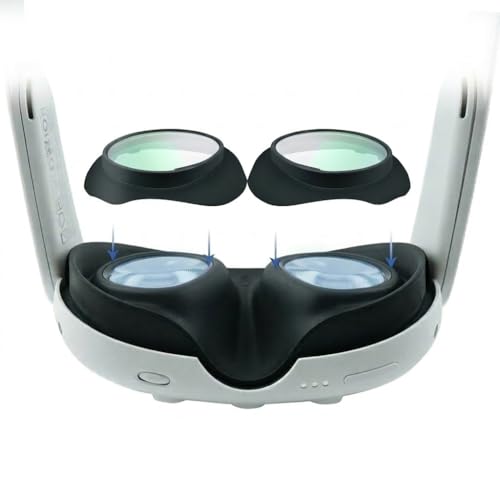
For Quest 3 owners seeking a filtered lens cover, Quest 3 Anti-Blue-Light Lens Covers is distinguished by its claimed blue-light blocking and anti-glare properties. The pair is precision-molded for Quest 3, and the maker says the covers block more than 90% of blue light. The product is also positioned for eyeglass wearers as a spacer to reduce contact between glasses and the headset optics.
Unlike a soft cover placed over lenses during storage, these covers are intended to sit on the optics. Quest 3S owners should choose another option because this product is specified for Quest 3.
Bottom line: Choose this for Quest 3 if filtered lens covers are your priority.
AMVR Quest 3 Silicone Glasses Spacer

For prescription-glasses wearers who want a slim buffer, AMVR Quest 3 Silicone Glasses Spacer uses soft silicone rings with a 3.2 mm thickness. The all-in-one spacer is designed to keep glasses from contacting Quest 3 lenses, and the maker also describes a light- and dust-blocking cover function. That spacer-first design sets it apart from simple covers meant mainly for storage.
This set is explicitly not for Quest 3S, and it contains a spacer frame rather than lenses. Choose it when lens contact is the concern, not when you need a filtered optical cover or a protector for multiple headset models.
Bottom line: Choose this if glasses clearance matters and you have a Quest 3, not a 3S.
Quest 3 Lens Cover and Spacer Kit

For someone wanting both storage protection and a glasses buffer, Quest 3 Lens Cover and Spacer Kit combines a lens cover, a spacer, and blue-light-blocking glasses. Its fit is Quest 3 rather than Quest 3S, so it suits owners who want a bundled set for one headset model. The maker says the spacer magnets were upgraded to address a falling-off issue.
The included blue-light-blocking item is glasses, not a specified optical lens insert. This kit is less suitable if you only need a simple fabric cover or want a spacer-only component; those needs point to different designs.
Bottom line: Pick this if you want a Quest 3 cover and glasses spacer together.
Orzero Washable VR Lens Cover

For buyers prioritizing a washable fabric protector, Orzero Washable VR Lens Cover uses high-density sponge and lycra fabric and is described as washable. It is compatible with Quest 3 and Quest 3S, as well as several other headsets, making it a broader-fit alternative to Quest 3-only optical covers and spacers. The soft sleeve is intended to guard against dust and scratches and block sunlight during storage.
A fabric cover does not create extra space for eyeglasses during play. Choose a spacer design instead if glasses-to-lens contact is the issue.
Bottom line: Choose this for a washable, multi-headset cover used between sessions.
How to choose a Quest 3 lens protector
Choose by when the protection is needed: a storage cover goes over the lenses when the headset is put away, while a spacer separates glasses from the headset during wear. Direct sunlight can damage VR display optics, so use a cover whenever the headset is stored near a bright window or carried uncovered. For glasses wearers, prioritize a spacer made for the Quest 3; covers that sit over the lenses do not necessarily prevent frames from touching them.
Fit is the first filter: Quest 3 and Quest 3S accessories are not universally interchangeable. If you own a 3S, select only a product whose compatibility explicitly includes it; if you own a Quest 3, a model-specific spacer or a multi-headset cover may suit the job. Treat blue-light claims separately from physical scratch protection, since one does not establish the other.
Storage covers versus glasses spacers
Storage covers protect exposed optics while the headset is idle, whereas glasses spacers create a physical buffer during use. A cloth or foam cover can reduce dust exposure and block direct light when fitted over the lenses, but it should be removed before putting on the headset. A spacer stays in the headset and is useful when eyeglass frames could otherwise meet the optics.
Use the table to match the protector style to the problem you are trying to solve.
| Need | Protector style | When it is used |
|---|---|---|
| Keep dust and light off stored lenses | Soft cover or sleeve | Between sessions |
| Reduce eyeglass contact with lenses | Spacer or spacer kit | During headset use |
| Filtered lens cover | Optical cover | Fitted over the lenses |
Do not assume that a cover doubles as a spacer or that a spacer includes lens inserts; the product style determines the function.
Quest 3 and Quest 3S fit checks
Quest 3 and Quest 3S are distinct headset models, so verify the exact model name before choosing a fitted accessory. Some covers in this group name both models, while the spacer options specify Quest 3 and exclude 3S. That compatibility difference matters more than color or accessory bundle size.
For glasses clearance, check that the accessory is a spacer rather than a storage cover and that it is intended for your headset model. A 3.2 mm spacer thickness is given for one option here, but it should not be treated as a universal fit measurement for every wearer or frame. If eyeglasses still press against the lenses, stop using the combination and check the headset fit; lens contact can scratch optics.
Protecting VR lenses between sessions
Keep VR lenses out of direct sunlight: focused light can damage the display, and a storage cover helps block exposure when the headset is not being worn. Store the headset with the cover in place and avoid setting controllers or other accessories against the lenses, since hard objects can scratch the optical surface.
Clean lenses with a clean, dry microfiber cloth rather than household glass cleaner or abrasive fabric. Remove dust gently before wiping so particles are less likely to drag across the lens. A washable fabric cover should be fully dry before it goes back over the optics; trapped moisture and debris are reasons to clean the cover periodically.
Frequently Asked Questions
Can direct sunlight damage Quest 3 lenses?
Yes, direct sunlight can damage the headset display optics because the lenses can focus light onto the display. Keep the headset out of sunbeams and use a cover during storage, especially near windows or outdoors.
Can I use a Quest 3S lens protector on Quest 3?
Not always; accessory compatibility is model-specific. Choose a protector whose fit explicitly includes your headset, since some Quest 3 spacers exclude Quest 3S.
How do I stop glasses from scratching Quest 3 lenses?
Use a Quest 3-compatible glasses spacer to keep frames from touching the headset optics. Stop wearing the headset if the frames still contact the lenses, because even light rubbing can scratch them.
Should a lens cover stay on while playing?
A storage cover should be removed before wearing the headset. A glasses spacer is the type meant to remain fitted during use.
What should I use to clean VR headset lenses?
Use a clean, dry microfiber cloth and avoid household glass cleaner or abrasive fabric. Gently remove dust before wiping to limit the chance of scratching the lens surface.