
Rapitest Electronic Soil Tester: 5 Models Compared

The Luster Leaf Rapitest 1860 is the closest match for a Rapitest electronic soil tester if you mainly need soil pH and fertility readings. Choose another model if you want moisture or sunlight measurements, or prefer a chemical nutrient test kit over an electronic meter.
We earn a commission if you buy through links on this page. As an Amazon Associate I earn from qualifying purchases. Products are compared on manufacturer specifications, not hands-on testing.
- Best overall: Luster Leaf Rapitest 1860 – Checks soil pH and fertility in about one minute and includes plant-specific pH guidance.
- Best for four readings: Luster Leaf Rapitest 1880 – Measures soil pH, moisture, fertility and sunlight.
- Best for probe measurements: Luster Leaf Rapitest 1818 4-in-1 – Uses three stainless steel probes and requires no batteries.
| Product | Best for | Measurements | Power | Probe or test type | Shop |
|---|---|---|---|---|---|
| Luster Leaf Rapitest 1860 | pH and fertility | pH, fertility | 1 AA battery | Electronic soil tester | Check Price on Amazon |
| Luster Leaf Rapitest 1880 | Four soil readings | pH, moisture, fertility, sunlight | — | Electronic soil analyzer | Check Price on Amazon |
| Luster Leaf Rapitest 1818 4-in-1 | Battery-free readings | pH, moisture, fertility, sunlight | No batteries | Three stainless steel probes | Check Price on Amazon |
| Buladeke 7-in-1 Digital Soil Tester | Digital readings | pH, EC, TDS, fertility, temperature, moisture | 4 AAA batteries | Digital probe tester | Check Price on Amazon |
| Rapitest Garden Soil Test Kit | Nutrient test results | pH, nitrogen, phosphorus, potash | — | Capsule and color comparator | Check Price on Amazon |
Rapitest Electronic Soil Testers and Alternatives
Compare what each tool measures and how it takes readings before choosing one for your garden.
Luster Leaf Rapitest 1860

For a focused pH and fertility check, Luster Leaf Rapitest 1860 measures both in about one minute and includes a guide to ideal pH ranges for more than 350 plants. Its soil-only design and single AA battery make it a straightforward option for gardeners who want those two readings rather than a broader set of measurements. The guide can help match a reading to a plant’s preferences, but it does not provide moisture or sunlight readings. Choose a different tool if those extra measurements are part of your decision.
Bottom line: Pick this if pH and fertility are the readings you need.
Luster Leaf Rapitest 1880

Unlike the two-reading Luster Leaf Rapitest 1860, Luster Leaf Rapitest 1880 adds soil moisture and sunlight to pH and fertility, making it more useful when you are diagnosing several growing conditions. Its large scale plate and included recommendations are intended for fruits, vegetables, trees, shrubs, flowers, grasses and lawns. This is still a soil analyzer, so its sunlight measurement does not replace observing how much direct light a spot receives through the day. Choose it when the extra readings matter; for pH and fertility alone, a narrower tool may be enough.
Bottom line: Choose this when moisture and sunlight readings are useful alongside pH and fertility.
Luster Leaf Rapitest 1818 4-in-1
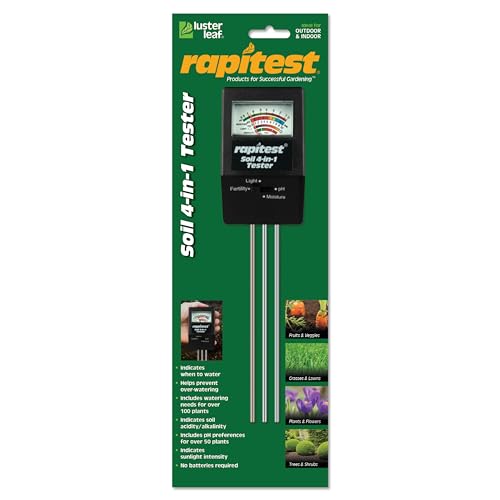
Battery-free operation sets Luster Leaf Rapitest 1818 4-in-1 apart from the other electronic-style Rapitest options here: it measures pH, moisture, fertility and light with three stainless steel probes, and requires no batteries. That combination suits gardeners who want several kinds of readings without keeping batteries on hand. The product is designed for soil use only, so it is not a general-purpose light meter or a test for water or growing media outside soil. Its measurements overlap with Luster Leaf Rapitest 1880, so compare their formats and included guidance when deciding between them.
Bottom line: Pick this if you want four soil readings without batteries.
Buladeke 7-in-1 Digital Soil Tester
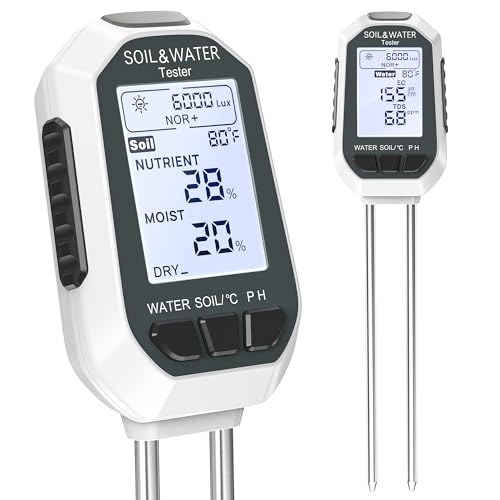
For gardeners who want a digital display and more measurement categories, Buladeke 7-in-1 Digital Soil Tester is a broader alternative to the Rapitest meters, with pH, EC, TDS, fertility, temperature, moisture and sunlight functions. Its large LCD has a backlight, and it uses four AAA batteries, which are not included. This is not a Rapitest model; choose it for its digital display and range of measurements.
Bottom line: Choose this if a backlit display and the additional measurement types fit your needs.
Rapitest Garden Soil Test Kit

Unlike the electronic meters, Rapitest Garden Soil Test Kit uses capsules and color comparators to test soil pH plus nitrogen, phosphorus and potash, with supplies for 20 tests. The included plant pH preference list covers more than 450 plants, and the instructions are intended for both new and experienced gardeners. It is a test kit rather than a reusable electronic meter, so it makes more sense when nutrient-specific results are the priority than when you want quick moisture or sunlight readings. Choose an electronic model instead if those readings are essential.
Bottom line: Pick this when nutrient testing matters more than electronic readings.
How to choose a Rapitest soil tester
Choose by the measurement that will change what you do next: pH and fertility, moisture, sunlight or individual nutrients. Soil pH uses a 0-to-14 scale; 7 is neutral, lower readings are acidic and higher readings are alkaline. Many garden plants grow well around pH 6.0 to 7.0, but plant preferences differ, so use a plant-specific range rather than aiming for one number for every bed. A broad meter can combine several readings, while a chemical kit can test nitrogen, phosphorus and potash separately. If your main question is whether to adjust pH, prioritize a pH reading and a guide matched to your plant; if growth is poor despite suitable pH, nutrient testing may be more useful.
Getting useful soil readings
Take readings from the root zone, not just the dry surface: for garden beds, sample several spots in the area and avoid recently fertilized patches or compost piles. Soil moisture changes with depth, texture and recent watering, so compare readings at a consistent depth and time rather than treating one spot as the whole bed. For pH decisions, a composite soil sample from multiple locations gives a better picture of a bed than a single probe insertion. Clean a probe between contrasting soil areas to avoid carrying material between samples. When a pH change would affect a large planting, verify the result with a soil laboratory test before applying amendments.
Electronic meters and chemical test kits compared
Electronic meters are useful for repeated on-the-spot readings, while capsule kits provide a different route to specific nutrient results. Neither approach removes the need to sample representative soil; poor sampling can mislead even when the measurement is repeatable. A pH meter reading and a nutrient kit answer different questions, so choose based on the decision you need to make rather than the number of features alone. Use this guide to match the tool type to the question:
| Need | Useful tool type | What it helps assess |
|---|---|---|
| Soil acidity or alkalinity | pH meter or pH test kit | Whether soil pH suits a plant |
| Watering conditions | Moisture meter | Moisture at the probe depth |
| Specific nutrients | Nutrient test kit | Nitrogen, phosphorus and potash |
Common soil-testing mistakes
Avoid changing soil based on a single reading from one unusual spot; garden beds can vary from one end to the other. A second mistake is treating sunlight and soil moisture as fixed properties: light varies across the day and season, while moisture shifts after watering and rain. Take several readings where a plant will grow, and compare similar conditions. Do not assume that an overall fertility reading substitutes for separate nitrogen, phosphorus and potash results; those are distinct nutrient measures. If readings conflict with plant symptoms or a substantial amendment is planned, use a laboratory soil analysis to confirm the diagnosis before changing the bed.
Frequently Asked Questions
What soil pH is best for most garden plants?
Many garden plants do well in soil around pH 6.0 to 7.0, though plant preferences vary. Check the target plant’s range before adding lime or sulfur.
How many spots should I test in a garden bed?
Sample several representative spots rather than relying on one insertion; a composite of multiple locations better reflects a bed’s average condition. Keep unusual areas, such as a compost pile, separate from the main sample.
When should I check soil moisture with a meter?
Check at a consistent depth near the active root zone, because surface soil dries faster than deeper soil. For comparisons, take readings before watering and at the same time of day.
Can a soil tester measure garden sunlight accurately?
A sunlight reading describes conditions at the measurement spot and time, not the full day’s exposure. Observe the planting area through the day, since direct light changes with time and season.
When should I use a laboratory soil test?
Use a lab test when a major pH adjustment is planned or meter results do not fit plant performance. Composite samples from multiple spots provide a better view of the bed than a single sample.