
Reading Strips for Dyslexia: 4 Options Compared

For readers who want to track one line at a time, 8-Pack Guided Reading Strips is a straightforward choice, with a 7.5-by-1.3-inch strip in eight colors. Choose CNDNO 16-Piece Two-Size Set for a wider overlay that covers four to five lines, or hand2mind FingerFocus Highlighter for a wand-style pointer that follows words rather than covering lines.
Reading strips are transparent guides placed over text to help readers keep their place; they are not treatments for dyslexia. Compare the tint and coverage on the page or screen where the reader will use the tool.
We earn a commission if you buy through links on this page. As an Amazon Associate I earn from qualifying purchases. Products are compared on manufacturer specifications, not hands-on testing.
- Best overall: 8-Pack Guided Reading Strips – Eight color choices in a 7.5-by-1.3-inch single-line strip.
- Best for wider coverage: CNDNO 16-Piece Two-Size Set – Includes two widths, with the wider strip designed to cover four to five lines.
- Best for word tracking: hand2mind FingerFocus Highlighter – A transparent wand supports following text with a finger-pointing motion.
| Product | Best for | Format | Coverage | Pack | Shop |
|---|---|---|---|---|---|
| 8-Pack Guided Reading Strips | Single-line tracking | Flat overlay strip | Single line | 8 pieces | Check Price on Amazon |
| CNDNO 16-Piece Two-Size Set | Single or multiple lines | Flat overlay strips | 1 line; 4–5 lines | 16 pieces | Check Price on Amazon |
| Zonon 6-Piece Guided Reading Strips | Basic color selection | Gray-and-clear overlay | Single line | 6 pieces | Check Price on Amazon |
| hand2mind FingerFocus Highlighter | Following word by word | Transparent wand | Word-by-word pointer | 1 pack | Check Price on Amazon |
Reading Strips for Dyslexia Compared
Compare each format and coverage style with the reader’s preferred way to follow text.
8-Pack Guided Reading Strips

Eight color choices distinguish this set from the smaller six-color pack and the pointer-style tool. Each flexible PVC strip measures 7.5 by 1.3 inches, a narrow format suited to highlighting one line at a time while leaving nearby text visible. The colors are red, blue, orange, pink, green, yellow, gray, and clear, so the reader can compare tints and keep a preferred option handy.
The limitation is its single narrow width: readers who want to cover several lines at once may prefer a wider strip. Color preference is personal, so try the overlays on the material the reader uses most.
Bottom line: Choose this set when a reader wants a single-line guide and several color options.
CNDNO 16-Piece Two-Size Set

This set is the only one here with two overlay widths, offering a choice between a 7.5-by-1.3-inch strip for one line and a 7.5-by-2.8-inch strip intended for four to five lines. The two coverage areas make it useful for readers whose preferred guide changes between a dense passage and a single line. The strips are PVC, and the set includes eight pieces in each width.
The tradeoff is that a wider overlay exposes more text at once, which may not suit someone who wants a narrow visual window. Compare both widths on a typical page before settling on one.
Bottom line: Pick this set if the reader wants to switch between single-line and multi-line coverage.
Zonon 6-Piece Guided Reading Strips

Unlike the other flat strips here, these guides pair a gray shielding area with a transparent area for tracking a sentence. Each piece measures about 7.5 by 1.3 inches, and the six-piece set has red, green, blue, yellow, orange, and rose-red color options. That design suits a reader who wants a narrow guide with a shaded area intended to separate the current line from surrounding text.
The set has fewer color options than the eight-piece alternatives, and it does not offer a wider multi-line format. Readers who want to compare many tints or cover several lines should consider another format.
Bottom line: Choose these when the gray-and-clear divided design is the feature the reader wants.
hand2mind FingerFocus Highlighter
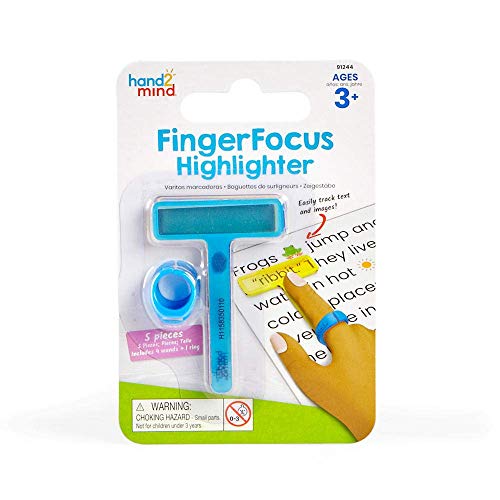
This option differs from flat overlays: it is a transparent wand that a reader moves along text, rather than a strip that covers a line or several lines. The maker says it can be used on pages and screens, and describes following words with a finger-pointing method to support sequential reading. Its individual-pack format suits readers who prefer an active pointer instead of a tinted viewing window.
The wand does not provide multiple overlay widths or a set of color choices, so it may not suit a reader specifically seeking a colored strip over the text. Its described approach also relies on moving the pointer as the reader progresses.
Bottom line: Choose this wand for a reader who prefers to point along words rather than overlay lines.
How to choose a reading strip for dyslexia
Choose by the amount of text the reader wants visible at once: a 1.3-inch-wide strip is intended for one line, while a 2.8-inch-wide strip is described for four to five lines. A moving pointer is a different approach, guiding the eye word by word without covering a full line. Start with the reading task: one-line practice, longer passages, or text on a screen can call for different formats.
Color is also personal rather than a universal setting. If a reader finds one tint distracting, try another, including a clear strip, and compare it on ordinary print and screen text. Colored overlays are reading aids; they do not diagnose dyslexia or replace instruction. When the reader is a child, use the guide as intended and keep small, thin pieces away from children who might chew or swallow them.
Reading strip sizes and line coverage
For a narrow reading window, choose a strip about 1.3 inches wide; for more surrounding text, a 2.8-inch width covers four to five lines according to the maker. Length matters too: the flat strips in these options are about 7.5 inches long, so check that this spans the text width the reader typically encounters. A simple rule is to begin with the one-line size when the goal is to isolate a line, and try the wider size only when keeping several lines visible is helpful.
The table separates coverage from format so a buyer can match the tool to the task without treating every reading aid as the same kind of strip. Screen use is specifically claimed for the wand-style option, not for every flat overlay; verify that a strip lies comfortably over the intended material.
| Format | Coverage | Consider when |
|---|---|---|
| Narrow flat strip | One line | Reader wants a focused line guide |
| Wide flat strip | Four to five lines | Reader prefers more text visible |
| Transparent wand | Word-by-word pointer | Reader tracks by moving a guide |
Colored overlays versus reading pointers
Flat overlays sit on the page and create a visual window, while a wand-style pointer moves along with the reader. The flat strip format is useful when the reader wants a stable guide over a line; the pointer format is suited to following words in sequence. These are different mechanics, not interchangeable claims of benefit, and the best match is the one the reader can use comfortably for the task.
For a fair comparison, distinguish physical format from color count and coverage. More colors do not mean a reader will find a better tint, and a wider guide is not automatically more helpful. Test the chosen format on the actual text, with enough lighting to read clearly and without covering words the reader needs to see.
Using and caring for reading strips
Place a flat guide so its viewing area aligns with the line being read, then move it down as the reader advances; a pointer instead moves along the words. Keep the guide flat and clean so its transparency remains useful, and avoid bending thin PVC sharply. For digital reading, use only a format the maker identifies for screens, and ensure the overlay does not interfere with touch controls or obscure important interface text.
These items are thin reading accessories rather than protective equipment. Keep them away from heat and supervise young children with small pieces, particularly if they tend to mouth classroom supplies. If a strip becomes cracked or has a sharp edge, stop using it and replace it.
Frequently Asked Questions
Do colored reading strips work the same for every reader?
No, preferred colors and coverage differ by reader and text. Compare a few tints over the same page, and choose the one that makes it easiest for that reader to keep a place.
How wide should a reading strip be for one line?
A strip about 1.3 inches wide is the single-line format among these options. A 2.8-inch width is intended to show about four to five lines instead.
Can a reading guide be used on a tablet screen?
The maker describes the wand-style highlighter as usable on pages and screens. Check that any physical guide does not obscure touch controls or make the display harder to read.
Are colored overlays a treatment for dyslexia?
No, colored reading guides are tools for following text, not a treatment or diagnosis for dyslexia. For persistent reading difficulties, seek guidance from a qualified educator or reading specialist.
How should thin reading strips be stored?
Store strips flat and away from heat, which can warp plastic. Keep them out of reach of children who may chew or swallow small classroom supplies.