
Recumbent Bike 400 lb Capacity: Models Compared

For a recumbent bike with a 400 lb capacity, Niceday Recumbent Bike is the clearest match because its 16 resistance levels and adjustable seat suit varied home routines. Choose another option if you want linked arm exercise or need a smaller bike; the models differ substantially in footprint and features.
We earn a commission if you buy through links on this page. As an Amazon Associate I earn from qualifying purchases. Products are compared on manufacturer specifications, not hands-on testing.
- Best overall: Niceday Recumbent Bike – Pairs a 400 lb capacity with 16 resistance levels and an adjustable seat.
- Best for quiet rides: 400 lb Recumbent Bike, Gray – Offers a claimed below-10 dB belt-driven system and 16 magnetic resistance levels.
- Best for arm exercise: Recumbent Bike with Arm Exerciser – Links arm and leg movement for seated full-body workouts.
| Product | Best for | Resistance levels | Overall size (L × W × H) | Weight | Shop |
|---|---|---|---|---|---|
| Niceday Recumbent Bike | Resistance variety | 16 | 50 × 23 × 45 in | 84 lb | Check Price on Amazon |
| 400 lb Recumbent Bike, Gray | Quiet training | 16 | 45 × 22 × 40 in | 51 lb | Check Price on Amazon |
| Recumbent Bike with Arm Exerciser | Arm-leg workouts | — | 24.6 × 55.1 × 47.2 in | 53.1 lb | Check Price on Amazon |
| TRMDDF Recumbent Bike | Compact footprint | 16 | 47.1 × 20.4 × 31 in | 35 lb | Check Price on Amazon |
Recumbent bikes with 400 lb capacity
Compare each bike’s resistance setup, dimensions and extra features before choosing a fit for your routine and space.
Niceday Recumbent Bike

Niceday Recumbent Bike combines a 400 lb capacity with 16 resistance levels, making it the most versatile match here for households that want to adjust workout effort. Its mechanical knob controls resistance, and the adjustable seat and heart-rate handle add basic fit and monitoring features. The maker also presents it as a low-impact option for mobility work. At 50 × 23 inches, it needs more floor length than some alternatives, so measure the intended space before choosing it.
Bottom line: Choose this if you want 16 resistance settings and can accommodate its 50-inch length.
400 lb Recumbent Bike, Gray
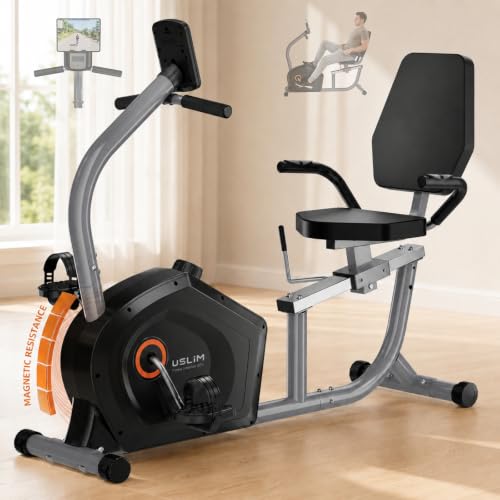
400 lb Recumbent Bike, Gray stands out for its maker-claimed below-10 dB belt-driven operation, a useful distinction for shared rooms or early workouts. The bike has 16 magnetic resistance levels and an adjustable padded seat and backrest, while its dimensions are 45 × 22 × 40 inches. The seat measures 12.60 × 10.24 inches. Its quieter operation is the main differentiator; buyers prioritizing an app or linked arm exercise should compare those features separately because they are not part of this model’s described feature set.
Bottom line: Pick this for a quieter claimed drive system and a 45-inch footprint.
Recumbent Bike with Arm Exerciser

Recumbent Bike with Arm Exerciser adds synchronized arm exercisers to leg pedaling, unlike the other confirmed-capacity models. It supports up to 400 lb and has a padded adjustable seat, magnetic resistance and an LCD monitor. Its unusual 55.1-inch width and 24.6-inch length make its footprint oriented differently from the other bikes, so check the floor plan carefully rather than judging fit by length alone.
Bottom line: Choose this for linked arm and leg movement, provided its wide footprint fits.
TRMDDF Recumbent Bike

TRMDDF Recumbent Bike is the lightest and narrowest option with a 400 lb capacity, at 35 lb and 20.4 inches wide. It also offers 16 magnetic resistance levels, a padded seat and an LCD monitor for straightforward home exercise. Its reported height is 31 inches, notably lower than the other bikes, so check ceiling or storage constraints against the actual assembled configuration.
Bottom line: Pick this for a lighter, narrower 16-level bike if its low overall height suits your space.
How to choose a 400 lb capacity recumbent bike
Start with the capacity rating, then compare resistance control, seat fit and footprint. A 400 lb rating is a maximum user-load figure, not a measure of how much workout intensity a bike provides. Magnetic resistance uses a magnet near the flywheel to change pedaling drag without contact; a belt-driven system transfers pedal motion to the flywheel and can reduce mechanical noise. More resistance levels give finer adjustment, but they do not establish a specific maximum workload. Measure the floor area and allow room to mount and dismount, especially around the seat and pedals.
Use a simple rule: if your available width is under 23 inches, only a model at or below that dimension fits on paper, but allow extra clearance for access. If capacity is a must, prioritize models with an explicit 400 lb rating rather than inferring it from a heavy frame.
Seat fit and bike dimensions
Seat travel and frame dimensions determine whether a recumbent bike fits both the rider and the room. For home bikes, the key fit measurement is the distance from the seat back to the pedal at its farthest point; the rider should reach the pedal with a slight knee bend rather than locking the knee. Seat adjustment positions alone do not establish a universal height range because rider inseam and crank geometry also matter.
Measure the intended footprint in length and width, then add clearance for getting on and off. Recumbent bikes usually have a low step-over design, but a particular frame’s access path can still be obstructed by furniture. If multiple riders will share one bike, prioritize quick seat adjustment and confirm the full rider-fit range before ordering.
Magnetic resistance and workout controls
Magnetic resistance changes pedaling effort by moving a magnet closer to or farther from the flywheel, so resistance levels are useful for matching a session to a rider’s ability. Sixteen levels provide more adjustment steps than eight, though the number alone does not reveal how heavy the top setting feels. Mechanical knobs and lever selectors also differ in how quickly a rider can change effort while seated.
Low-impact pedaling keeps the feet on the pedals and avoids the repeated impact of running, but it is still exercise with moving parts. Increase resistance gradually and stop if a movement causes pain or dizziness. Heart-rate handles provide a convenient contact point, but hand-contact readings are not a substitute for medical monitoring.
Recumbent bike capacity and safety
A 400 lb maximum capacity is a weight limit, not a guarantee that every rider will find the seat or pedal position comfortable. Keep the bike on a level, stable floor and use it only within its load rating; rocking, loose parts or frame movement are reasons to stop and inspect the setup. Recumbent bikes have rotating cranks and pedals, so keep loose clothing and hands clear of moving joints.
For rehabilitation or recovery, a recumbent position may feel easier to mount than an upright bike, but a home exercise bike is not a substitute for a clinician’s specific restrictions. Start with short sessions and low resistance when returning to activity. Keep children away from the pedals and adjustment mechanisms during use.
Frequently Asked Questions
How much room does a recumbent bike need?
Allow room for the full frame plus access beside the seat and pedals. A 50-inch-long frame needs more than 50 inches of usable floor length once mounting clearance is included.
Are 16 resistance levels enough for home exercise?
Sixteen settings provide finer steps than an eight-level system, which can help riders make smaller effort changes. The level count does not tell you the bike’s maximum resistance or exact workload.
How should a recumbent bike seat fit?
At the pedal’s farthest point, the knee should retain a slight bend rather than lock straight. Adjust seat distance for each rider; shared bikes need enough travel for the shortest and tallest users.
Is magnetic resistance quiet on a recumbent bike?
Magnetic resistance avoids friction at the flywheel, which typically makes it quieter than contact-based resistance. Belt, bearings, floor stability and cadence also affect the sound during a ride.
Can a 400 lb capacity bike be used for rehab?
A capacity rating only describes the maximum supported user load; it does not establish that a bike is appropriate for a particular recovery plan. Follow a clinician’s activity restrictions, and begin with low resistance when cleared.