
Rice Cooker Inner Pot: 3 Replacements Compared

Linkidea Aluminum Inner Pot suits the widest range of listed cookers because it names four compatible models and has a nonstick aluminum interior. Choose a different option if your cooker is not one of those models or you specifically want an uncoated stainless steel pot.
A rice cooker inner pot is the removable vessel that holds the rice and water during cooking; replacement pots are not universal, even when their capacity or shape looks similar.
We earn a commission if you buy through links on this page. As an Amazon Associate I earn from qualifying purchases. Products are compared on manufacturer specifications, not hands-on testing.
- Best overall: Linkidea Aluminum Inner Pot – Its compatibility list includes four Tiger and Zojirushi models.
- Best for dishwasher care: 304 Stainless Steel JBV-A10U Pot – The 304 stainless steel pot is described as dishwasher safe.
- Best for coating-free steel: Coating-Free 304 Steel JBV-A10U Pot – It specifies an uncoated 304 stainless steel interior for the JBV-A10U.
| Product | Best for | Compatible models | Material and surface | Capacity | Shop |
|---|---|---|---|---|---|
| Linkidea Aluminum Inner Pot | Multi-model compatibility | Tiger JBV-10CU, JBV-A10U; Zojirushi NS-WAC10 | Aluminum alloy, nonstick coating | 5.5 cups | Check Price on Amazon |
| 304 Stainless Steel JBV-A10U Pot | Dishwasher cleanup | Tiger JBV-A10U | 304 stainless steel | 5.5 cups | Check Price on Amazon |
| Coating-Free 304 Steel JBV-A10U Pot | Uncoated cooking surface | Tiger JBV-A10U | 304 stainless steel, uncoated | 5.5 cups uncooked | Check Price on Amazon |
Rice cooker inner pots compared
Match the cooker’s full model number first, then weigh material and cleaning preferences.
Linkidea Aluminum Inner Pot

Linkidea Aluminum Inner Pot names four compatible cooker models, while the other exact-fit options here name only Tiger JBV-A10U. Its aluminum-alloy body has a nonstick coating, and the 5.5-cup capacity is intended for the cooker models rather than serving as a universal sizing guide. The maker also describes it for rice, grains, soups and stews. Choose it if your cooker model appears in the compatibility list and you prefer a coated surface. Its key limitation is model-specific fit: confirm the complete model number, since matching brand or capacity alone is not enough.
Bottom line: Pick this if your cooker is one of the four named models and you want a nonstick-coated pot.
304 Stainless Steel JBV-A10U Pot

304 Stainless Steel JBV-A10U Pot pairs Tiger JBV-A10U compatibility with dishwasher-safe cleaning, a combination that sets it apart from the aluminum replacement. The pot is made from 304 stainless steel, and the maker says it is designed as a snug replacement bowl for that cooker. Its model match makes it a candidate only for JBV-A10U owners; it is not a general 5.5-cup replacement. The maker does not establish a pot diameter or height, so buyers who need to compare physical dimensions should verify those measurements before ordering.
Bottom line: Pick this if you own a JBV-A10U and prioritize dishwasher-safe stainless steel.
Coating-Free 304 Steel JBV-A10U Pot
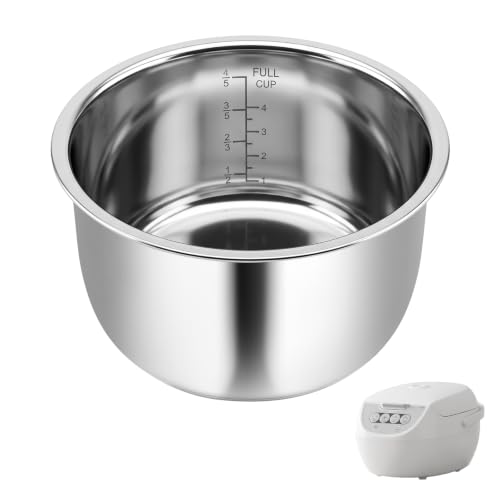
Coating-Free 304 Steel JBV-A10U Pot is the explicit coating-free choice for Tiger JBV-A10U: its 304 stainless steel surface has no nonstick coating. The maker presents it as a replacement for a worn or scratched original bowl. Choose it when avoiding a coating matters more than having a broader compatibility list.
Bottom line: Pick this if your cooker is a JBV-A10U and you want an uncoated steel surface.
How to choose a replacement rice cooker inner pot
Choose by the cooker’s complete model number before comparing material or capacity. Rice cooker pots are shaped for a specific heating chamber, and matching a brand name or cup count does not guarantee the rim, base or sensor will line up. Check the appliance label for the full model code, then compare it with the pot’s compatibility statement. Capacity labels can also be ambiguous: rice-cooker cups commonly refer to a small 180 mL measuring cup, not a US 240 mL cup. For this reason, a 5.5-cup capacity is not a substitute for model fit. If the model number is absent from a compatibility list, verify the fit before ordering.
Aluminum and stainless steel inner pots
Material determines the cooking surface and care tradeoff, but it does not determine whether a pot fits. Aluminum conducts heat readily and is often paired with a nonstick coating; stainless steel can be supplied with or without a coating. Avoid assuming that every steel pot is coating-free or dishwasher-safe: verify those specific traits on the candidate pot. A coated surface can be damaged by metal utensils or abrasive scouring pads, so use a soft utensil and sponge when care guidance is unavailable. A decision rule: choose a coating-free steel pot only when its cooker model matches and you are comfortable cooking without a nonstick surface.
The comparison below summarizes the purchase choices by construction and capacity rather than implying cross-model interchangeability.
| Construction | Examples here | Key fit point |
|---|---|---|
| Coated aluminum | 5.5-cup Linkidea | Four named models |
| 304 stainless steel | Two JBV-A10U options | Tiger JBV-A10U only |
How to check pot size and shape
Check the replacement pot’s diameter, height, base shape and rim against the original when model compatibility alone is uncertain. A cooker relies on the inner pot sitting flat against its heating plate; a pot that is too narrow, tall or uneven can sit incorrectly and interfere with normal heating. Measure the original across the widest top opening and from the bottom exterior to the rim, using inches, and compare like-for-like measurements. Include the base contour and rim profile, not just the top diameter. A measurable decision rule is to stop if any key dimension or base shape differs from the original; do not force a pot that does not seat easily.
Frequently Asked Questions
Can rice cooker inner pots be used across brands?
Only when the replacement explicitly matches the cooker model or its dimensions and shape have been confirmed. Brand and cup capacity by themselves do not establish fit.
What does a 5.5-cup rice cooker capacity mean?
Rice cooker capacity commonly uses a 180 mL rice-cooker measuring cup rather than a US 240 mL cup. Treat the capacity as a cooker-size clue, not proof that a replacement bowl fits.
How should I measure a rice cooker inner pot?
Measure the widest top diameter and the exterior height from bottom to rim in inches, then compare the base and rim shapes too. A matching top width alone cannot confirm that the pot will sit correctly.
Can I use metal utensils on a coated inner pot?
Avoid metal utensils on a coated cooking surface because they can scratch or damage the coating. A soft utensil and nonabrasive sponge are safer choices when the maker’s care directions are unavailable.