
RJ45 Connectors for Cat6: 3 Plugs Compared

For most custom Cat6 UTP cables, Cable Matters Cat6 Pass-Through, 100-Pack stands out because it supports 23–24 AWG conductors and is rated for 10Gbps. Choose CableCreation Cat6 RJ45, 100-Pack or ZOERAX Cat6 Pass-Through, 100-Pack instead if your cable is 24–26 AWG or has a round or flat stranded design.
These 8P8C modular plugs, commonly called RJ45 connectors, terminate individual Ethernet cable ends; selecting one that matches conductor gauge and cable construction matters more than the pack count.
We earn a commission if you buy through links on this page. As an Amazon Associate I earn from qualifying purchases. Products are compared on manufacturer specifications, not hands-on testing.
- Best overall: Cable Matters Cat6 Pass-Through, 100-Pack – Supports 23–24 AWG conductors and is rated for 10Gbps.
- Best for 24–26 AWG cable: CableCreation Cat6 RJ45, 100-Pack – Fits solid or stranded UTP, including round or flat stranded cable.
- Best for mixed cable types: ZOERAX Cat6 Pass-Through, 100-Pack – Supports 24–26 AWG stranded wire and 23 AWG solid wire.
| Product | Best for | Wire gauge | Cable compatibility | Shop |
|---|---|---|---|---|
| Cable Matters Cat6 Pass-Through, 100-Pack | 23–24 AWG UTP | 23–24 AWG | Solid or stranded UTP | Check Price on Amazon |
| CableCreation Cat6 RJ45, 100-Pack | 24–26 AWG cable | 24–26 AWG | Solid or stranded UTP; round or flat stranded | Check Price on Amazon |
| ZOERAX Cat6 Pass-Through, 100-Pack | Stranded or 23 AWG | 24–26 AWG stranded; 23 AWG solid | Round or flat stranded; up to 6.1 mm diameter | Check Price on Amazon |
Cat6 RJ45 connectors compared
Match the plug’s supported gauge and cable construction to the cable you plan to terminate.
Cable Matters Cat6 Pass-Through, 100-Pack
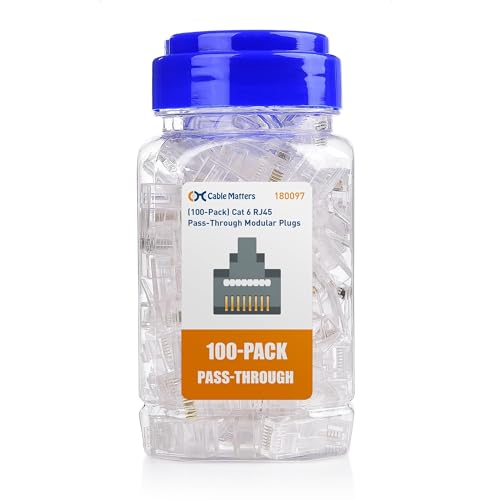
Cable Matters Cat6 Pass-Through, 100-Pack is the broadest fit for heavier-gauge conductors among these plugs, supporting 23–24 AWG UTP cable and insulated conductors 0.97–1.07 mm in diameter. Its pass-through opening lets wires extend through the plug before crimping, which can simplify trimming and checking wire order. Cable Matters rates the connectors for 10Gbps Ethernet. This option suits custom cable runs where the cable meets its supported dimensions; the 6.1 mm maximum cable diameter is a constraint to verify before ordering. The 100-pack also makes sense when terminating multiple cables.
Bottom line: Choose this for 23–24 AWG UTP cable with conductors within its specified dimensions.
CableCreation Cat6 RJ45, 100-Pack

CableCreation Cat6 RJ45, 100-Pack distinguishes itself by accepting 24–26 AWG solid or stranded UTP, including round or flat stranded cable. That makes it a candidate for lighter-gauge patch cable that does not fit a plug intended for thicker conductors. CableCreation describes the contacts as three-pin and says the plugs support Gigabit Ethernet and Cat5e backward compatibility. The performance is Gigabit rather than 10Gbps, so choose another option if the product rating needs to match a 10Gbps target. Confirm your cable is unshielded and within the supported gauge range.
Bottom line: Choose this for 24–26 AWG UTP, especially round or flat stranded cable.
ZOERAX Cat6 Pass-Through, 100-Pack

ZOERAX Cat6 Pass-Through, 100-Pack covers two cable cases with a clear distinction: it accepts 24–26 AWG stranded wire, including round or flat construction, and 23 AWG solid cable. Its pass-through design feeds the conductors through the plug for crimping, and its maximum cable outer diameter is 6.1 mm. ZOERAX rates it for Gigabit Ethernet and backward compatibility with Cat5e. The gauge support is not interchangeable across solid and stranded conductors, so check both the wire type and gauge before choosing it; this matters especially if terminating solid 24–26 AWG cable.
Bottom line: Choose this when you need 24–26 AWG stranded or 23 AWG solid cable support.
How to choose Cat6 RJ45 connectors
Start with the cable’s conductor gauge, construction, and jacket diameter, then match those measurements to the plug. Cat6 cable uses four twisted pairs, and each pair’s twist should be preserved close to the termination; excessive untwisting can impair performance. Standard Ethernet wiring uses T568A or T568B pin assignments, and both ends of a typical patch cable should use the same scheme. Pass-through plugs make wire order visible at the front before crimping, but the tool must trim the exposed conductors flush. Pick a plug only when its gauge and cable construction match your cable; otherwise, the contact blades may not seat as intended.
Cat6 cable length and speed limits
A Cat6 Ethernet channel is limited to 100 meters (328 feet), including patch cords, for standard 1Gbps Ethernet; the permanent in-wall link is typically limited to 90 meters (295 feet). Cat6 can support 10Gbps over shorter distances, commonly up to 55 meters (180 feet), depending on installation conditions and alien crosstalk. A connector’s speed rating alone does not make a complete run meet that performance: cable category, termination quality, and equipment all matter. For long 10Gbps runs, do not assume that a 10Gbps-rated plug guarantees a 100-meter Cat6 link.
Pass-through plugs and wiring mistakes
Pass-through connectors let the eight conductors protrude through the nose so you can check their sequence before crimping; the tool then cuts them. T568B order is white-orange, orange, white-green, blue, white-blue, green, white-brown, brown. T568A swaps the green and orange pairs. Use one scheme at both cable ends for a straight-through patch cable, and avoid mixing pair positions based on color alone. Keep pair twists close to the contacts and inspect that no copper extends beyond the trimmed plug face. A pass-through plug needs a compatible crimper with a trimming blade; a standard crimper may not cut the wires flush.
When to replace a terminated Ethernet end
Re-terminate a damaged or poorly seated plug rather than repeatedly bending its latch or forcing it into a port. The plug’s eight contacts should align with the eight conductors, and the cable jacket should reach under the strain-relief area so a pull does not load the individual wires. For permanent building cabling, a keystone jack and patch cord are often a better fit than crimping a plug directly onto solid in-wall cable; stranded patch cable is generally used for flexible cords. After termination, a basic wire-map tester can identify opens, shorts, and reversed pairs, though it cannot certify Cat6 bandwidth.
Frequently Asked Questions
What does RJ45 mean on a Cat6 plug?
RJ45 is the common name for the 8-position, 8-contact modular plug used for Ethernet. Cat6 describes the cabling category, not a different connector shape.
Can I use Cat6 RJ45 connectors on Cat5e cable?
Many Cat6 plugs are backward compatible with Cat5e, but the plug must also match the cable’s gauge and construction. Check those physical characteristics before terminating.
Should both ends use T568A or T568B?
Use the same wiring scheme on both ends for a standard straight-through patch cable. T568A and T568B differ by swapping the green and orange pairs.
How much Cat6 cable can carry 10Gbps?
Cat6 commonly supports 10Gbps Ethernet up to 55 meters (180 feet), with the achievable distance affected by installation and crosstalk. The usual 100-meter (328-foot) channel limit applies to 1Gbps.
Do pass-through RJ45 plugs need a special crimper?
Use a pass-through-compatible crimper with a blade that trims the wires at the plug face. Without a flush cut, exposed conductor ends can create termination problems.