
Rockville 15 Inch Speakers: Powered and Passive Options

For most setups, Rockville DX15 Powered Pair is the most straightforward Rockville 15 inch speaker choice because its powered design and built-in two-channel mixer reduce the need for a separate amplifier and mixer. Choose Rockville RSG15 with SBG1158 Subwoofers or Rockville RSG15.28 Dual-15 Pair instead if you already have suitable amplification and want passive cabinets, or Rockville RAM15BT V2 when battery-powered portability matters more than continuous mains power.
We earn a commission if you buy through links on this page. As an Amazon Associate I earn from qualifying purchases. Products are compared on manufacturer specifications, not hands-on testing.
- Best overall: Rockville DX15 Powered Pair – Powered 15-inch pair with a built-in two-channel mixer and 500W RMS per speaker.
- Best for battery use: Rockville RAM15BT V2 – Rechargeable design claims 4–8 hours of playtime and includes two wireless microphones.
- Best for passive output: Rockville RSG15.28 Dual-15 Pair – Each passive cabinet has dual 15-inch woofers and 1500W RMS power handling.
| Product | Best for | Type | Power per speaker | Standout feature | Shop |
|---|---|---|---|---|---|
| Rockville DX15 Powered Pair | Powered PA setup | Powered | 500W RMS | Two-channel mixer | Check Price on Amazon |
| Rockville RSG15 with SBG1158 Subwoofers | Full PA bundle | Passive | 750W RMS | Subwoofers and poles | Check Price on Amazon |
| Rockville RAM15BT V2 | Battery portability | Powered, rechargeable | 200W RMS | Bluetooth and wireless mics | Check Price on Amazon |
| Rockville BPA15 | Portable powered speaker | Powered | 200W RMS | Bluetooth and wheels | Check Price on Amazon |
| Rockville RSG15.28 Dual-15 Pair | Dual-woofer passive | Passive | 1500W RMS | Dual 15-inch woofers | Check Price on Amazon |
Rockville 15 Inch Speakers Compared
Choose by whether you need built-in amplification, battery operation or passive cabinets for an existing PA system.
Rockville DX15 Powered Pair

Rockville DX15 Powered Pair differs from the passive cabinets because each speaker has its own Class-D amplifier, rated at 500W RMS, plus a two-channel mixer. The pair includes two 15-inch powered speakers with XLR and 1/4-inch mic and line inputs, XLR output, and dual 35 mm pole-mount sockets. The maker specifies a 3-inch voice coil on the woofer, a 1.75-inch titanium compression driver, and a 2,000 Hz crossover. This suits DJs or event setups that need amplification built into the cabinets. It still needs AC power, so it is less suitable where outlets are unavailable.
Bottom line: Choose this pair for a mains-powered PA that needs integrated mixing and amplification.
Rockville RSG15 with SBG1158 Subwoofers

Unlike the powered pairs, Rockville RSG15 with SBG1158 Subwoofers is a passive system bundle that combines two RSG15 tops with two SBG1158 subwoofers and two 20-inch mounting poles. Each top has a 15-inch woofer, four piezo bullet tweeters and a compression horn; the maker gives 750W RMS per top, 8-ohm impedance, and 102 dB sensitivity. SpeakON and 1/4-inch inputs allow connection to an external amplifier. This is suited to buyers building a larger PA with separate amplification and dedicated subwoofers. Its passive design means the amplifier and speaker cables are separate requirements.
Bottom line: Choose this bundle if you want matching passive tops, subwoofers and poles.
Rockville RAM15BT V2

Rockville RAM15BT V2 stands apart with a built-in rechargeable battery, wheels, carry handles and two included VHF wireless microphones. The maker claims 4–8 hours of playtime depending on volume, and its 15-inch powered cabinet supports Bluetooth, USB/SD/MMC playback, FM radio and TWS stereo linking with a second unit. It is a fit for mobile speech or music where access to an outlet is limited. The battery runtime changes with volume, so it is a less predictable choice for long events than a speaker connected to mains power.
Bottom line: Choose it for mobile use when rechargeable operation and included microphones matter.
Rockville BPA15
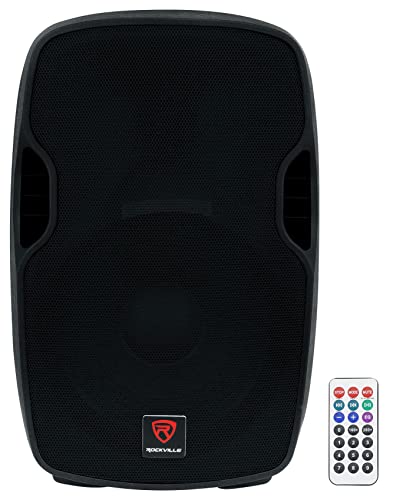
Rockville BPA15 is a single powered speaker with a 15-inch woofer, a 1-inch titanium-diaphragm compression driver, Bluetooth and built-in USB/SD MP3 playback. It weighs 39.5 pounds and includes wheels, handles, XLR and 1/4-inch mic inputs, RCA and 1/8-inch aux inputs, and an XLR line output. A two-band EQ provides simple tone adjustment without an external processor. This suits users wanting several playback choices and built-in transport features in one cabinet. Its 200W RMS rating is lower than the DX15 pair’s 500W RMS per speaker, so it is not the match for buyers prioritizing higher rated output.
Bottom line: Choose this single cabinet for varied built-in playback and wheeled transport.
Rockville RSG15.28 Dual-15 Pair

For buyers seeking passive cabinets with two large drivers each, Rockville RSG15.28 Dual-15 Pair pairs dual 15-inch woofers with four 3-inch piezo bullets and a piezo horn. Each cabinet is rated at 1500W RMS, has 8-ohm impedance and 105 dB sensitivity, and includes SpeakON and 1/4-inch input and output connections for daisy-chaining. Carpeted MDF enclosures, steel grilles, corner protectors and recessed handles suit transport between venues. This is for a system with an external amplifier sized for the cabinets’ impedance and power handling. Unlike Rockville RSG15 with SBG1158 Subwoofers, the pair does not include matching subwoofers or speaker poles.
Bottom line: Choose this pair when dual-woofer passive cabinets matter more than an all-in-one bundle.
How to choose powered or passive 15-inch speakers
Powered speakers suit setups that need amplification inside each cabinet; passive speakers require an external power amplifier. Match passive speaker impedance and power handling to the amplifier: these Rockville passive options are 8 ohms, but their RMS ratings differ substantially. A single 8-ohm cabinet connected to an amp channel draws less current than a 4-ohm load; check the amplifier’s minimum stable impedance before connecting multiple cabinets in parallel. Powered models simplify matching because their amplification is built in, but each still needs electrical power. Choose battery operation only when portability away from outlets is central; the rechargeable model’s maker-stated runtime depends on volume.
What the power ratings mean
RMS, program and peak ratings are not interchangeable. RMS is the more useful figure for comparing continuous power handling or output claims; peak figures describe brief transients and can make models look more alike than they are. A passive cabinet’s power-handling rating is not the amplifier’s required output, and the amplifier should not be driven into clipping to chase a headline wattage. Sensitivity also matters: a 3 dB increase in sensitivity can produce about the same sound pressure as doubling amplifier power under comparable conditions. For a permanent installation, leave headroom and use an amplifier appropriate to the speaker load.
Inputs and setup for a PA speaker
Microphone inputs, line inputs and speaker-level connections serve different signals. XLR and 1/4-inch inputs on powered PA speakers can accept mic or line signals where the control supports it; passive speaker terminals connect to an amplifier’s speaker output, never directly to a phone or mixer line output. A 35 mm pole mount is common for raising a PA cabinet above seated listeners, while a subwoofer pole needs a stable, compatible socket. Keep speaker cables away from mains cords where practical, secure stands on level ground, and do not exceed a stand’s rated load. Before ordering a passive system, confirm the amplifier’s impedance compatibility and required cable connectors.
Choosing a 15-inch PA cabinet for its job
A 15-inch woofer is a common full-range PA size, but it does not guarantee deep bass or even coverage by itself. Horn design, crossover, cabinet tuning, room size and placement all affect the result. For speech, prioritize clear midrange and raise the cabinet’s horn above head height; for bass-heavy music, a dedicated subwoofer can carry low frequencies and reduce strain on the tops. Battery cabinets favor quick mobile setups, while paired powered cabinets suit stereo coverage and passive bundles suit systems already built around separate amplification. Keep heavy cabinets secured during transport, use two people for large or awkward lifts, and never place a cabinet where it can fall onto an audience.
Frequently Asked Questions
Do powered PA speakers need an external amplifier?
Powered PA speakers have amplification built into the cabinet, so they take a line-level audio source rather than a separate speaker-amplifier output. They still need mains power unless the model has a battery.
Can I connect an 8-ohm speaker to any amplifier?
An 8-ohm speaker works only if the amplifier supports an 8-ohm load on that channel. Check the amplifier’s minimum impedance before connecting two cabinets in parallel, since the combined load can be lower.
How high should I place a PA speaker?
For speech in a typical room, place the speaker so its high-frequency driver is above seated listeners’ heads and aimed toward the audience. A pole stand must be level, stable and rated for the cabinet’s weight.
Does a 15-inch speaker always need a subwoofer?
No; a full-range 15-inch PA cabinet can cover many speech and general music uses without a subwoofer. Bass-heavy music and larger rooms benefit more from dedicated subs, with crossover and placement adjusted to the room.