
Rubber Battery Terminal Covers: 3 Types Compared

For most standard top-post batteries, Red/Black Rubber Terminal Covers, 6-Pack is the best starting point because its red and black rubber covers are sized for positive and negative terminals. Choose Ampper Military-Spec Top-Post Cover Pair instead for military-spec posts; its larger shape is not intended for standard terminals.
Battery terminal covers are insulating boots that shield exposed posts and cable connections. Match the boot to the terminal style and cable route before choosing a set.
We earn a commission if you buy through links on this page. As an Amazon Associate I earn from qualifying purchases. Products are compared on manufacturer specifications, not hands-on testing.
- Best overall: Red/Black Rubber Terminal Covers, 6-Pack – A red-and-black rubber set intended to distinguish positive and negative terminals.
- Best for military-spec posts: Ampper Military-Spec Top-Post Cover Pair – The flexible covers are made for military-spec terminals and accept cable up to 4/0 gauge.
- Best for a multi-piece set: Red/Black Rubber/PVC Terminal Covers, 6-Pack – The set includes six covers, with three red and three black.
| Product | Best for | Material | Quantity | Terminal fit | Shop |
|---|---|---|---|---|---|
| Red/Black Rubber Terminal Covers, 6-Pack | Standard top posts | Rubber | 6 covers | Top post | Check Price on Amazon |
| Ampper Military-Spec Top-Post Cover Pair | Military-spec posts | Flexible rubber | 1 red/black pair | Military-spec top post | Check Price on Amazon |
| Red/Black Rubber/PVC Terminal Covers, 6-Pack | Six-piece set | Rubber/PVC | 6 covers | Universal top post | Check Price on Amazon |
Rubber Battery Terminal Covers
Compare the cover material, set size and terminal style before selecting a boot for your battery connections.
Red/Black Rubber Terminal Covers, 6-Pack

For a straightforward red-and-black set, these six soft rubber covers include both colors for distinguishing positive and negative terminals. The maker says the insulating rubber is wear-resistant and heat-resistant, and that the covers help reduce exposure to air and stud wear. This set suits buyers seeking basic post protection for a car, motorcycle or truck. The measurements are 3.5 inches long, 2.5 inches wide and 0.25 inch high; confirm the cover shape and clearance against your terminal before ordering, since the measurements alone do not establish a precise post fit.
Bottom line: Choose this set for color-coded rubber covers when your battery has a compatible top-post layout.
Ampper Military-Spec Top-Post Cover Pair

Unlike general top-post boots, this pair is specifically made for military-spec battery terminals and includes matching red and black washers. The flexible rubber covers have inner dimensions of 2.1 by 1.7 inches or 2.36 by 1.1 inches, and the cable opening accommodates cable up to 4/0 gauge. That makes this the relevant choice when the terminal is the larger military-spec style and the cable needs room to enter the cover. It is not for standard battery terminals, so check the terminal style rather than assuming all top posts are interchangeable.
Bottom line: Choose this pair only when your battery uses military-spec posts and the cable fits its opening.
Red/Black Rubber/PVC Terminal Covers, 6-Pack
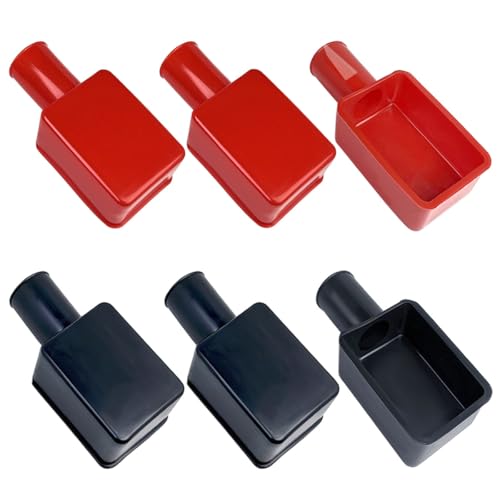
This set differs from the single red-and-black pair by supplying three covers of each color. The maker describes the soft rubber/PVC boots as flexible and intended for standard top-post batteries in cars, trucks, motorcycles, RVs and boats; it also says they help insulate against incidental contact, dust and moisture. The six-piece count may suit a buyer who wants spare covers or needs several connections covered. Because the material is given as rubber/PVC rather than a single material, choose it for the top-post fit and set quantity, not a preference for rubber composition alone.
Bottom line: Pick this set when six color-coded covers are more useful than a single pair.
How to choose battery terminal covers
Choose by terminal shape first, then check the cable opening and boot coverage. A boot must cover exposed conductive connection points without pulling the cable sideways or preventing the clamp from seating. Red is conventionally used to identify positive and black negative, but color alone is not a substitute for checking the battery’s polarity marks before making a connection. Battery posts and cable lugs come in different shapes, so a general top-post cap is not automatically a fit for a military-spec terminal. If a boot cannot sit fully over the connection without force, do not stretch it into place; match the cover to the terminal style instead.
For vehicle batteries, allow room for the cable bend and the surrounding hold-down or nearby components. A cover that fits the post but is pinched by a hood or enclosure can shift or tear.
Standard and military-spec post fit
Standard top posts and military-spec terminals are different sizes, so identify the terminal style before choosing a cover. Military-spec posts use larger terminal hardware than common automotive top posts; covers made for one style may not seat correctly on the other. The Ampper pair is explicitly for military-spec posts, while the other included options are general top-post sets. Cable clearance also matters: the military-spec pair accepts cable up to 4/0 gauge, but that does not guarantee fit for every lug shape or routing angle. Compare both the post dimensions and the route through the cover opening. A measurable decision rule is simple: if your connection is military-spec, use a boot identified for that style; if it is standard, avoid the military-only pair.
What battery terminal covers protect against
Battery terminal covers provide an insulating barrier over exposed conductive connections, which can reduce the chance of an accidental short from a tool or other metal object. Keep the cover material away from the actual contact surfaces between the post and clamp: those surfaces need a secure metal-to-metal connection. Corrosion often appears as a powdery deposit around battery terminals; inspect connections during routine battery checks and clean them only with the vehicle powered down and the appropriate precautions. A cover does not repair a loose clamp or corroded connection. Confirm the battery is disconnected according to the vehicle procedure before working near terminals, and reconnect positive and negative in the correct order specified by the vehicle maker.
Common fit mistakes to avoid
The most common mistake is buying by color or pack count without verifying terminal style. A cover can be red and black yet still have the wrong opening for the post or cable lug. Another mistake is treating the cover as a replacement for a properly tightened terminal clamp; the boot insulates, while the clamp makes the electrical connection. Do not force a tight boot across sharp cable edges, since stretching or abrasion can damage its insulating layer. Before installation, check that the cable reaches naturally, the cover fully shields exposed metal, and nearby parts do not compress it. If the cable gauge or terminal shape is uncertain, measure the connection and confirm the boot’s usable opening before selecting it.
Frequently Asked Questions
Can battery terminal covers cause a poor connection?
A cover should not sit between the battery post and the clamp’s contact surfaces. Install the boot over the completed connection so the clamp can seat firmly against the post.
Should positive and negative terminals use different colors?
Red commonly identifies positive and black identifies negative on battery accessories. Verify the battery’s polarity markings before connecting cables because color coding is only a visual aid.
How do I tell military-spec battery posts from standard posts?
Military-spec terminal hardware is larger than common automotive top-post hardware. Check the terminal style and dimensions before buying; a boot expressly marked for military-spec posts may not fit a standard post.
Can a terminal cover replace a battery clamp?
No, the cover is an insulating barrier, not an electrical connector. The clamp must make a secure metal-to-metal connection with the battery post before the boot covers it.