
Scissors for Metal Cutting: 4 Shears Compared

For most sheet-metal work, HURRICANE 10-Inch Straight-Cut Snips is the closest match because its straight-cut blades are rated for up to 20-gauge cold-rolled steel. Choose a different tool if you need tight curves or circles, or want general-purpose shop shears rather than aviation snips.
Aviation snips use short, compound-leverage blades to cut sheet metal; straight-cut versions work best for straight lines and broad curves.
We earn a commission if you buy through links on this page. As an Amazon Associate I earn from qualifying purchases. Products are compared on manufacturer specifications, not hands-on testing.
- Best overall: HURRICANE 10-Inch Straight-Cut Snips – Its straight-cut blades handle up to 20-gauge cold-rolled steel and 22-gauge stainless steel.
- Best for a safety latch: Amazon Basics Straight-Cut Aviation Snips – The latch locks the handles closed and releases with one hand.
| Product | Best for | Cold-rolled steel capacity | Stainless steel capacity | Shop |
|---|---|---|---|---|
| HURRICANE 10-Inch Straight-Cut Snips | Thin sheet metal | 20 gauge | 22 gauge | Check Price on Amazon |
| Amazon Basics Straight-Cut Aviation Snips | Latch storage | 18 gauge | 22 gauge | Check Price on Amazon |
| 10-Inch Cr-V Straight-Cut Aviation Snips | Gentle curves | 18 gauge | 22 gauge | Check Price on Amazon |
| TOOLMAK 8-Inch Straight Tin Snips | Compact handling | — | — | Check Price on Amazon |
Scissors for Metal Cutting Compared
Match the blade style and rated sheet thickness to the shape and material of your project.
HURRICANE 10-Inch Straight-Cut Snips
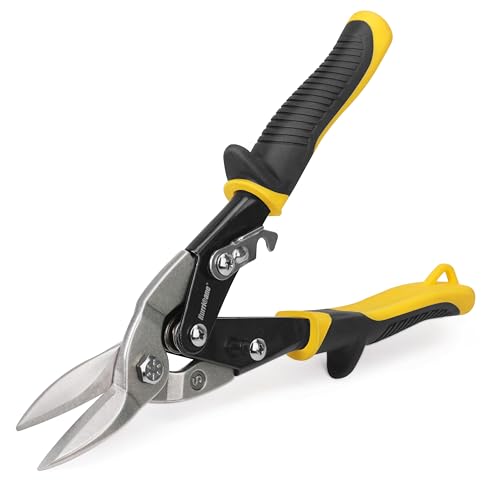
HURRICANE 10-Inch Straight-Cut Snips is the only snip here rated for 20-gauge cold-rolled steel, while its stainless-steel limit is 22 gauge. The 10-inch aviation design has Cr-V blades with micro-serrations intended to grip thin sheet metal, and the straight-cut profile also handles wide, gentle curves. It suits duct, gutter, and similar sheet work where those cuts fit the job. Its limits exclude hardened steel, rods, and wire mesh, and the straight blades are not for tight circles or sharp angles.
Bottom line: Pick this for thin sheet work when the 20-gauge cold-rolled-steel rating matters.
Amazon Basics Straight-Cut Aviation Snips

Amazon Basics Straight-Cut Aviation Snips adds a safety latch that keeps the handles shut when the tool is stored, with a one-handed auto-release for opening. Its high-leverage straight-cut design uses heat-treated Cr-V steel blades and a rubberized grip. The maker rates it for 18-gauge cold-rolled steel and 22-gauge stainless steel, and also says it can cut materials such as thin PVC and metal wire. This is a useful choice when closed-handle storage is important, but it does not match the 20-gauge cold-rolled-steel rating of HURRICANE 10-Inch Straight-Cut Snips.
Bottom line: Choose this if a locking latch and multi-material use are priorities.
10-Inch Cr-V Straight-Cut Aviation Snips

10-Inch Cr-V Straight-Cut Aviation Snips explicitly pairs straight cuts with smooth, gentle curves, making it a fit for sheet jobs that change direction without requiring tight turns. Its Cr-V blades have serrated edges, and the hardness is 58–62 HRC. The maker rates the snips for up to 18-gauge cold-rolled or galvanized sheet and 22-gauge stainless steel; the features also name copper, aluminum, plastic, cardboard, chicken wire, and hardware cloth. Its 18-gauge cold-rolled rating is lower than HURRICANE 10-Inch Straight-Cut Snips’s, so compare the material thickness before choosing.
Bottom line: Pick this for straight runs and broad curves across the named materials.
TOOLMAK 8-Inch Straight Tin Snips

TOOLMAK 8-Inch Straight Tin Snips is the shortest tool here at 8 inches, with stainless-steel blades and a serrated edge intended to reduce slipping. Its right-hand design includes TPR-covered grips, a self-tensioning spring, and a safety lock. The features name thin iron among its uses, but give no gauge capacity, so this option is harder to match to a specified sheet thickness than the rated 10-inch snips. Choose it for a compact straight-blade tool when the material is thin and you can verify it is within the cutting range.
Bottom line: Pick this for compact handling when the sheet thickness is confirmed first.
How to choose scissors for cutting metal
Choose aviation snips by cut direction and the sheet’s thickness, not by overall tool length alone. Straight-cut snips suit long lines and broad curves; left- and right-cut patterns are designed to turn more easily in their respective directions. A gauge rating is meaningful only for the named metal: stainless steel is harder to cut than cold-rolled steel at the same gauge. For these tools, compare the steel type and gauge before cutting, and do not treat a rating for one metal as a rating for another.
Use this selection rule: if the sheet exceeds the tool’s gauge capacity, select a tool rated for that material and thickness rather than forcing the cut. For tight circles or sharp corners, straight-cut aviation snips are the wrong profile; choose a snip pattern intended for directional curves.
Understand sheet-metal gauges
Gauge numbers run in reverse: a lower gauge number means thicker sheet. For cold-rolled steel, 18 gauge is about 0.048 inch and 20 gauge is about 0.036 inch; stainless steel uses a different gauge-to-thickness chart, so do not transfer those measurements across metals. Galvanized sheet is steel with a zinc coating, and its cut rating should be checked separately when a tool gives one.
Before cutting, identify the base metal and measure thickness with a caliper if the material is unlabeled. A one-gauge difference can be enough to put a sheet outside a snip’s rating. Sheet edges and offcuts are sharp, so wear cut-resistant gloves and eye protection, and keep hands out of the closing blade path.
Match the snip style to the cut
Straight-cut aviation snips are most predictable on straight lines and gentle arcs; they are not a substitute for a snip made to turn through tight curves. Conventional aviation snips generally come in straight, left-cut, and right-cut patterns, with the color coding commonly used to distinguish patterns rather than guarantee cutting capacity. Always use the tool’s actual pattern and metal rating as the deciding criteria.
The table gives a practical match by design, not a substitute for checking the gauge against your sheet.
| Cut or need | Snip choice | Why it fits |
|---|---|---|
| Long straight seam | Straight-cut | Blade direction tracks a straight line |
| Broad curve | Straight or directional aviation snip | Check that the product names broad-curve use |
| Tight circle or sharp turn | Left- or right-cut pattern | Straight-cut models may not turn cleanly |
| Unrated sheet thickness | Gauge-rated snip for that metal | Capacity needs to match material and thickness |
Cut safely and keep blades working
Metal snips can leave burrs and sharp offcuts, so wear eye protection and cut-resistant gloves and support the sheet so it cannot spring into your hand. Keep fingers behind the handles and away from the blade line; never use tin snips on metal rods, hardened steel, or wire unless the tool is specifically rated for that material. A snip’s short blades are for sheet, not prying or twisting.
After cutting, remove metal chips and wipe the blades dry before storing the tool closed. A clean, dry blade helps limit corrosion and keeps residue from interfering with the serrations. If the snips bind, slip, or leave a ragged edge, stop and check that the sheet is within capacity and that the blade edges are undamaged rather than forcing the cut.
Frequently Asked Questions
What gauge metal can aviation snips cut?
Aviation snip capacity varies by metal and tool: these models are rated from 18- to 20-gauge cold-rolled steel and up to 22-gauge stainless steel. Check the rating for the exact metal because gauge-to-thickness conversion differs by material.
Are straight-cut tin snips good for curves?
Straight-cut tin snips can handle broad, gentle curves, but they are not intended for tight circles or sharp angles. Choose left- or right-cut aviation snips when the path requires a tighter directional turn.
What is the difference between left and right cut snips?
Left- and right-cut snips are shaped to turn more naturally in opposite directions, while straight-cut snips favor straight runs and broad arcs. The color convention is common but not universal, so confirm the actual cut pattern.
Can I cut stainless steel with tin snips?
Some aviation tin snips are rated for stainless steel, commonly at a thinner gauge than their cold-rolled-steel rating. For example, the tools here cite 22-gauge stainless steel; do not assume a steel capacity applies to stainless.
How do I reduce slipping while cutting sheet metal?
Use sharp, serrated snips rated for the sheet and keep the material supported close to the cut line. Wear eye protection and cut-resistant gloves because freshly cut sheet edges and offcuts can be sharp.