
Screw and Nail Organization: 4 Storage Options Compared

For portable screw and nail organization, choose Jack Boss Double-Sided Organizer, 2-Pack if you want two clear-lid cases with removable dividers; its double-sided design and 34 compartments per case are the deciding features. Choose a wall rack instead if you want parts visible at a fixed workstation, or a single case if you need less storage.
We earn a commission if you buy through links on this page. As an Amazon Associate I earn from qualifying purchases. Products are compared on manufacturer specifications, not hands-on testing.
- Best overall: Jack Boss Double-Sided Organizer, 2-Pack – Two double-sided cases offer 34 compartments each, removable dividers, and transparent lids.
- Best for maximum bin count: VEVOR 48-Bin Wall Rack – The wall-mounted rack includes 48 bins and panels.
- Best for a single case: 34-Compartment Double-Sided Organizer – The portable double-sided case has 34 compartments, a handle, and secure latches.
- Best for color-coded sorting: HORUSDY 30-Piece Wall Bin Rack – The 30 removable bins come in three colors and two sizes.
| Product | Best for | Storage style | Compartment or bin count | Size | Shop |
|---|---|---|---|---|---|
| Jack Boss Double-Sided Organizer, 2-Pack | Portable bulk sorting | Double-sided cases | 34 per case | 12.8 × 11 × 3.15 in. | Check Price on Amazon |
| VEVOR 48-Bin Wall Rack | Fixed workstations | Wall rack with panels | 48 bins | 37.40 × 21.34 × 6.77 in. | Check Price on Amazon |
| 34-Compartment Double-Sided Organizer | Single portable case | Double-sided case | 34 compartments | 12.75 × 10.63 × 3.15 in. | Check Price on Amazon |
| HORUSDY 30-Piece Wall Bin Rack | Color-coded sorting | Wall rack with removable bins | 30 bins | 25.5 × 13.7 × 4.6 in. | Check Price on Amazon |
Screw and Nail Organization Options
Match the storage format to how many fastener types you sort and whether you need to carry them or keep them at a workstation.
Jack Boss Double-Sided Organizer, 2-Pack

Two double-sided cases distinguish this set from the single-case option, while transparent lids make stored parts visible. Each case has 34 compartments and 24 removable dividers; the minimum compartment size is 2.56 × 2.36 inches. Use the dividers to separate screw and nail types or adjust space for larger hardware. The two-case format suits a home workshop that needs separate portable assortments. The compartment minimum matters for very small fasteners: check that each piece fits the available space before relying on the case for tiny parts.
Bottom line: Choose this set if you want two portable, adjustable cases for separate assortments.
VEVOR 48-Bin Wall Rack

The 48-bin wall rack provides the highest bin count among these options and keeps parts arranged in a fixed workstation layout. Its bins are made from PP plastic and can be stacked or used with the included wall panel; the rack measures 37.40 × 21.34 × 6.77 inches. This format suits a garage or shop that sorts many fastener types and has wall space for a dedicated station. Unlike a portable case, it is designed around a panel and bins rather than a carry handle, so it is less suited to taking an assortment from job to job.
Bottom line: Choose this rack for a fixed workspace with room for 48 bins.
34-Compartment Double-Sided Organizer
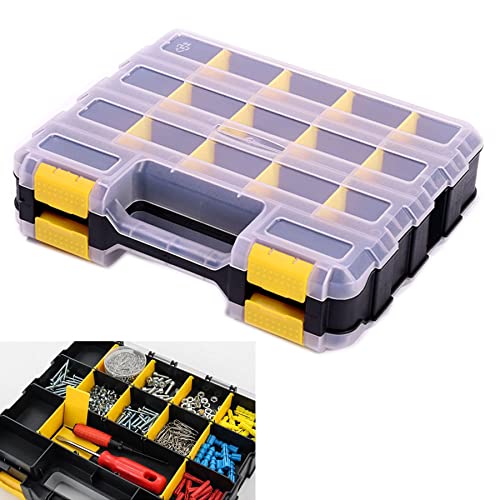
A single case with a carrying handle and secure latches is the main distinction of this 34-compartment organizer. Its double-sided layout has removable dividers, and a transparent lid helps identify stored screws, nuts, nails, and bolts. The case measures 12.75 × 10.63 × 3.15 inches and suits someone who wants one portable assortment rather than a two-case set or wall rack.
Bottom line: Choose this case if you need one portable organizer with a handle and latches.
HORUSDY 30-Piece Wall Bin Rack

Color-coded removable bins make this wall rack distinct: it includes nine small red bins, nine small blue bins, and 12 large orange bins. The product gives capacities of 12 cubic inches for red bins and 76 cubic inches for blue bins, making bin size a practical sorting distinction. This rack suits a workshop where fastener categories benefit from visible color groupings and bins need to come off the wall for access. The capacities differ by color, so do not assume every bin holds the same volume; sort parts according to the bin size provided.
Bottom line: Choose this rack if removable, color-coded bins suit your sorting routine.
How to choose screw and nail storage
Choose a case for portable assortments and a wall rack when parts need to stay visible at a workstation. Compartment count alone does not tell you whether an organizer will fit your fasteners: the smallest screw or nail should fit without forcing the lid, and longer nails need a compartment long enough to lie flat. Separate fasteners by type and size, then label the compartments; mixing similar-looking screws can slow repairs and lead to the wrong fastener being used. For a frequently changing assortment, removable dividers or bins make re-sorting easier. If you sort more than 30 categories, compare the 34-compartment cases with the 48-bin wall rack, while also checking each compartment’s usable dimensions.
Cases and wall racks compared
Portable cases and wall-mounted racks solve different access problems. Cases travel with a toolbox and keep parts enclosed; wall racks make bins reachable without opening a lid. The table summarizes the formats and counts supplied for these options.
| Storage type | Count | Useful for |
|---|---|---|
| Double-sided case | 34 compartments | Portable assortments |
| Wall-mounted bin rack | 30 or 48 bins | Fixed shop sorting |
Use a wall system only where there is space to mount it securely and access the bins. If the organizer must move between work areas, a handled case is the more practical format. Bin counts and compartment counts are not directly equivalent: bins may vary in size, while dividers let case compartments be rearranged.
Sort screws and nails by size
Sort first by fastener type, then by diameter and length; those measurements distinguish screws or nails that look similar in a mixed container. Store nails lying flat when compartment length permits, and keep sharp points directed away from fingers when transferring them. A useful rule is to reserve separate compartments for each size you use regularly rather than combining sizes because they fit together. Small parts can slip through gaps when a lid or divider does not close cleanly, so check that the case is latched before carrying it. For a wall rack, keep frequently used fasteners in reachable bins and heavier hardware in lower bins to reduce spills during access.
Set up and maintain a parts organizer
Labeling each compartment with fastener type and size makes return-to-storage consistent, especially when several screw lengths share a head style. A common mistake is to fill every compartment to the rim; leave enough room for fingers to remove small parts without scattering neighboring hardware. Inspect cases periodically for cracked dividers, worn latches, or lids that no longer close flush, and check removable bins for secure seating before loading them. Wall racks need a stable mounting surface and appropriate mounting hardware for the wall type; do not assume a loaded rack is safe on an unsupported surface. Keep organizers dry, since moisture can cause steel fasteners to rust.
Frequently Asked Questions
How should I sort screws and nails in an organizer?
Separate them by type, then by diameter and length so similar fasteners do not get mixed. Label each compartment with those measurements, especially when several sizes have similar heads.
How many compartments should a screw organizer have?
Choose at least one compartment for every fastener type and size you want to keep separate. A 34-compartment case fits a smaller assortment than a 48-bin rack, but bin sizes and compartment dimensions affect usable capacity.
Are wall-mounted parts bins better than cases?
Wall bins suit a fixed workstation where you want frequent access, while a latched case is easier to carry between work areas. Choose a rack only if you have a suitable mounting surface and enough space to reach its bins.
How do I keep small screws from mixing together?
Use compartments that close securely and avoid filling them so high that parts spill across dividers. Confirm the smallest fasteners fit their compartments and keep the case latched while carrying it.
Can I store nails and screws in the same organizer?
Yes, if separate compartments keep each fastener type and size apart. Place nails flat when the compartment allows, and handle sharp points carefully when sorting or retrieving them.