
Self Adhesive Caulk Strip: 4 Options Compared

For most broad tub, sink, or counter edges, Fixmend PVC Caulk Tape, 3 Rolls is the closest match, with 1.5-inch-wide PVC tape and three 10.5-foot rolls. Choose a narrower option if you are covering a slim seam rather than a fixture edge.
Self-adhesive caulk strip is peel-and-stick tape used to cover joints around fixtures; it is not the same as a bead of caulk applied from a tube.
We earn a commission if you buy through links on this page. As an Amazon Associate I earn from qualifying purchases. Products are compared on manufacturer specifications, not hands-on testing.
- Best overall: Fixmend PVC Caulk Tape, 3 Rolls – Three rolls of 1.5-inch PVC tape suit broad fixture edges and provide 31.5 feet total.
- Best for longer runs: White PVC Caulk Tape, 19.7 Ft – Its single 19.7-foot roll exceeds the 10.5-foot rolls.
| Product | Best for | Material | Width | Roll length | Shop |
|---|---|---|---|---|---|
| Fixmend PVC Caulk Tape, 3 Rolls | Broad fixture edges | PVC | 1.5 in | 10.5 ft each | Check Price on Amazon |
| Mokani PVC Caulk Tape, 2 Rolls | Creased corners | PVC | 1.5 in | 10.5 ft each | Check Price on Amazon |
| TOUSEA White Caulk Tape, 1.5-Inch | Thicker edge tape | — | 1.5 in | 10.5 ft | Check Price on Amazon |
| White PVC Caulk Tape, 19.7 Ft | Longer straight runs | PVC | 0.3 in | 19.7 ft | Check Price on Amazon |
Self adhesive caulk strip options
Compare the tape width, material, and roll length against the joint you need to cover.
Fixmend PVC Caulk Tape, 3 Rolls
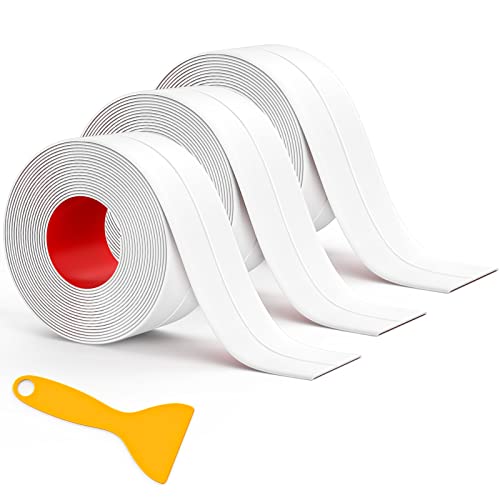
Three 1.5-inch-wide rolls make this a practical match for broad edges around tubs, toilets, sinks, or counters. The PVC tape includes a sealing tool, and the maker recommends cleaning and drying the surface, warming the tape with a hair dryer, then pressing it smooth. Those steps matter for someone seeking a finished edge without applying tube caulk. The trade-off is width: at 1.5 inches, it is broader than a narrow seam-covering strip, so measure the joint and surrounding surface before cutting.
Bottom line: Pick this for broad fixture edges when you want three rolls and an included smoothing tool.
Mokani PVC Caulk Tape, 2 Rolls

The crease down the center is the distinguishing feature here: it lets the 1.5-inch tape fold to a 90-degree corner between a wall and fixture. Two 10.5-foot PVC rolls and a sealing tool suit bathroom or kitchen joints where the strip must turn neatly. The maker says to soften it with a hair dryer in low temperatures, which can help with application. The limitation is the same broad 1.5-inch format; for a very narrow gap, the strip may cover more surrounding area than desired.
Bottom line: Choose this when a folded corner is more important than getting three rolls.
TOUSEA White Caulk Tape, 1.5-Inch

TOUSEA specifies a 1.2 mm thickness alongside the familiar 1.5-inch width, making thickness a useful distinction for buyers comparing broad edge strips. The tape has a center crease and is presented for fixture and countertop edges, including tubs, toilets, sinks, and cooktops. The maker describes it as waterproof and suitable for several surface types.
Bottom line: Pick this if the 1.2 mm thickness and center crease fit your edge.
White PVC Caulk Tape, 19.7 Ft

This roll combines a narrow 0.3-inch width with a 19.7-foot length, setting it apart from the 1.5-inch fixture-edge tapes. Flexible PVC is described by the maker as suitable for curved edges and corners, and the strip can be cut with scissors before peeling and pressing it into place. That format suits a slim seam or a longer narrow run around a compatible edge. Its small width is the limitation for broad fixture borders, where it will not cover as much surface as 1.5-inch tape.
Bottom line: Choose this for a longer, narrow joint rather than a broad fixture border.
How to choose caulk strip width
Match strip width to the surface you need to cover, not just the visible gap. A 0.3-inch strip fits slim seams and leaves less tape on adjacent surfaces; a 1.5-inch strip creates a broad border around fixtures and can cover more of the surrounding edge. Measure the entire area the tape must bridge, including the flat surface on each side of the joint, then choose a width that covers it without obstructing nearby parts. A center crease is useful where the tape must bend into a right-angle wall-to-fixture corner. For irregular or wide gaps, peel-and-stick tape is trim, not a substitute for filling the gap with a suitable caulk.
Preparing wet-area surfaces
Clean and fully dry the surface before applying adhesive tape; dust, soap residue, and moisture interfere with contact. Apply the strip at room temperature where practical, and press it down along its full length, especially at corners and endpoints. Some makers recommend gentle hair-dryer warming to soften the tape, particularly in a cool room; avoid overheating the strip or nearby surfaces. Peel-and-stick strips are intended for compatible, smooth surfaces such as tile, glass, metal, or plastic, but compatibility varies by finish. Test a small inconspicuous section if the surface is delicate or textured, and do not rely on trim tape to contain water where a failed seal could cause damage.
Self adhesive tape compared by use
Choose narrow PU tape for a slim seam and wider creased PVC tape when the strip must bridge a fixture edge or fold into a corner. Roll length matters after the width is right: calculate the joint perimeter before opening a roll, then allow extra for trimming and corner cuts. The table groups these formats by practical use rather than ranking one material for every job.
| Format | Typical use | Decision point |
|---|---|---|
| 0.3-inch PU | Thin seam or edge | Use where little cover is needed |
| 0.3-inch PVC | Long narrow run | Choose for greater roll length |
| 1.5-inch creased tape | Fixture border or corner | Choose when broad coverage or folding matters |
A tape’s material alone does not determine fit; width, crease, and surface compatibility are equally important.
When tape is not the right caulk repair
Peel-and-stick caulk strips cover the visible edge, while conventional caulk fills and bonds within a joint. Use tape for a clean, narrow surface seam when the surface is smooth and the strip can lie flat; do not use it to bridge a large opening, a moving joint, or a damaged waterproofing layer. Around a tub or shower, a leak behind the surround needs repair at the source rather than a cosmetic cover. Cut lengths carefully and avoid stretching the strip, since tension can pull an end loose. For a joint that must remain watertight under repeated movement, select a caulk made for that joint and follow its curing instructions.
Frequently Asked Questions
How wide should caulk tape be for a bathtub edge?
A 1.5-inch strip gives broad coverage around a tub edge, while 0.3-inch tape suits a narrow seam. Measure the flat area the strip needs to bridge before cutting.
Can self adhesive caulk strip go over old caulk?
A clean, smooth surface is important for adhesion, so remove loose or raised caulk before applying tape. A strip should not be used to cover a failing or leaking joint.
Does caulk tape need a dry surface?
Yes, clean and dry the surface before pressing down the adhesive. Soap film and moisture can interfere with contact, especially near corners and endpoints.
Can caulk strip seal a large gap?
No, peel-and-stick strip is best for covering a narrow surface joint, not filling a large opening. Use an appropriate caulk or repair method for gaps that need to be filled.
How do you apply caulk tape around a corner?
A center crease helps a 1.5-inch strip fold to a 90-degree corner. Press along the bend and trim carefully rather than stretching the tape around the turn.