
Sensory Spinning Chair for Kids: 5 Models Compared

For most families, Sensory Spinning Chair, Blue is a straightforward starting point: its roughly 23-by-21-inch footprint and 220-pound capacity make its size and limit easy to compare. Choose another model if a shorter chair or a smaller footprint better suits your room; spinning toys need clear space and adult supervision.
We earn a commission if you buy through links on this page. As an Amazon Associate I earn from qualifying purchases. Products are compared on manufacturer specifications, not hands-on testing.
- Best overall: Sensory Spinning Chair, Blue – A roughly 23-by-21-inch footprint and 220-pound capacity provide clear sizing and load information.
- Best for stated age guidance: FERUERW Sensory Spinning Chair – It specifies use for ages 3–12 and measures 22 inches across.
- Best for compact footprint: GAKINUNE Sensory Spinning Chair, Green – Its 20-by-20-inch footprint is smaller than the other models with dimensions.
| Product | Best for | Footprint (L × W) | Height | Weight capacity | Shop |
|---|---|---|---|---|---|
| Sensory Spinning Chair, Blue | Clear capacity limit | 22.83 × 20.87 in | 11.81 in | 220 lb | Check Price on Amazon |
| FERUERW Sensory Spinning Chair | Age range guidance | 22 × 22 in | 10.6 in | 220 lb | Check Price on Amazon |
| Sensory Spinning Chair, Deep Green | Green color option | 22.83 × 20.87 in | 11.81 in | — | Check Price on Amazon |
| Sensory Spinning Chair, Blue, 8.9-Inch | Lowest seat height | 21.3 × 21.7 in | 8.9 in | 220 lb | Check Price on Amazon |
| GAKINUNE Sensory Spinning Chair, Green | Smallest footprint | 20 × 20 in | 10 in | — | Check Price on Amazon |
Sensory Spinning Chairs for Kids
Compare each chair’s dimensions and stated age guidance, then allow room for movement and supervision.
Sensory Spinning Chair, Blue

Sensory Spinning Chair, Blue gives a clear 220-pound capacity alongside its approximately 23-by-21-inch footprint. The chair has a metal base and non-slip design, and the maker describes it as a sit-and-spin toy intended to encourage active movement. Its compact height of 11.81 inches may suit a play area where a low seat is preferred. The maker also makes claims about balance, coordination, and motion sickness; those are not a substitute for medical advice. The specifications do not give an age range, so families choosing for a young child should confirm age suitability before ordering.
Bottom line: Choose this if you want a low chair with a 220-pound capacity.
FERUERW Sensory Spinning Chair
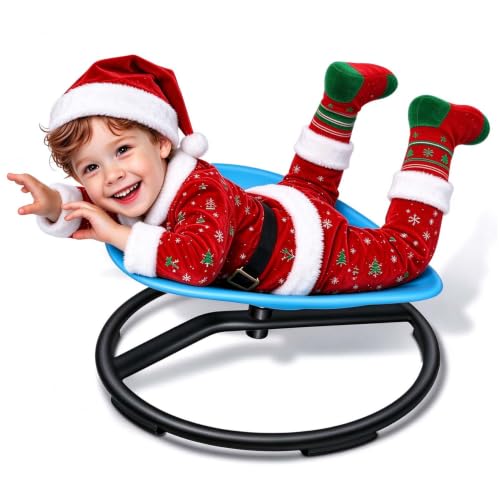
FERUERW Sensory Spinning Chair stands out for naming an age range: ages 3–12, with a 220-pound capacity and a 22-inch-square footprint. Its height of 10.6 inches is the shortest among the models with dimensions provided. The maker describes a widened metal base with rubber foot pads and a PP plastic seat; it also claims smooth 360-degree spinning and sensory-regulation benefits. Treat the latter as manufacturer claims rather than guaranteed outcomes. The chair’s 22-inch width still calls for an uncluttered play zone, and an adult should supervise spinning, especially for children near the lower end of the age range.
Bottom line: Choose this if stated age guidance and a short seat matter most.
Sensory Spinning Chair, Deep Green

The maker describes a smooth 360-degree spin, a non-slip base, and use for children ages 3 and up. Those details make it a relevant alternative when color and age guidance are priorities. As with any spinning seat, use it on a clear, level surface with an adult nearby.
Bottom line: Choose this if deep green and an age-3-plus indication fit your needs.
Sensory Spinning Chair, Blue, 8.9-Inch

Sensory Spinning Chair, Blue, 8.9-Inch has the lowest seat height in this group at 8.9 inches, while its footprint is about 21 by 22 inches and its capacity is 220 pounds. The maker describes a steel base with anti-slip pads and smooth 360-degree rotation, and identifies the chair for age 3 and up. Those are useful differentiators for a buyer comparing low seats and stated age fit. The maker’s claims about reducing motion sickness and improving focus are not assured results. At this low height, check that a child can sit and get up comfortably, and supervise active spinning.
Bottom line: Choose this if a lower seat height is your main priority.
GAKINUNE Sensory Spinning Chair, Green
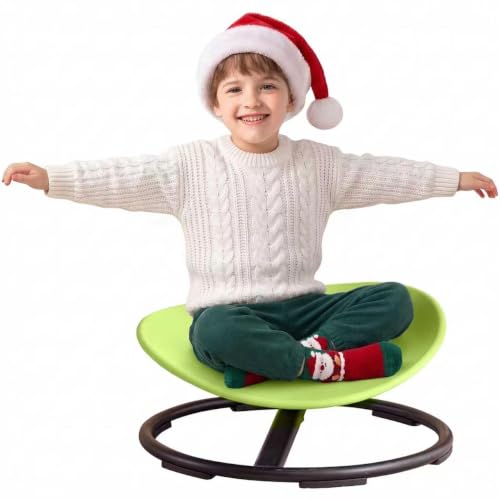
GAKINUNE Sensory Spinning Chair, Green has the smallest footprint, measuring 20 by 20 inches, and stands 10 inches high. The maker describes it as an upgraded green chair for indoor or outdoor play, with 360-degree spinning and a wide seat. Compared with the larger models, its dimensions may be easier to accommodate in a tighter play area, though spinning still needs clear space around the chair. The specifications do not include an age range or weight capacity, so verify both before choosing it for a child. The maker’s balance and coordination claims should be understood as intended-play claims, not guaranteed outcomes.
Bottom line: Choose this if you need the smallest footprint.
How to choose a sensory spinning chair for kids
Start with the chair’s footprint, height, age guidance, and weight capacity rather than claims about focus or sensory outcomes. These chairs rotate around a central base; a child’s body movement creates the spin, while the seat and base support the child. Keep the chair on a level, non-slippery floor and leave an unobstructed zone around it. A practical planning rule is to leave about 3 feet of clear space from the chair’s edge to walls, furniture, and other play equipment. That clearance helps reduce collisions but does not eliminate fall risk. For any child who becomes dizzy, unsteady, nauseated, or distressed, stop the spinning and let the child rest.
Compare chair size and capacity
Match the chair’s dimensions to both the child and the room; the footprints here range from 20 to about 23 inches across. A smaller footprint can be easier to place, but it does not mean the surrounding spin zone can also shrink. Seat heights range from 8.9 to 11.81 inches among models with measurements, so consider whether the child can sit down and stand up comfortably. Capacity matters too: a 220-pound limit appears for three models, while two have no capacity in the specifications. Use the comparison as a starting point, not as a substitute for checking the child’s fit.
| Need | Compare | Decision cue |
|---|---|---|
| Smallest footprint | 20 × 20 in | Prioritize room placement, while preserving clear space around it. |
| Lowest seat height | 8.9 in | Check that the child can get on and off comfortably. |
| Stated maximum capacity | 220 lb | Compare the child’s weight with the chair’s limit. |
Safe spinning play and supervision
Spinning can quickly cause dizziness or loss of balance, so keep play supervised and stop when a child shows discomfort or becomes unsteady. Clear away hard or sharp objects, keep other children out of the spin area, and use the chair only on a stable, level surface. Do not treat a weight capacity as a guarantee against tipping or injury; it is one limit, not a measure of safe spinning speed. For children with balance concerns, a history of motion sensitivity, or medical needs, ask a qualified clinician whether spinning play is appropriate. Avoid pushing a child faster than they choose or using the chair as a substitute for prescribed care.
What sensory spinning chairs do
A spinning chair provides rotational movement through a seat mounted on a rotating base. The inner ear helps the brain detect head movement and orientation, so spinning can feel stimulating or disorienting depending on the child and the amount of movement. There is no single spinning duration or pace that suits every child; brief, child-led turns with pauses are a cautious approach. These toys are not medical devices, and manufacturer claims about calming, attention, balance, or motion sickness should not be treated as established results for an individual child. Choose the chair for its dimensions, construction, and safe fit, then observe how the child responds.
Frequently Asked Questions
How much space should a spinning chair have?
Plan for roughly 3 feet of clear space beyond the chair’s edge when possible, with no walls, furniture, or other children in the spin path. An adult should supervise because clearance cannot prevent every fall.
Can a three-year-old use a sensory spinning chair?
Some models here state an age recommendation of 3 and up, but not every chair gives age guidance. For a young child, check the specific model’s age fit and supervise closely on a level, uncluttered floor.
How long should a child spin at once?
There is no universal safe duration that fits every child. Keep turns brief and child-led, pause between spins, and stop immediately if the child appears dizzy, nauseated, distressed, or unsteady.
Do spinning chairs help with motion sickness?
A spinning chair should not be relied on to prevent or treat motion sickness. The maker of some models makes that claim, but responses to spinning vary; ask a healthcare professional about recurring or severe symptoms.
What weight capacity should I check?
Choose a chair whose capacity is at least the child’s weight, leaving a margin rather than using the maximum as a target.