
Senville Mini Splits: 4 Models Compared by Fit

For multiple rooms with individual temperature control, Senville AURA 18,000 BTU Dual Zone is the sensible starting point: it connects two 9,000 BTU indoor units to one outdoor unit. Choose Senville LETO 9,000 BTU instead for a single-room 9,000 BTU system on 110/120V power; larger spaces or a different electrical setup may point to another model.
We earn a commission if you buy through links on this page. As an Amazon Associate I earn from qualifying purchases. Products are compared on manufacturer specifications, not hands-on testing.
- Best overall: Senville AURA 18,000 BTU Dual Zone – Two independently controlled 9,000 BTU indoor units support a multiroom setup.
- Best for larger two-zone capacity: Senville Dual Zone 28,000 BTU – This dual-zone model is described as a 28,000 BTU system with two 12,000 BTU indoor units.
- Best for 208/230V single-zone use: Senville LETO 24,000 BTU – Its 24,000 BTU capacity and 208/230V power suit buyers comparing a larger single-zone setup.
- Best for 110/120V rooms: Senville LETO 9,000 BTU – This 9,000 BTU single-zone model uses 110/120V power.
| Product | Best for | Configuration | Voltage | Shop |
|---|---|---|---|---|
| Senville AURA 18,000 BTU Dual Zone | Two-room control | 2 × 9,000 BTU | — | Check Price on Amazon |
| Senville Dual Zone 28,000 BTU | Larger two-zone setup | 2 × 12,000 BTU | 208–230V | Check Price on Amazon |
| Senville LETO 24,000 BTU | Large single zone | Single zone; 24,000 BTU | 208/230V | Check Price on Amazon |
| Senville LETO 9,000 BTU | Small single zone | Single zone; 9,000 BTU | 110/120V | Check Price on Amazon |
Senville mini split systems compared
Start with the number of rooms, then compare capacity and electrical requirements before choosing a system.
Senville AURA 18,000 BTU Dual Zone
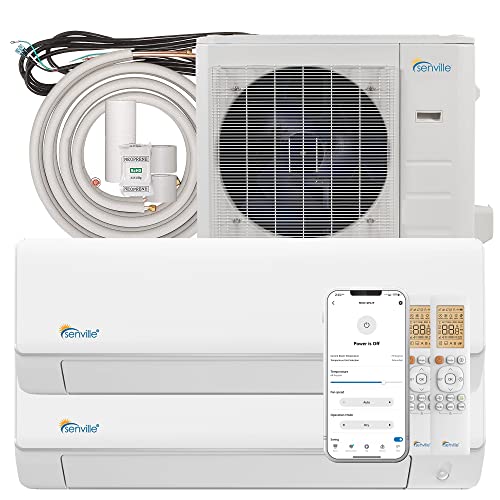
For separate temperature settings in two rooms, this AURA pairs two 9,000 BTU indoor air handlers with one outdoor unit. The combined system is identified as 18,000 BTU and is Energy Star and AHRI certified. Senville says the system works with Alexa and app control, and includes a 24-hour timer. The dual-zone layout is the key distinction from the single-zone LETO models. The electrical requirement should be confirmed before choosing, since the maker does not establish the voltage; that matters when matching the unit to an existing circuit.
Bottom line: Choose this when two rooms need separate temperature controls.
Senville Dual Zone 28,000 BTU

This dual-zone system is the option here that specifies 208–230V power and two 12,000 BTU indoor units. Its name identifies it as a 28,000 BTU system, while its size configuration is two 12,000 BTU units; compare the exact system configuration with your planned installation. Senville describes app and supported voice-assistant control, heat-pump operation in low outdoor temperatures, and Energy Star and AHRI certification. One outdoor unit serves both indoor air handlers. This choice is less suitable when the project calls for one room or a 110/120V system.
Bottom line: Pick this for a two-room plan that calls for 208–230V.
Senville LETO 24,000 BTU
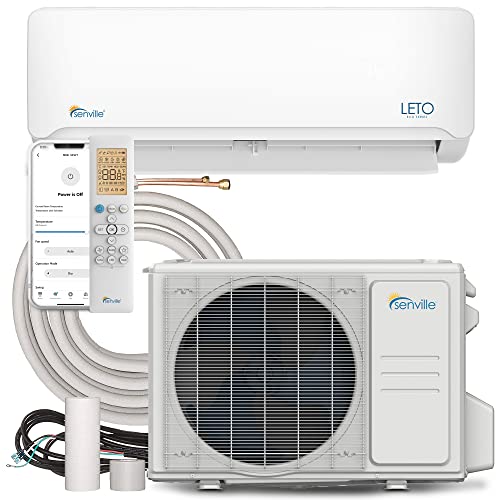
Unlike the two AURA configurations, this LETO is a single-zone 24,000 BTU system on 208/230V power. Its functions include air conditioning, heat pump, dehumidifier, fan and turbo modes; Senville says the heat pump functions down to 5°F. The package includes an indoor air handler, outdoor condenser and remote control, and the system is described as UL listed and AHRI certified. Its single-zone design makes it a poor match for separate temperature control in multiple rooms. Room-by-room heat loss and gain still matter more than capacity alone.
Bottom line: Choose it for one zone where 208/230V power is planned.
Senville LETO 9,000 BTU
This is the only single-zone option with 110/120V power, and its capacity is 9,000 BTU. Senville describes the LETO as a 4-in-1 system with cooling, heat-pump, dehumidifier and fan functions, plus a turbo mode; the heat pump is described as functional down to 5°F. It is also identified as UL listed and AHRI certified. The 110/120V requirement distinguishes it from the 208/230V LETO model, but electrical compatibility does not establish that 9,000 BTU is the right capacity for a particular room.
Bottom line: Pick it for a single-zone project requiring 110/120V.
How to choose a Senville mini split
Choose a Senville mini split by room count, load and electrical supply, not by brand name alone. A single-zone system connects one indoor air handler to one outdoor unit; a multi-zone system connects several indoor units to one outdoor unit, with individual room controls on compatible systems. Capacity calculations should account for insulation, windows, ceiling height, air leakage, sun exposure and local design temperatures. A rough 20 BTU per square foot estimate can be a starting point, not a final sizing rule: a sunny, poorly insulated room can need more, while a shaded, well-insulated room can need less. Have a qualified HVAC contractor perform a room-by-room load calculation before deciding between these capacities.
What the zone count changes
Zone count determines how many rooms can have separate indoor units and temperature settings; it does not guarantee equal comfort throughout a home. An indoor unit serves the room where it is installed, so closed doors, hallways and distant rooms can limit air movement between spaces. A two-zone setup can work for two distinct rooms, while an open-plan area may need a different distribution plan. Compare indoor-unit capacity and placement against the load of each room rather than splitting the system’s total capacity evenly by assumption. The table summarizes the practical distinction.
| Setup | Room control | Best fit |
|---|---|---|
| Single zone | One indoor unit | One room or open area |
| Multi-zone | Multiple indoor units | Separate rooms needing individual settings |
Check voltage and installation needs
Match the system voltage to the planned electrical circuit before selecting a model: the options here include 110/120V and 208/230V units. Mini splits also require refrigerant piping between the indoor and outdoor equipment, condensate drainage, secure mounting and electrical work. Line-set length, elevation difference, breaker sizing and disconnect requirements depend on the specific equipment and installation; do not assume that a similar-looking unit shares the same limits. Refrigerant work and electrical connections should be handled by qualified professionals, and refrigerant handling is subject to EPA Section 608 requirements. Confirm the exact voltage and installation specifications before ordering.
What mini split modes do
A heat pump moves heat rather than creating it with resistance elements: in cooling mode it carries indoor heat outdoors, and in heating mode it reverses that process. Dehumidify mode removes moisture while cooling behavior can vary by system; fan mode circulates air without the same heating or cooling action. A low-temperature heating threshold is not a guarantee of full heating capacity at that outdoor temperature. Heat-pump output and efficiency generally fall as outdoor temperatures drop, so cold-climate buyers should compare the model’s capacity data at local winter design temperatures and plan backup heat where needed.
Frequently Asked Questions
How many BTUs does a mini split need per square foot?
A rough starting estimate is about 20 BTU per square foot, but it is not a substitute for a room load calculation. Windows, insulation, ceiling height, air leakage, sun and climate can move the required capacity substantially.
Can one mini split cool multiple rooms?
A multi-zone mini split can connect multiple indoor units to one outdoor unit, with separate controls for rooms served by those units. Air from one room does not reliably replace a dedicated indoor unit in a closed or distant room.
Does a heat pump work below freezing?
Many heat pumps can provide heat below 32°F, but heating output and efficiency decline as outdoor temperature falls. Compare capacity at the area’s winter design temperature, rather than relying only on a minimum operating-temperature claim.
What voltage does a mini split require?
Voltage depends on the specific model; these choices include both 110/120V and 208/230V systems. Check the unit’s electrical requirements and have a qualified installer confirm the circuit and breaker sizing before installation.
How often should mini split filters be cleaned?
Washable mini split filters commonly need cleaning every two to four weeks during regular use, with more frequent checks in dusty homes or heavy-use seasons. Clean filters help maintain airflow; inspect the indoor unit’s manual for the filter-care method.