
Shallow Pots for Succulents: Four Sizes Compared

For most small succulent arrangements, Octagonal Shallow Succulent Pots, 4-Pack is the most versatile choice because its 5.9-inch opening and 2.6-inch depth pair a broad planting area with a shallow root zone. Choose a different size or material if your plant needs a wider container, or if you prefer faster-drying terracotta over glazed ceramic.
Shallow succulent pots are low containers that hold less mix than deep pots, so drainage and careful watering matter.
We earn a commission if you buy through links on this page. As an Amazon Associate I earn from qualifying purchases. Products are compared on manufacturer specifications, not hands-on testing.
- Best overall: Octagonal Shallow Succulent Pots, 4-Pack – Its 5.9-inch opening, 2.6-inch depth, drainage grid and four-pot set suit compact plantings.
- Best for terracotta: Small Terracotta Succulent Pot, 5-Inch – The 5-inch clay pot has a drainage hole and includes saucers.
- Best for larger plants: Ceramic Succulent Pots, 7.3- and 10-Inch Set – The two-pot set includes 7.3- and 10-inch ceramic containers with drainage trays.
| Product | Best for | Top width | Depth | Material | Shop |
|---|---|---|---|---|---|
| Octagonal Shallow Succulent Pots, 4-Pack | Compact groupings | 5.9 in | 2.6 in | — | Check Price on Amazon |
| Small Terracotta Succulent Pot, 5-Inch | Breathable clay | 5 in | 2.17 in | Terracotta | Check Price on Amazon |
| Ceramic Succulent Pots, 7.3- and 10-Inch Set | Wide arrangements | 7.3 in and 10 in | 2.17 in and 2.6 in | Ceramic | Check Price on Amazon |
| VanEnjoy Glazed Ceramic Planter, 7.3-Inch | Single wide plant | 7.3 in | — | Glazed ceramic | Check Price on Amazon |
Shallow Pots for Succulents Compared
Compare each pot’s footprint, depth and material against the plant you intend to repot.
Octagonal Shallow Succulent Pots, 4-Pack
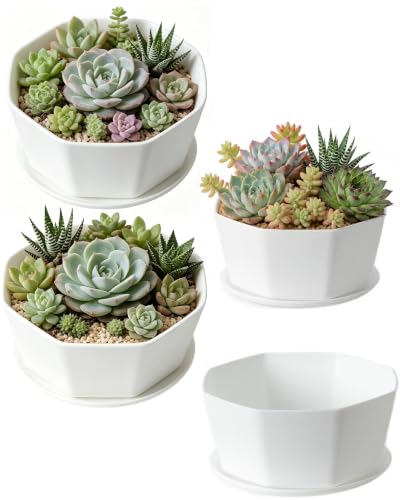
The four-pot set offers the shallowest root zone here at 2.6 inches, with an octagonal opening 5.9 inches across. Each pot tapers to a 4.7-inch base, so it occupies less sill space than its top width suggests. The maker says the slotted grid base spreads drainage across the floor; its matching saucer holds about 60 ml and should be emptied after watering. At about 2 oz per pot, these are easy to lift, but the maker notes that a tall plant can tip them. Choose this set for low, compact succulents rather than top-heavy growth.
Bottom line: Pick these for compact succulents when low depth and a smaller base footprint matter.
Small Terracotta Succulent Pot, 5-Inch

The 5-inch terracotta pot is the smallest option by width and depth, making it suited to an individual small succulent rather than a wide arrangement. It measures 4.8 inches long and wide and 2.17 inches high, with a drainage hole and saucer. The maker says the porous clay lets air and water pass through the walls and encourages quicker drying. That can suit growers who tend to water generously, but terracotta also dries faster than glazed ceramic, so it may need more frequent moisture checks in warm, dry rooms. The package includes six terracotta saucers.
Bottom line: Choose this for one small succulent and a breathable clay container.
Ceramic Succulent Pots, 7.3- and 10-Inch Set
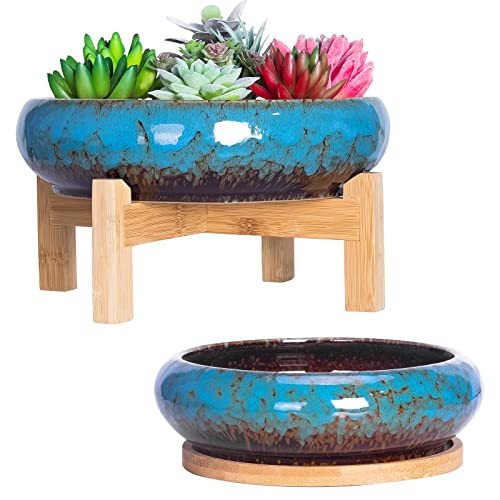
The two ceramic pots provide the widest choice of planting area: 7.3 inches and 10 inches across, with corresponding depths of 2.17 and 2.6 inches. Both include drainage holes, and the set comes with drainage trays. The smooth glazed finish gives these containers a different look and moisture behavior from unglazed clay; glazed surfaces do not wick water through the walls. The maker describes the pots as suitable for succulents, cacti and bonsai. Their shallow profile limits the amount of mix beneath roots, so choose a wider size only when the plant or arrangement needs that extra surface area.
Bottom line: Pick this set for a wide succulent arrangement or a choice of two planting sizes.
VanEnjoy Glazed Ceramic Planter, 7.3-Inch

The 7.3-inch round glazed ceramic pot is a single-container alternative to the two-size set, useful when you want one broad planting surface. Its name specifies a drainage hole and a shallow profile, while its dimensions give a width of about 6.1 inches and a height of about 2.2 inches; those dimensions do not match the 7.3-inch name, so confirm the actual rim diameter before choosing it for a particular plant. Glazed ceramic does not wick moisture through its walls like terracotta, making careful watering especially important in a shallow pot.
Bottom line: Choose this for a single glazed pot after confirming its actual rim width.
How to Choose Shallow Succulent Pots
Choose a pot by the root ball’s width and the plant’s watering needs, not by foliage spread alone. A useful rule is to select a container about 1 to 2 inches wider than the root ball; excess empty mix stays wet longer and can increase the risk of root problems. Most succulents do better in a container with a drainage hole, because water needs a route out rather than collecting under the roots. Unglazed terracotta wicks moisture through its porous walls and dries more quickly, while glazed ceramic retains moisture longer. For a small windowsill plant, favor a pot whose base fits the available space as well as one whose rim clears the root ball.
How Deep Should a Succulent Pot Be
Many compact succulents have relatively shallow root systems, so a deep pot is not automatically better. A depth of roughly 2 to 4 inches suits many small rosette succulents, while larger specimens and plants with longer roots need more room; the root ball is the deciding measurement. Leave enough depth for roots and a modest layer of mix beneath them, rather than burying the plant’s stem. A too-deep pot holds more damp soil than a shallow-rooted plant can use. Use a freely draining succulent or cactus mix, and avoid adding gravel at the bottom: a gravel layer does not improve drainage and can leave water perched in the soil above it.
Drainage, Saucers and Watering
A drainage hole and an open path for excess water matter more than a decorative layer of stones. Water the soil thoroughly until water exits the hole, then empty the saucer so the pot does not sit in standing water. Let the mix dry substantially before watering again; frequency changes with pot material, temperature, light and airflow, so a fixed weekly schedule can overwater a plant. Shallow pots contain less soil than deep ones and can dry faster, particularly in terracotta or a warm sunny spot. Check moisture in the mix below the surface rather than judging by dry-looking topsoil alone.
Match Pot Shape to the Planting
Wide, shallow pots work well for clustered succulents and bonsai-style arrangements, while a compact round pot suits one small plant. Use the root ball’s width to choose the rim, and make sure the plant has enough room without leaving a large volume of unused soil around it. Tapered sides can reduce the base footprint while preserving a wider opening, but a lightweight, shallow pot may be unstable under a tall or top-heavy plant. Before arranging several plants together, group only plants with similar light and watering needs; a mixed container is harder to water correctly when one plant dries much faster than its neighbors.
Frequently Asked Questions
Can succulents grow in shallow pots?
Yes, many compact succulents grow well in shallow pots when their root balls fit and the container drains freely. Choose depth based on the roots, and avoid burying the stem in extra soil.
Do succulent pots need drainage holes?
A drainage hole is strongly preferred because it lets excess water leave the root zone. Empty the saucer after watering rather than allowing the pot to stand in collected water.
How wide should a pot be for a succulent?
Choose a rim roughly 1 to 2 inches wider than the root ball. A pot much wider than the roots holds extra mix that can remain damp longer than the plant needs.
Is terracotta or ceramic better for succulents?
Unglazed terracotta dries faster because its porous walls wick moisture, while glazed ceramic does not wick water through the sides. Terracotta suits growers who need faster drying; ceramic needs more cautious watering when the mix remains moist.
Should I put rocks in the bottom of a succulent pot?
No, a gravel layer does not improve drainage and can leave water held in the soil above it. Use a drainage hole and a freely draining potting mix instead.