
Shawls With Arm Holes: Wraps Compared by Design

For a shawl with arm holes, the PULI wrap is the direct match because its features specify armholes for easier movement. Choose a different wrap if you prefer a reversible plaid design, a cotton blend, or pockets; those alternatives are open-front layers, not confirmed armhole styles.
We earn a commission if you buy through links on this page. As an Amazon Associate I earn from qualifying purchases. Products are compared on manufacturer specifications, not hands-on testing.
- Best overall: PULI Armhole Shawl Wrap – The features specifically identify armholes, the deciding detail for this search.
- Best for reversible style: PAMEILA Reversible Plaid Ruana – The plaid wrap is described as reversible and measures 59 inches in full length.
- Best for pockets: Ferand Pocketed Acrylic Ruana – The open-front cape has two patch pockets for carrying small essentials.
| Product | Best for | Design | Material | Length | Shop |
|---|---|---|---|---|---|
| PULI Armhole Shawl Wrap | Easy arm movement | Armholes; open front | — | One size | Check Price on Amazon |
| PAMEILA Reversible Plaid Ruana | Reversible plaid | Open-front reversible ruana | 50% polyester, 50% acrylic | 59 in full length | Check Price on Amazon |
| Bestshe Cotton-Blend Plaid Poncho | Cotton blend | Open-front poncho | 65% cotton, 35% polyester | — | Check Price on Amazon |
| Ferand Pocketed Acrylic Ruana | Pocket storage | Open-front ruana with pockets | Acrylic | — | Check Price on Amazon |
Shawls With Arm Holes and Related Wraps
Compare the direct armhole match with open-front alternatives that differ in fabric, length and storage.
PULI Armhole Shawl Wrap

The PULI wrap is the only option here whose features explicitly call out armholes, making that construction detail its key distinction. It has a soft drape, a dolman-sleeve shawl shape and an open front; the size is one size in Barley Twist. The brand says it is intended for layering through fall and winter as well as cool spring nights and air-conditioned rooms. It suits someone who wants a wrap that stays arranged around the arms while moving.
Bottom line: Pick this if armholes are essential to how you want the shawl to sit.
PAMEILA Reversible Plaid Ruana

The fabric is a 50% polyester and 50% acrylic blend, and the one-size cut is below hip length. Its reversible construction suits someone who wants a plaid layer that can be worn with either side showing. The limitation is that this draped ruana does not offer the specified arm openings needed to keep fabric anchored during arm movement, so choose it for its open-front style instead.
Bottom line: Choose this for reversible plaid and a 59-inch length, not for confirmed armholes.
Bestshe Cotton-Blend Plaid Poncho
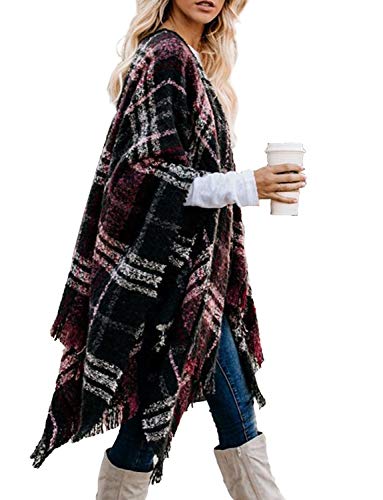
The Bestshe poncho differs from the direct match by using a 65% cotton and 35% polyester blend in a closure-free, open-front shape; its features do not confirm armholes. That construction slips on without a closure and is intended to move naturally while walking, sitting or commuting. It may suit someone who wants a relaxed poncho layer and values the cotton content. The trade-off is that the specifications give no garment length or armhole measurement, so it cannot be compared for coverage or arm fit against the PULI wrap. Treat it as an open-front alternative, not an armhole-specific shawl.
Bottom line: Pick this if a cotton-blend open-front poncho matters more than specified armholes.
Ferand Pocketed Acrylic Ruana

The Ferand wrap is the only option with pockets: its features identify two patch pockets for small items such as a phone, keys or cards. The pockets make it a useful alternative for someone who wants hands-free storage in a relaxed layer for travel or everyday wear. Compared with the PULI design, the key distinction is storage rather than arm positioning.
Bottom line: Choose this for two pockets and an open-front acrylic layer.
How to choose a shawl with arm holes
Start by checking whether the garment actually has armholes, rather than assuming every open-front wrap does. Armholes create fixed openings for the arms; a ruana or cape usually relies on fabric draped over the shoulders, so its panels can shift as the wearer moves. If you need the wrap to remain anchored while reaching or carrying items, choose a design with explicitly identified armholes. If a loose drape is the priority, an open-front ruana can work without them. Compare the garment’s measurements with the body area you want covered, and confirm sleeve or arm opening measurements when fit is important. A one-size label alone does not establish the width, length or arm opening that will suit a particular wearer.
Armhole shawls versus open-front wraps
An armhole shawl has openings intended to keep the arms in place while the remaining fabric drapes around the body; a poncho or ruana can have an open front without any arm openings. The distinction matters for movement: a fixed arm opening can reduce the need to reposition fabric, while an unstructured wrap allows more styling flexibility. Use the table to match the construction to the task. Select an armhole design when you want a more secure position around the arms; choose an open-front wrap when you prefer an uninterrupted drape, a reversible pattern or extra pockets. Product names such as “poncho,” “cape” and “shawl” do not by themselves confirm armhole construction, so look for that feature explicitly.
| Need | Construction to look for | Trade-off |
|---|---|---|
| Keep fabric positioned on arms | Explicit armholes | Opening fit matters |
| Loose, adjustable drape | Open-front ruana or cape | May need repositioning |
| Carry small essentials | Open-front style with pockets | Pocket placement affects access |
How to check fit and coverage
Use garment dimensions, not “one size,” to judge coverage: a full length measures only one direction and does not tell you the wrap’s width or arm opening. For a shawl with armholes, check both the opening size and the distance between openings if the seller provides them; these determine how comfortably the fabric sits across the shoulders and upper body. For a draped wrap, compare its length and width with a garment you already like, laid flat and measured in inches. If you want coverage below the hips, verify the garment’s actual length rather than relying on a style label. A measurable decision rule is simple: if the product does not provide the dimensions you need to compare against a well-fitting layer, confirm those measurements before ordering.
Fabric, layering and care
Blends do not guarantee a particular softness, warmth or drape, so use the fiber content as a comparison point rather than a performance promise. Layer a wrap over a thin top when you want less bulk, or over a sweater when you need more insulation; the resulting warmth depends on the layers and room or outdoor conditions. For care, follow the garment’s care label because acrylic and blended knits can respond differently to heat and agitation. Avoid assuming that a wrap can be machine-dried or ironed unless its label allows it.
Frequently Asked Questions
Do all open-front shawls have armholes?
No. Open-front describes the front opening, not openings for the arms. Check for explicit armhole wording or visible arm openings if you need the wrap to stay positioned during movement.
What is the difference between a ruana and a shawl?
A ruana is generally a draped outer layer with an open front, while shawl is a broader term for a fabric wrap worn over the shoulders. Names alone do not establish armholes, sleeves or exact coverage, so compare construction and measurements.
How should I measure a wrap for coverage?
Measure a similar garment laid flat in inches, checking both length and width. A full-length figure such as 59 inches gives only one dimension, so confirm width too if shoulder or hip coverage is important.
Can an armhole shawl fit over a sweater?
Often it can be layered over a sweater, but the arm openings and shoulder width determine whether it sits comfortably. Compare the opening measurements with your intended base layer, especially if the sweater has bulky sleeves.
How do I care for an acrylic blend shawl?
Use the care label for the specific garment, because fiber blends and knit construction can tolerate different washing and drying methods. Heat can damage some synthetic fibers, so do not assume dryer or iron use is suitable without checking the label.