
Small Sanders for Tight Spaces: 5 Models Compared

For most small, tight-space sanding, choose HOZO NeoSander Reciprocating Detail Sander if you want a pen-shaped reciprocating sander with adjustable stroke. Choose SHALL Mini Pen Sander instead if interchangeable head shapes matter more; the larger detail and file formats suit different access needs.
A small sander uses a compact sanding surface or narrow abrasive to reach areas a full-size sheet sander cannot. Match the head shape to the work area before choosing by speed alone.
We earn a commission if you buy through links on this page. As an Amazon Associate I earn from qualifying purchases. Products are compared on manufacturer specifications, not hands-on testing.
- Best overall: HOZO NeoSander Reciprocating Detail Sander – Its reciprocating motion and adjustable 0.6–1.8 mm stroke offer control in fine detail work.
- Best for varied head shapes: SHALL Mini Pen Sander – Eight sanding heads include square, slim, triangular, and circular shapes.
- Best for narrow slots: WEN 6307 Detailing File Sander – Its 1/2-inch-wide belt reaches into narrow areas and pivots to meet the work.
| Product | Best for | Motion or speed | Sanding format | Included accessories | Shop |
|---|---|---|---|---|---|
| HOZO NeoSander Reciprocating Detail Sander | Adjustable detail work | 13,000 SPM | Reciprocating pen | Adjustable 0.6–1.8 mm stroke | Check Price on Amazon |
| SHALL Mini Pen Sander | Multiple head shapes | 5,000–10,000 SPM | Reciprocating pen | 8 sanding heads; 18 sheets | Check Price on Amazon |
| SKIL Multi-Function Detail Sander SR232301 | Corners and contours | 13,500 orbits per minute | Detail sander; 4-in-1 | 3 attachments; 12 sheets | Check Price on Amazon |
| WEN 6307 Detailing File Sander | Narrow recessed areas | 1,080–1,800 ft/min belt speed | 1/2 × 18-inch belt | 3 abrasive belts | Check Price on Amazon |
| HARDELL Mini Cordless Rotary Tool 69-Piece Kit | Versatile craft shaping | 5,000–18,000 RPM | Rotary tool | 69 accessories | Check Price on Amazon |
Small Sanders for Tight Spaces
Compare the sanding motion and abrasive shape first, then choose the format that can reach your work area.
HOZO NeoSander Reciprocating Detail Sander

Unlike the other compact sanders here, HOZO NeoSander Reciprocating Detail Sander combines a pen-style body with a steplessly adjustable reciprocating stroke. HOZO says its linear motor runs at 13,000 SPM, while the stroke adjusts from 0.6 to 1.8 mm for changing sanding intensity. The aluminum-alloy body is about 4.1 inches long, a useful size for close control on small craft or model surfaces. This format suits delicate shaping and finishing more than broad panels. The product features do not identify included abrasive shapes, so buyers who need a particular head should confirm that fit before ordering.
Bottom line: Choose this for compact reciprocating sanding with adjustable stroke length.
SHALL Mini Pen Sander

SHALL Mini Pen Sander stands out for its set of eight sanding heads, rather than a variable stroke mechanism. SHALL says its four speed settings span 5,000 to 10,000 strokes per minute; the shapes include square, rectangular, slim, triangular, and circular heads. The slender pen format is suited to small surfaces and tight corners, and 18 sanding sheets are included. Consider it when the work changes shape often and the extra heads are useful. Its speed range tops out below the 13,000 SPM claimed for HOZO NeoSander Reciprocating Detail Sander, so buyers prioritizing the highest stroke rate may prefer that option.
Bottom line: Choose this when changing among several small sanding head shapes is important.
SKIL Multi-Function Detail Sander SR232301
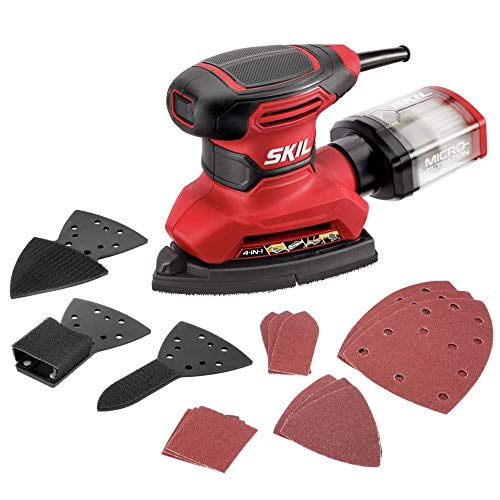
SKIL Multi-Function Detail Sander SR232301 is a palm-style detail sander rather than a pen tool, and its larger base is better suited to corners, edges, and small contoured surfaces than narrow recesses. SKIL says its 1.2-amp motor produces 13,500 orbits per minute. The tool-free attachments extend its working shapes, while hook-and-loop fastening makes sheet changes straightforward. A micro-filter dust box and 1-1/4-inch dust port provide two dust-collection approaches. Choose this when the area is broader than a pen sander head can cover; the 9.84-inch length and 5.7-inch width make it less suited to confined cavities than the pen formats.
Bottom line: Choose this for small surfaces and corners that need a broader sanding base.
WEN 6307 Detailing File Sander
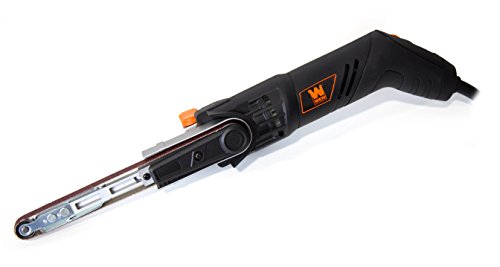
WEN 6307 Detailing File Sander uses a narrow continuous belt, not the reciprocating pad used by the pen sanders. Its 1/2-by-18-inch belt is designed to reach into long, narrow areas, and WEN says the variable-speed dial spans 1,080 to 1,800 feet per minute. The sanding arm pivots to approach the work from different angles, and the tool-free belt installation avoids tension adjustments. Three abrasive belts and a dust-port attachment are included. This format is useful for slots or edges with enough length for the belt path, but it is not the right shape for tiny isolated spots or delicate detail where a small head is easier to control.
Bottom line: Choose this for long, narrow recesses that suit a belt rather than a small pad.
HARDELL Mini Cordless Rotary Tool 69-Piece Kit

HARDELL Mini Cordless Rotary Tool 69-Piece Kit is the only rotary format in this group, so it sands by spinning an accessory rather than moving a pad or belt back and forth. HARDELL says the cordless tool has five settings from 5,000 to 18,000 RPM and includes 69 accessories for tasks such as sanding, grinding, and polishing. Its small rotary bit can work on tiny areas and shaped surfaces, while the broader accessory set makes it useful for other fine craft jobs. It is not a dedicated reciprocating sander, and the maker cautions that it is not for heavy-duty projects. Choose it for varied light-duty craft work, not larger sanding surfaces.
Bottom line: Choose this for small craft areas where rotary accessories offer useful flexibility.
How to choose a small sander for tight spaces
Choose by the shape and reach of the abrasive, not by speed alone. A pen sander has a small reciprocating head for localized work; a detail sander covers more area with a shaped pad; a file sander uses a narrow belt for elongated slots. Rotary tools use small spinning bits and are better for tiny or contoured areas than flat surfaces. For an opening under about 1 inch wide, a 1/2-inch belt or slim head may fit where a broad detail pad cannot, but check the whole tool body and approach angle as well. Oscillating or reciprocating speed figures and belt speed use different units, so do not compare their numbers as equivalent performance.
| Work area | Format to consider | Reason |
|---|---|---|
| Small localized patch | Pen sander | Compact reciprocating head |
| Corner or small contour | Detail sander | Shaped pad and attachments |
| Long narrow slot | File sander | Narrow continuous belt |
| Tiny shaped craft area | Rotary tool | Small spinning accessory |
Match sanding motion to the surface
Reciprocating and orbital sanders move an abrasive face across a surface, while a file sander carries abrasive around a belt and a rotary tool spins a bit. Flat faces and broad corners usually benefit from a pad that stays supported; narrow slots call for a belt or slim head that physically fits. For wood, a common progression is 80–120 grit for shaping and 150–220 grit for finer smoothing, with the starting grit depending on how rough the surface is. Skip grits only when the earlier scratches have already been removed. On delicate plastic prints or resin crafts, use light pressure and test an inconspicuous spot: heat from aggressive sanding can soften or mar plastic.
Control dust and protect yourself
Sanding creates airborne dust, so wear eye protection and a properly fitted particulate respirator, especially when working indoors or sanding unknown coatings. Wood dust can irritate the lungs, and old painted surfaces may contain hazardous material; avoid sanding paint of unknown age until its lead status is checked. Connect dust extraction when the tool supports it, and clean with a vacuum rather than blowing dust into the room. Small tools can still shed fine dust even when the sanding area is tiny. Keep fingers, loose sleeves, and cords away from moving belts and rotary bits, and unplug a corded tool or remove its battery before changing an abrasive or attachment.
Frequently Asked Questions
What grit should I use for small detail sanding?
For wood, 80–120 grit is a common range for shaping, while 150–220 grit is common for finer smoothing. Start finer on delicate surfaces and test first, since aggressive grit can remove material or leave scratches quickly on a small part.
Can a detail sander reach inside a narrow slot?
A broad detail-sander pad usually needs more room than a slim head or narrow belt. For an opening under about 1 inch, compare the abrasive width and the tool’s body clearance before choosing.
How do I reduce heat when sanding plastic prints?
Use light pressure, keep the abrasive moving, and work in short passes so friction does not build in one spot. A coarse abrasive or prolonged contact can soften or mark plastic; test an inconspicuous area first.
Should I wear a mask when sanding indoors?
Yes; wear eye protection and a properly fitted particulate respirator because sanding can put fine dust into the air. Use dust extraction where possible, and treat old paint of unknown age as a potential lead hazard until checked.
Is a rotary tool good for sanding large surfaces?
A rotary tool is better suited to tiny areas and shaped craft surfaces than broad flat panels. For larger faces, a pad-style detail sander keeps more abrasive in contact with the surface.