
Rosabella Organic Beet Root Capsules Compared by Formula

Rosabella Organic Beet Root, 60 Capsules is the closest match for someone seeking Rosabella organic beet root capsules, with 1,300 mg of organic beet root powder per serving and a 60-capsule bottle. Choose Organic Beet Root Powder, 60 Capsules if its production-facility standard matters more; choose Zazzee Organic Beet Root 20:1 Extract if you prefer a concentrated 20:1 extract and a larger bottle.
Beet supplements come as powders or extracts, and milligrams of powder do not tell you the nitrate content. If you take medication that affects blood pressure or have a history of kidney stones, ask a clinician whether a beet supplement is appropriate for you.
We earn a commission if you buy through links on this page. As an Amazon Associate I earn from qualifying purchases. Products are compared on manufacturer specifications, not hands-on testing.
- Best overall: Rosabella Organic Beet Root, 60 Capsules – Provides 1,300 mg of organic beet root powder per serving in a 60-capsule bottle.
- Best for facility standard: Organic Beet Root Powder, 60 Capsules – Its maker cites a cGMP facility compliant with NSF/ANSI 455-2:2021 requirements.
- Best for extract format: Zazzee Organic Beet Root 20:1 Extract – Uses a 20:1 beet root extract and comes in a 120-capsule bottle.
| Product | Best for | Beet form | Amount per serving | Capsules | Shop |
|---|---|---|---|---|---|
| Rosabella Organic Beet Root, 60 Capsules | Organic powder formula | Organic beet root powder | 1,300 mg | 60 | Check Price on Amazon |
| Organic Beet Root Powder, 60 Capsules | Facility standard focus | Beetroot powder | 1,300 mg | 60 | Check Price on Amazon |
| Zazzee Organic Beet Root 20:1 Extract | Concentrated extract | Organic 20:1 beet root extract | — | 120 | Check Price on Amazon |
Rosabella Organic Beet Root Capsules and Alternatives
Compare powder and extract formulas by their form, serving amount, and capsule count.
Rosabella Organic Beet Root, 60 Capsules

Rosabella Organic Beet Root, 60 Capsules is the direct fit for shoppers seeking Rosabella organic beet root capsules: it supplies 1,300 mg of organic beet root powder per serving in a 60-capsule bottle. The maker says the beets are non-GMO and the formula is free of gluten, dairy, and soy. Capsules avoid the taste and preparation of beet juice or loose powder, which can suit a simple daily routine. The serving amount is powder weight, not a nitrate measurement, so it cannot be compared directly with a nitrate dose or an extract ratio.
Bottom line: Choose this if you want Rosabella’s 1,300 mg organic powder formula in a 60-capsule bottle.
Organic Beet Root Powder, 60 Capsules

Organic Beet Root Powder, 60 Capsules matches the 1,300 mg powder serving and 60-capsule count of Rosabella Organic Beet Root, 60 Capsules, while emphasizing its manufacturing facility rather than a named brand or organic certification. Its maker says the facility complies with cGMP requirements outlined in NSF/ANSI 455-2:2021. The maker also identifies the formula as non-GMO and free of gluten, dairy, soy, and several other common allergens.
Bottom line: Pick this if the cited facility-compliance claim matters more to you than an organic certification.
Zazzee Organic Beet Root 20:1 Extract
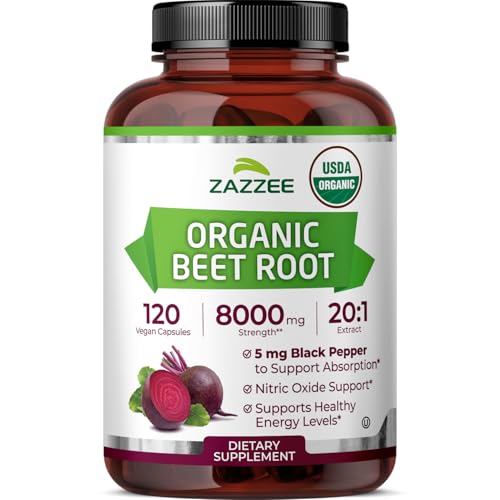
Zazzee Organic Beet Root 20:1 Extract differs from the 1,300 mg powder capsules because it uses a 20:1 organic beet root extract and includes organic black pepper extract, according to its maker. Its 120-capsule bottle is twice the capsule count of the two 60-count formulas, and the maker calls it a four-month supply. The product also identifies itself as vegan and certified kosher. An extract ratio does not translate directly into the same amount of beet powder, so this is a partial match rather than a like-for-like powder alternative; choose it if the extract format is your priority.
Bottom line: Choose this if you specifically want a 20:1 extract and a 120-capsule bottle.
How to compare beet powder and extract
Beet powder milligrams and extract ratios describe different things, so compare like with like. A 1,300 mg powder serving reports the mass of powder; a 20:1 ratio describes the relationship between starting material and extract, not a 20-fold nitrate dose. Nitrate content can vary with the beet source and processing, and none of the three supplied product facts gives a nitrate amount. Use this quick guide to avoid treating unlike numbers as equivalent.
| Label detail | What it tells you | What it does not establish |
|---|---|---|
| Powder milligrams | Mass of beet powder per serving | Nitrate content |
| Extract ratio | Concentration ratio for the extract | Equivalent powder dose or nitrate dose |
| Capsule count | Number of capsules in the bottle | Servings without capsules per serving |
For a like-for-like comparison, start with the same form and serving basis; if nitrate content is your deciding factor, confirm that the product provides a measured amount.
What organic and facility claims mean
USDA organic certification and a facility-compliance claim are different kinds of claims. Organic certification concerns how agricultural ingredients are produced and handled under the USDA National Organic Program; a manufacturing facility claim concerns production practices. The Rosabella and Zazzee products identify themselves as organic, while the second formula’s claims focus on non-GMO status and facility compliance. The second formula’s maker cites cGMP and NSF/ANSI 455-2:2021, but that is not the same as USDA organic certification. If organic certification is a requirement, confirm the current package carries the certification mark before ordering; do not infer certification from the word “natural.”
How to choose a capsule count and serving
Capsule count alone does not determine how long a bottle lasts; divide the count by the number of capsules in the serving. For example, a 60-count bottle lasts 30 days only when the serving is two capsules daily, while a 120-count bottle lasts 120 days at one capsule daily. The Rosabella and second powder formulas are identified as 30-day supplies, and the Zazzee extract as a four-month supply, but the facts do not give capsules per serving for each. Use the labeled serving size rather than assuming that every beet capsule is a one-capsule serving. If serving size is decisive, confirm it on the package before purchase.
Safety and routine considerations for beet supplements
People using medication that affects blood pressure should ask a clinician before adding a beet supplement, because beet compounds may affect blood pressure. Beet foods and supplements can also be relevant for people prone to calcium-oxalate kidney stones; discuss personal risk with a clinician rather than assuming a capsule is risk-free. Dietary supplements are not pre-approved by the FDA for effectiveness before marketing, so a facility or organic claim does not establish a health benefit. Follow the product label’s serving directions, avoid combining products to increase a dose, and stop use and seek medical advice if you have a concerning reaction.
Frequently Asked Questions
Does 1,300 mg of beet powder mean 1,300 mg of nitrate?
No. The 1,300 mg figure refers to beet powder mass, not nitrate content. Nitrate levels vary, so look for a measured nitrate amount if that is the basis for your choice.
Is beet root powder interchangeable with a 20:1 extract?
No, the numbers describe different measures. Powder milligrams give ingredient mass, while 20:1 is an extract ratio and does not establish an equivalent nitrate dose.
How do I work out how many days a bottle lasts?
Divide the capsule count by the number of capsules in the labeled daily serving. A 60-capsule bottle lasts 30 days at two capsules per day, but 60 days at one capsule daily.
Should I ask a doctor before taking beet capsules?
Ask a clinician first if you take medication that affects blood pressure or have a history of calcium-oxalate kidney stones. Individual medicines and medical history can change whether a supplement is appropriate.
Does a cGMP facility claim mean a beet supplement is organic?
No. A cGMP facility claim concerns manufacturing practices, while USDA organic certification concerns agricultural production and handling. Check the package for an organic certification if that matters to your choice.