
Small Sanders for Tight Places: 5 Types Compared

For most home projects, HYCHIKA Compact Detail Sander is the most versatile small sander for tight places because it combines a compact electric body with 14,000 OPM and a dust bag; choose a pneumatic mini sander instead if you already have a compatible air supply and need a 2- or 3-inch pad.
These tools range from powered orbital sanders to manual blocks, so match the tool to the space, finish and power source you have.
We earn a commission if you buy through links on this page. As an Amazon Associate I earn from qualifying purchases. Products are compared on manufacturer specifications, not hands-on testing.
- Best overall: HYCHIKA Compact Detail Sander – Compact electric detail sander with dust bag, six-hole dust collection and 14,000 OPM.
- Best for narrow powered sanding: PROSHI 2- and 3-Inch Angle Air Sander – Pneumatic angle-head sander includes interchangeable 2- and 3-inch pads.
- Best for hand finishing: POLIWELL 3.5-Inch Mini Hand Sander – Small foam block fits under an index finger and includes five grits.
| Product | Best for | Power or method | Pad or block size | Speed | Shop |
|---|---|---|---|---|---|
| HYCHIKA Compact Detail Sander | Home detail sanding | Electric, 1.6 A | 5.51 × 3.54 inches | 14,000 OPM | Check Price on Amazon |
| PROSHI 2- and 3-Inch Angle Air Sander | Small auto surfaces | Pneumatic | 2- and 3-inch pads | Adjustable regulator | Check Price on Amazon |
| ZHONG AN 2- and 3-Inch Air Sander | Auto detailing | Pneumatic | 2- and 3-inch pads | 13,000 RPM | Check Price on Amazon |
| POLIWELL 3.5-Inch Mini Hand Sander | Manual detail work | Manual foam block | 3.5 × 1 inches | Hand-powered | Check Price on Amazon |
| DEKOPRO 1A Electric Mouse Sander | Furniture corners | Corded electric, 100 W | Mouse-shaped base | 13,000 RPM | Check Price on Amazon |
Small Sanders for Tight Places Compared
Match the sander’s working footprint and power source to the surface and access you have.
HYCHIKA Compact Detail Sander

For a compact electric detail sander, this model pairs 14,000 OPM with a six-hole dust collection system and a dust bag. It comes with twelve hook-and-loop sheets in P80, P120 and P240 grits, each 5.51 × 3.54 inches, for coarse, medium and fine sanding. The small-corner, paint-removal and rust-removal tasks described for the tool suit DIY users who want powered sanding without an air compressor. Its paper footprint is larger than a narrow crevice, so it is better for reachable flat patches and corners than very thin gaps.
Bottom line: Choose this for powered home projects where the surface can accommodate its paper footprint.
PROSHI 2- and 3-Inch Angle Air Sander
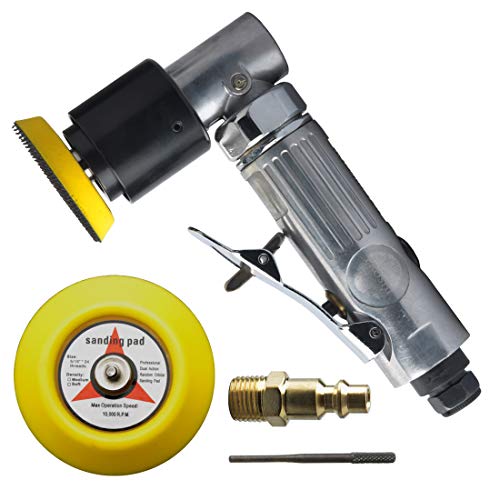
The angle head and interchangeable 2- and 3-inch pads distinguish this pneumatic sander from larger-footprint detail tools. A built-in regulator lets the operator adjust speed for sanding, polishing or waxing, and hook-and-loop pads support quick disc changes. The applications span metal, wood, plastic, rubber and stone, making it a fit for small surface work when compressed air is available. The key limitation is the air supply requirement: without a compressor and suitable hose setup, this tool cannot serve as a standalone option.
Bottom line: Choose this when you have compressed air and want small powered pads for edges or auto work.
ZHONG AN 2- and 3-Inch Air Sander

The 13,000 RPM speed sets this dual-size pneumatic sander apart from the other small-pad air option here. Its 2- and 3-inch hook-and-loop pads are intended for confined automotive areas such as door jambs, wheel wells and grille gaps, as well as woodworking and metalwork. The maker describes its action as dual-action random orbit, intended to leave even sanding traces. This model is best suited to users with compressed air who prioritize small-area detailing; buyers needing a corded household tool should choose an electric detail sander instead.
Bottom line: Pick this for compact auto detailing if you already have an air source.
POLIWELL 3.5-Inch Mini Hand Sander

This manual foam block is the only non-powered option in the group, so it gives direct control in small crevices without a cord or air hose. The 3.5 × 1-inch polyurethane foam body fits under an index finger, and the kit includes 100 aluminum-oxide sheets across 80, 120, 180, 240 and 400 grit. It suits crafts and small wood or plastic projects where careful hand pressure matters more than rapid material removal. Manual sanding takes more time and effort over broad areas than a powered tool.
Bottom line: Choose this for controlled hand sanding in small crevices and craft work.
DEKOPRO 1A Electric Mouse Sander

The mouse-shaped base and five included paper grades make this corded sander a useful alternative when a pointed detail sander profile suits furniture edges and corners. Its 100 W motor runs at up to 13,000 RPM, and the 15 four-hole sheets range from P60 through P1000, covering rough removal through fine finishing. A dust collection bag and tube are included. The features do not give a base measurement, so buyers with a very narrow slot should confirm the working footprint before choosing it.
Bottom line: Choose this for corded furniture and woodworking tasks that benefit from a pointed base.
How to choose a small sander for tight places
Choose by the narrowest part of the work area, not by the tool’s overall body size. A 2-inch pad covers a smaller footprint than a conventional 5-inch random-orbit pad, while a pointed mouse base or finger-sized hand block can reach corners where a round pad cannot. For a space narrower than the pad, hand sanding may offer better access. Also decide whether you have compressed air: pneumatic tools need an air source, while corded electric tools need an outlet. For a practical rule, if the surface patch is under 2 inches wide, favor a small-pad air sander or hand block over a broad detail base.
| Work condition | Tool type to consider |
|---|---|
| Small flat patch with power nearby | Electric detail sander |
| Auto spot or edge with compressed air | 2- or 3-inch pneumatic sander |
| Very narrow crevice or controlled finish | Manual mini block |
Air sanders and electric detail sanders compared
Pneumatic mini sanders use compressed air to drive a small rotating or orbital pad; electric detail sanders run from household power and often have a shaped base for corners. A small pneumatic pad can be easier to position on a localized curved or flat area, but the compressor, hose and fittings become part of the setup. Electric tools are self-contained apart from the cord and can include dust collection, which matters indoors. Manual blocks avoid both power setups and give direct pressure control. A common mistake is choosing by RPM alone: speed does not tell you the tool’s usable footprint, orbit pattern, dust handling or whether its power source fits your workspace.
Match sanding paper and grit to the task
Grit number indicates abrasive coarseness: lower numbers remove material more aggressively, while higher numbers refine scratches and prepare a surface for finishing. The included paper ranges here begin at P60 for coarse work and extend to P1000 for fine finishing, but the correct progression depends on the material and the finish goal. Avoid jumping directly from a very coarse grit to a very fine one; the finer abrasive may not remove deep scratches efficiently. Match the paper attachment as well: hook-and-loop discs or sheets need a compatible backing pad, and a sheet’s dimensions must fit the tool base. Use lighter pressure near edges to reduce the chance of cutting through a finish.
Control dust and protect yourself while sanding
Sanding creates airborne dust, and coatings or metal work can add hazards beyond ordinary wood dust. Use eye protection and a properly fitted particulate respirator, especially when sanding paint or unknown coatings; older paint may contain lead, so do not dry-sand it casually. A dust bag or extraction system can capture some debris but does not replace respiratory protection or room ventilation. Keep the workpiece secured, keep hands clear of the moving pad, and disconnect a corded tool or air supply before changing abrasive. For automotive work, avoid sanding hot panels and protect nearby glass, trim and paint that should remain untouched.
Frequently Asked Questions
What size sander works best in tight spaces?
A 2- or 3-inch pad suits small open patches, while a finger-sized hand block or pointed detail base can reach narrower corners. If the gap is narrower than the pad, use hand sanding rather than forcing a powered tool into it.
Can an air sander run without a compressor?
No, a pneumatic sander needs compressed air delivered through a hose and compatible fittings. Check the tool’s required air pressure and flow against the compressor before using it.
What grit should I use to remove paint?
P60 or P80 abrasive removes material more aggressively than P240 or P400, but the right starting grit depends on the coating and substrate. Test an inconspicuous area first and step through finer grits to reduce visible scratches.
How do I keep a small sander from leaving swirl marks?
Use the abrasive grade suited to the material, keep the pad flat, and avoid pressing hard or lingering in one spot. Random-orbit action can reduce patterned marks, but it does not eliminate the need for a consistent sanding progression.
Is a dust bag enough protection when sanding?
No, a dust bag captures some particles but does not prevent all airborne dust. Wear eye protection and a suitable respirator, and provide ventilation, particularly when working on paint or metal.