
Solar Stick-On Lights: 3 Step and Deck Options Compared

DetarZinLED Solar Step Lights, 6-Pack is the strongest fit for most buyers seeking solar stick-on lights because its product name explicitly identifies it as stick-on and its shell is rated IP68 by the maker. Choose Solar Flat Strip Deck Lights, 8-Pack for a larger flat strip format, or SOLPEX Solar Deck Lights, 16-Pack if you need more lights but can confirm its mounting method before ordering.
Solar stick-on lights are compact outdoor fixtures that collect sunlight during the day and illuminate after dark; their usefulness depends on both a sunlit panel and a clean, compatible mounting surface.
We earn a commission if you buy through links on this page. As an Amazon Associate I earn from qualifying purchases. Products are compared on manufacturer specifications, not hands-on testing.
- Best overall: DetarZinLED Solar Step Lights, 6-Pack – Explicitly identified as stick-on, with an IP68 waterproof rating claimed by the maker.
- Best for flat strips: Solar Flat Strip Deck Lights, 8-Pack – An eight-pack with a flat, rounded-rectangle profile for steps, docks, or driveways.
- Best for larger sets: SOLPEX Solar Deck Lights, 16-Pack – A 16-pack with automatic dusk-on and dawn-off operation, though the mounting method needs confirmation.
| Product | Best for | Pack size | Color | Shop |
|---|---|---|---|---|
| DetarZinLED Solar Step Lights, 6-Pack | Weather exposure | 6 lights | Warm white | Check Price on Amazon |
| SOLPEX Solar Deck Lights, 16-Pack | More fixtures | 16 lights | Warm white | Check Price on Amazon |
| Solar Flat Strip Deck Lights, 8-Pack | Flat surfaces | 8 lights | Color needs confirmation | Check Price on Amazon |
Solar stick-on lights compared
Compare these step and deck lights by pack size, weather rating, and color before deciding where to mount them.
DetarZinLED Solar Step Lights, 6-Pack

DetarZinLED Solar Step Lights, 6-Pack stands apart with its explicit stick-on positioning and a polycarbonate shell. The maker says the integrated, ultrasonically welded design reaches IP68 and can withstand up to 5 tons of load, making this set the clearest match for exposed steps or walkways where surface durability matters. Each light measures about 6.0 inches long, 1.7 inches wide, and 1.0 inch high. The tradeoff is the six-light pack size; buyers covering a long run of stairs or a wide deck may need more fixtures than this set provides.
Bottom line: Choose this set when an explicitly stick-on design and a maker-claimed IP68 rating matter most.
SOLPEX Solar Deck Lights, 16-Pack
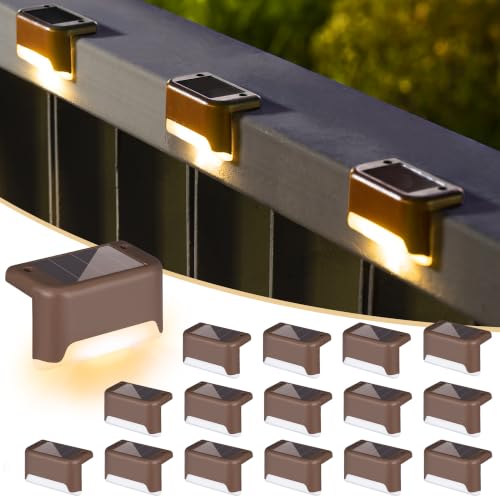
SOLPEX Solar Deck Lights, 16-Pack gives you the largest set here, with 16 warm-white deck lights for spreading along multiple steps, a fence, or a patio edge. The maker says the lights switch on automatically at dusk and off at dawn, and that a sunny day can provide a full charge in 4 to 5 hours. Each unit measures about 3.5 inches long, 1.8 inches wide, and 1.9 inches high. The key limitation for a stick-on search is that its product name and features do not establish an adhesive mounting method; confirm the attachment style before choosing it for a no-drill installation.
Bottom line: Pick this set if you need more fixtures and can verify that its mounting method suits your surface.
Solar Flat Strip Deck Lights, 8-Pack

Solar Flat Strip Deck Lights, 8-Pack is the flat, rounded-rectangle option, with an eight-light set positioned for steps, docks, driveways, and paths. The product features describe a 30-LED wraparound glow, automatic dusk-on and dawn-off operation, and an ABS body intended to resist impacts; those performance and durability points are maker claims. Its dimensions are about 6.2 inches long, 6.9 inches wide, and 2.2 inches high, so check the available landing area before mounting. The color needs confirmation: the product name and color field say warm white, while the maker says blue.
Bottom line: Choose this style for a broad, flat mounting area after confirming the light color.
How to choose solar stick-on lights
Start with the mounting surface and available sunlight, then compare pack size and light direction. Outdoor solar panels need direct exposure to recharge; shade from eaves, trees, or railings reduces the sunlight reaching the panel and can shorten nighttime operation. Measure each step or landing before choosing a fixture: a light about 6 inches long needs a different footprint from one about 3.5 inches long. For a narrow stair tread, favor a compact fixture that does not intrude on the walking area; for a broad dock or deck edge, a wider strip can spread light over more of the surface. Confirm whether the set attaches with adhesive, screws, or another method, because a no-drill requirement makes mounting type decisive.
Mounting surfaces and sunlight placement
Mount solar lights where the panel faces open sky and the adhesive or fastener meets a clean, dry surface. Dust, moisture, peeling paint, rough wood grain, and textured masonry can all weaken adhesive contact; smooth, sound surfaces generally offer more reliable contact area. Allow the surface to dry fully after cleaning, and avoid placing the panel beneath an overhang that blocks midday sun. On stairs, position lights so they illuminate the tread without creating glare at eye level or narrowing the usable step. For uneven or porous surfaces, do not assume a peel-and-stick pad will hold; choose a mounting method suited to that surface instead. Keep the fixture accessible enough to wipe dirt from its solar panel periodically.
Compare step, deck, and strip light styles
Compact step lights, multi-piece deck sets, and broad flat strips solve different coverage problems. A compact fixture can fit narrow stair edges, while a larger pack makes it easier to place lights at regular intervals across a long run. Flat strip formats occupy more surface area and may suit wide landings or dock edges, but they need room around the mounting point. Use the table to match the format to the space you measured.
| Need | Useful format | Check before mounting |
|---|---|---|
| Narrow steps | Compact step light | Fixture footprint and walking clearance |
| Several stairs or a broad deck | Higher-count set | Light spacing and mounting method |
| Wide landing or dock edge | Flat strip format | Available surface area and color |
Warm-white and blue light create different appearances, so confirm the intended color when the product wording conflicts.
Solar charging and upkeep
Solar lights charge best in an unshaded location, and dirty panels can collect less sunlight than clean ones. A set that requires 4 to 5 hours of sun for a full charge still depends on the amount and intensity of sunlight available at the installation spot. Wipe the panel with a soft, damp cloth when dust or pollen accumulates, and check that branches or seasonal growth have not started shading it. Rainy weather and winter days can reduce charging time, so automatic dusk-to-dawn operation does not guarantee the same runtime every night. Before installation, switch on any fixture that has a manual power control, and check that the light activates in darkness rather than under nearby porch lighting.
Frequently Asked Questions
How much sun do stick-on solar lights need?
Direct, unobstructed daylight is best because shade reduces the energy reaching the panel. One set in this comparison says 4 to 5 hours on a sunny day can fully charge it; overcast weather or partial shade can reduce operating time.
Will adhesive solar lights stick to rough wood?
Adhesive holds more reliably on clean, dry, smooth surfaces than on rough or porous wood. If the wood sheds fibers, has peeling finish, or stays damp, use a mounting approach designed for that material rather than assuming a stick-on pad will hold.
Where should solar step lights go on stairs?
Place each light where it can illuminate the tread without reducing walking clearance or shining directly into a person’s eyes. Measure the fixture first; a unit about 6 inches long may not fit a narrow stair edge.
Can solar deck lights charge in cloudy weather?
They can receive some daylight in cloudy conditions, but weaker sunlight can reduce charging and nighttime runtime. Obstructions such as roof eaves and tree cover further limit the light reaching the panel.
How often should solar light panels be cleaned?
Clean a panel when dust, pollen, or grime visibly covers it, since a clean surface admits more sunlight. Use a soft damp cloth and avoid abrasive tools that could scratch the panel.