
SpeeCo 3 Point Quick Hitch: Category 1 Compared

For most Category 1 tractor owners, SpeeCo Category 1 Quick E-Hitch S1411601K is the SpeeCo 3-point quick hitch to consider first because it connects to Category 1 implements without adapter bushings. Choose SpeeCo Category 1 OEM Quick Hitch S14110100 instead if you want its spring-loaded lower-pin levers and adjustable top hook; Category 2 tractor owners need a different fit.
A 3-point quick hitch stays on the tractor and lets compatible implements connect at the lower lift arms and top link with less manual pinning.
We earn a commission if you buy through links on this page. As an Amazon Associate I earn from qualifying purchases. Products are compared on manufacturer specifications, not hands-on testing.
- Best overall: SpeeCo Category 1 Quick E-Hitch S1411601K – Its Category 1 design connects without adapter bushings.
- Best for locking levers: SpeeCo Category 1 OEM Quick Hitch S14110100 – Spring-loaded levers secure the lower lift pins, and the top hook adjusts.
- Best for Category 2: Garvee Category 2 Quick Hitch – Its fit is Category 2 tractors and implements, not Category 1.
| Product | Best for | Category | Lift capacity | Overall dimensions | Shop |
|---|---|---|---|---|---|
| SpeeCo Category 1 Quick E-Hitch S1411601K | Bushing-free hookup | Category 1 | 2,000 lb | 32 × 26 × 9 in. | Check Price on Amazon |
| SpeeCo Category 1 OEM Quick Hitch S14110100 | Lever-secured hookup | Category 1 | 50 hp capacity | — | Check Price on Amazon |
| Garvee Category 2 Quick Hitch | Category 2 tractors | Category 2 | 4,000 lb | 37 × 24 × 9 in. | Check Price on Amazon |
SpeeCo 3 Point Quick Hitch Options
Match the hitch category and implement hookup style before comparing frame size or capacity.
SpeeCo Category 1 Quick E-Hitch S1411601K
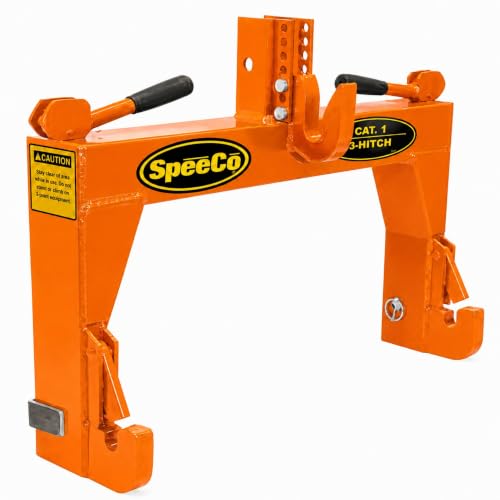
SpeeCo Category 1 Quick E-Hitch S1411601K is the SpeeCo option here that explicitly connects to Category 1 implements without adapter bushings. Its adjustable top-link bracket adds setup flexibility, and its powder-coated steel frame measures 32 inches long by 26 inches high by 9 inches wide. The maker says the hitch works with most Category 1 attachments, including brush cutters, land planes and snow blowers.
This model suits owners prioritizing a bushing-free connection. Its 2,000-pound lift capacity is lower than the 4,000-pound figure for the Category 2 alternative, so choose by tractor and implement limits rather than assuming the larger number is interchangeable.
Bottom line: Choose it for a Category 1 setup that needs no adapter bushings.
SpeeCo Category 1 OEM Quick Hitch S14110100

SpeeCo Category 1 OEM Quick Hitch S14110100 stands apart from the other SpeeCo option with spring-loaded lower-pin levers and an adjustable top hook. The maker says the hitch is for Category 1 tractors with a 50-horsepower capacity; it includes bushings and uses 7/8-inch pins. That combination makes it a candidate for owners whose implements need the included bushing arrangement and who prefer lever-secured lower connections.
Unlike SpeeCo Category 1 Quick E-Hitch S1411601K, this model does not provide a frame size or a pound-based lift rating in the specifications. Verify that your implements’ pin and hook positions work with its adjustable top hook before choosing it.
Bottom line: Choose it for spring-loaded lower-pin levers and an adjustable top hook.
Garvee Category 2 Quick Hitch

Garvee Category 2 Quick Hitch is a Category 2 alternative rather than a SpeeCo or Category 1 hitch. It has 2-inch receivers, a five-level adjustable bolt and a triangular welded frame; the maker claims a 4,000-pound capacity and fit for most Category 2 tractors. Its frame measures 37 inches long by 24 inches high by 9 inches wide.
This option suits a Category 2 tractor and matching implements, not a Category 1 setup. Category 2 lower pins are larger than Category 1 pins, so the capacity alone does not establish compatibility; confirm tractor and implement categories before purchase.
Bottom line: Choose it only for a matching Category 2 tractor and implement set.
How to Choose a SpeeCo 3-Point Quick Hitch
Choose by hitch category first, then compare the connection style and stated capacity. Category 1 lower lift pins are typically 7/8 inch in diameter; Category 2 lower pins are typically 1-1/8 inches, so those categories do not become interchangeable just because a hitch frame can be attached to a tractor. Top-link and implement geometry also need to match.
Use the tractor manual’s hitch category and lift limits as the starting point. Then check each implement’s lower pin spacing and top-hook position against the hitch. A quick hitch changes the distance and geometry between tractor and implement; some implements need compatible pins or bushings, while others may not align at all. If your implement sits too high or cannot latch at the top, do not treat added capacity as a fix.
Category 1 and Category 2 Fit Differences
Category 1 and Category 2 quick hitches serve different pin sizes and tractor classes. Typical lower-pin diameters are 7/8 inch for Category 1 and 1-1/8 inches for Category 2; top-link pin sizes also differ, commonly 3/4 inch and 1 inch respectively. Confirm measurements on the tractor and implement rather than relying on category labels alone, especially with older or modified equipment.
The practical rule is simple: if the tractor and implement show different categories, do not buy based only on a hitch’s capacity figure. Category 2 may offer a larger frame and pin arrangement, but that does not make it a substitute for a Category 1 hitch. Check clearance around fenders, tires and PTO guards too, because a quick hitch can change the implement’s position relative to the tractor.
Quick Hitch Hookup and Clearance Checks
Before attaching an implement, park on firm, level ground, lower the three-point arms and shut off the tractor. Keep hands clear of pinch points while aligning lower pins and the top link, and never stand between a tractor and an implement while the tractor is moving. Use the tractor’s parking brake and prevent rolling before making connections.
After latching, raise the implement only a few inches and check that both lower connections and the top hook remain engaged. Confirm that the PTO shaft has adequate overlap and does not bottom out through the full lift range; a quick hitch can alter the distance. Keep people clear of a raised implement, and never work underneath one supported only by the tractor’s hydraulics.
Quick Hitch Compatibility Mistakes to Avoid
The most common mistake is assuming every implement in a category will latch without adjustment. Quick hitches have fixed frame geometry, while implement pin locations, top-link brackets and attachment widths can vary; a model that fits one mower may not clear another. Compare measurements and hook positions before relying on a general compatibility claim.
Another mistake is treating a hitch’s capacity as the tractor’s safe lifting limit. The tractor’s three-point lift rating, measured at a specified distance behind the lift points, and the implement’s weight and center of gravity also matter. A heavy implement extending farther back creates more leverage. Choose a hitch only when its category, tractor limits and implement geometry all agree.
Frequently Asked Questions
What size are Category 1 quick hitch pins?
Category 1 lower lift pins are typically 7/8 inch in diameter, and the top-link pin is commonly 3/4 inch. Check your implement measurements because worn or altered parts may differ.
Can a Category 1 quick hitch fit Category 2 implements?
Not as a direct fit: Category 2 lower pins are typically 1-1/8 inches, compared with 7/8 inch for Category 1. Use a hitch and any approved adapters that match the tractor and implement categories.
How do I check quick hitch implement compatibility?
Compare the implement’s lower-pin spacing, pin diameters and top-link position with the hitch geometry before connecting. Then verify that the PTO shaft has safe overlap and does not bottom out throughout the lift range.
Does a quick hitch reduce tractor lift capacity?
A quick hitch moves the implement farther behind the tractor’s lift points, increasing leverage and potentially reducing what the tractor can safely lift. Follow the tractor’s lift rating and account for implement weight and how far its center of gravity sits behind the hitch.
Is it safe to work beneath a raised implement?
No; never work under an implement held only by tractor hydraulics. Lower it to the ground or support it with equipment rated for the load, and keep people clear while lifting or lowering.