
Speed Radar Gun Baseball: 4 Models Compared

The Bushnell Velocity Bushnell Velocity Speed Gun is the broad-use pick for baseball and other sports, with a maker-stated measurement range of 10 to 200 mph and a one-handed grip. Choose a ball-focused model instead if you want a pocket-size unit or app-linked video analysis.
We earn a commission if you buy through links on this page. As an Amazon Associate I earn from qualifying purchases. Products are compared on manufacturer specifications, not hands-on testing.
- Best overall: Bushnell Velocity Speed Gun – Measures 10 to 200 mph and is designed for one-handed use across sports.
- Best for video analysis: Pocket Radar Smart Coach – Pairs speed readings with a companion app that can overlay velocity on video.
- Best for pocket portability: Pocket Radar Ball Coach – A stand-alone ball-speed radar weighing 0.25 pounds.
- Best for training displays: PLAYAPUT Baseball Radar Gun – Offers side LED and rear LCD displays, plus recall for the last ten records.
| Product | Best for | Speed range or accuracy | App support | Weight | Shop |
|---|---|---|---|---|---|
| Bushnell Velocity Speed Gun | Multi-sport use | 10–200 mph | No app feature given | 1.1 lb | Check Price on Amazon |
| Pocket Radar Smart Coach | Video analysis | ±1 mph at 120 ft for baseball | iOS/Android companion app | 0.25 lb | Check Price on Amazon |
| Pocket Radar Ball Coach | Pocket portability | Fastest ball speed; no range figure | Not compatible | 0.25 lb | Check Price on Amazon |
| PLAYAPUT Baseball Radar Gun | Group displays | 3–150 mph; ±1 mph/kph | No app feature given | — | Check Price on Amazon |
Baseball speed radar guns
Compare the models by their speed capabilities, app features and portability before choosing a setup.
Bushnell Velocity Speed Gun

The Bushnell Velocity is the broadest-use option here: it is made for sports as well as automotive speed monitoring, rather than only ball-in-flight measurement. The maker says it reads speeds from 10 to 200 mph, and its pistol-grip shape is intended for one-handed operation with a large LCD. Its 1.1-pound weight and 8.4-inch width make it less pocketable than the compact Pocket Radar units. Choose it if you want one handheld device for baseball and other speed-measurement situations; buyers focused on ball-only readings may prefer a dedicated ball radar.
Bottom line: Pick this for broad sports use and a wide stated measurement span.
Pocket Radar Smart Coach
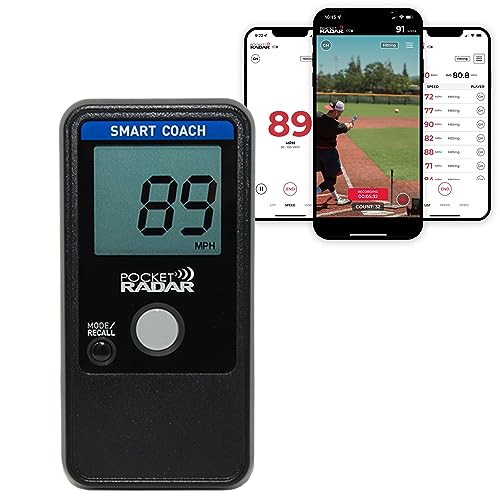
The Smart Coach is distinguished by app-connected video analysis: its companion app can overlay radar readings on video for mechanics review. The maker claims ±1 mph accuracy on a baseball thrown from 120 feet and says softball readings can be taken from 150 feet. At about a quarter pound and roughly 4.5 inches long, this handheld unit is compact compared with the Bushnell. Its app capability is the key reason to choose it, but anyone wanting a simpler stand-alone unit may not need the video workflow.
Bottom line: Choose this when app-linked video is part of the training routine.
Pocket Radar Ball Coach

The Ball Coach is a stand-alone ball-speed radar, not the app-connected Smart Coach. Its maker says it finds the fastest speed of a ball or puck across sports including baseball, softball, tennis and cricket; the product is explicitly not compatible with the Pocket Radar app. Its 0.25-pound weight and 4.6-inch length make it easy to carry compared with a pistol-grip unit. A two-year manufacturer warranty is included. Choose it for portable, straightforward readings, but choose another model if recording readings alongside video is essential.
Bottom line: Pick this for portable ball-speed readings without app integration.
PLAYAPUT Baseball Radar Gun

The PLAYAPUT separates itself with two viewing angles: a side LED display and a rear LCD, plus recall for the last ten records. The maker gives a 3 to 150 mph measurement range and ±1 mph/kph accuracy, with a lower-speed mode below 25 mph and a higher-speed mode above that threshold. It can be handheld or used hands-free with its tripod. It suits practices where multiple players need to see readings.
Bottom line: Choose this when dual displays and recent-reading recall matter.
How to choose a baseball speed radar gun
Choose by measurement purpose first: a radar gun aimed at a moving ball reads ball speed, while a training sensor attached to or used with a ball is a different tool. Compare whether the unit gives a speed range, an accuracy, app functions or only a fastest-speed reading; those are not interchangeable specifications. A gun with a upper limit of 150 mph covers ordinary baseball pitch readings, while a broader range can serve other sports or uses. For practice groups, prioritize a display visible to the pitcher and coach; for solo review, app and video functions may be more useful. Do not treat an accuracy claim at a distance as proof of the same accuracy at every distance.
Radar placement and baseball speed readings
Radar readings depend on aim: point the unit along the ball’s path rather than across it, because an angle can make the displayed speed lower than the ball’s actual speed. This is called cosine error; a small alignment error matters less than a large one. Baseball pitching distance from mound to home plate is 60 feet 6 inches, but a radar gun can be positioned behind the pitcher or catcher depending on the measurement setup. Keep the device steady and aim through the ball’s path, not at a moving background. Pitch readings also depend on when the radar captures the ball: a speed near release can differ from a reading closer to the plate as the ball slows.
Ball radar guns versus pitching sensors
A handheld radar gun measures a moving ball without attaching a sensor to it; a ball-based pitching sensor is a different category and should not be compared as a radar gun. This distinction matters when buying for a team, since a gun can measure varied ball or puck sports, while a purpose-built sensor may tie readings to one training routine. Radar devices also differ in whether they capture the fastest ball speed, provide an app connection, or simply show a live number. A displayed number is not automatically a pitcher’s release velocity: location and timing shape what the radar captures. For a radar gun, the table below identifies which models emphasize a range, app workflow or portable stand-alone use.
| Need | Choose by |
|---|---|
| Broad sport use | Wide stated speed span |
| Video-based review | App and video integration |
| Simple ball readings | Stand-alone fastest-speed measurement |
| Practice visibility | Display placement and reading recall |
Safe setup and common reading mistakes
Keep the radar operator and equipment outside the throwing lane, and never have a player retrieve a ball while another player is throwing. For repeated practice, use a clear lane with players waiting behind the thrower; radar equipment does not make an unsafe throwing setup safe. A common mistake is comparing readings from different positions as though they were identical: a reading close to release and one near the plate measure at different points in flight. Another is swinging the gun across the ball’s trajectory, which increases alignment error. Record the measurement position and use the same setup when comparing sessions so changes in device placement do not masquerade as changes in pitching speed.
Frequently Asked Questions
Why can two radar guns show different pitch speeds?
Radar placement and timing can change the result because a pitch loses speed as it travels from release toward home plate. Aim along the ball’s path; an off-angle reading can be reduced by cosine error.
Where should I stand to measure a baseball pitch?
Stand behind the pitcher or catcher with a clear view down the ball’s path, and keep the operator out of the throwing lane. The standard mound-to-plate distance is 60 feet 6 inches, but the radar’s position determines which part of the flight it captures.
Does a radar gun measure release velocity?
Only if the radar setup captures the ball close to release; a reading farther down the flight path will generally be lower as the pitch slows. Keep the device position consistent when comparing readings.
How far away can a baseball radar gun read?
The useful distance depends on the model and the target: one model here claims ±1 mph accuracy for baseball at 120 feet. Do not assume that accuracy or distance applies to a different radar gun.
Can one radar gun measure other sports balls?
Some handheld sports radar guns can measure balls in multiple sports, but the supported targets vary by model. Check that the device names your sport and ball type before relying on it.