
STA-BIL Diesel Fuel Stabilizer: Sizes Compared

STA-BIL diesel fuel stabilizer is available in sizes that treat 320 to 1,280 gallons, so choose by the total diesel volume you plan to store. STA-BIL Diesel Stabilizer, 32 oz is the straightforward choice for up to 320 gallons; choose STA-BIL Diesel Stabilizer, 128 oz for a larger batch and STA-BIL Diesel Stabilizer, 32 oz 4-Pack if you want multiple 32-ounce bottles.
For routine cold-weather operation rather than long-term storage, consider a seasonal diesel treatment instead; these stabilizer sizes are the closer match for preserving stored fuel.
We earn a commission if you buy through links on this page. As an Amazon Associate I earn from qualifying purchases. Products are compared on manufacturer specifications, not hands-on testing.
- Best overall: STA-BIL Diesel Stabilizer, 32 oz – The 32-ounce bottle treats up to 320 gallons and is a practical size for a single storage batch.
- Best for large tanks: STA-BIL Diesel Stabilizer, 128 oz – The 128-ounce jug treats up to 1,280 gallons.
- Best for multiple containers: STA-BIL Diesel Stabilizer, 32 oz 4-Pack – The package contains four 32-ounce bottles for separate storage or dosing needs.
| Product | Best for | Package size | Stated treatment capacity | Package count | Shop |
|---|---|---|---|---|---|
| STA-BIL Diesel Stabilizer, 32 oz | Single storage batch | 32 fl oz | 320 gal | 1 bottle | Check Price on Amazon |
| STA-BIL Diesel Stabilizer, 128 oz | Large storage volume | 128 fl oz | 1,280 gal | 1 bottle | Check Price on Amazon |
| STA-BIL Diesel Stabilizer, 32 oz 4-Pack | Several fuel containers | 4 × 32 fl oz | 320 gal stated | 4 bottles | Check Price on Amazon |
STA-BIL Diesel Fuel Stabilizer Sizes
Compare the package formats by how much fuel each is intended to treat and how you plan to store it.
STA-BIL Diesel Stabilizer, 32 oz
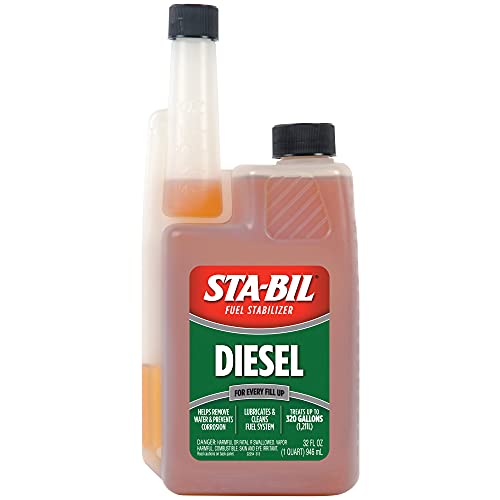
For a single batch of stored diesel, this 32-ounce bottle is sized to treat up to 320 gallons. The product name says it keeps fuel fresh for up to 12 months, and the maker describes sludge and sediment prevention along with cleaning and lubrication of fuel-system components. That combination makes it a fit for owners preserving a moderate volume rather than buying a larger container. Its limit is capacity: storage operations above 320 gallons need multiple doses or a larger package, so calculate the batch volume before treating fuel.
Bottom line: Choose this bottle when your stored batch is no more than 320 gallons.
STA-BIL Diesel Stabilizer, 128 oz

This one-gallon container is the large-volume option, with a treatment capacity of 1,280 gallons. It is intended for buyers treating a substantial reserve in one container rather than keeping several smaller bottles on hand. The product name gives the same up-to-12-month freshness claim as the smaller bottle, and its features describe sludge and sediment prevention plus fuel-system cleaning and lubrication. The larger jug is less convenient when treating only a small quantity; measure the fuel volume and dose proportionally rather than assuming the whole jug is needed.
Bottom line: Pick this jug for a storage supply approaching 1,280 gallons.
STA-BIL Diesel Stabilizer, 32 oz 4-Pack

This package differs from the single-bottle options by providing four 32-ounce bottles, which can be useful when treating separate containers or keeping doses divided. The product name states a 320-gallon treatment capacity; use the bottle directions to determine the dose for each container rather than assuming a package-wide capacity. A four-pack is less suited to someone who wants one compact bottle or a single large jug, and the capacity wording should be checked against the dosing directions before splitting treatment among multiple tanks.
Bottom line: Choose the four-pack when separate bottles suit your storage setup.
How to choose a diesel fuel stabilizer size
Choose a package by matching its treatment capacity to the gallons you will actually store. Diesel fuel is commonly stored for months, but heat, oxygen exposure, and water contamination can accelerate degradation; a cool, sealed tank with little headspace generally supports better storage than a partly filled tank exposed to temperature swings. Additive dosing is based on fuel volume, not tank capacity, so estimate the amount of fuel present before treating. A useful rule is to choose the 32-ounce size when the batch is at or below 320 gallons, and the one-gallon format for a batch approaching 1,280 gallons. Avoid treating an entire tank with a full bottle if its volume is much smaller than the bottle’s capacity.
Long-term fuel storage also benefits from clean, dry tanks and periodic inspection for water or sediment; a stabilizer is not a substitute for removing contaminated fuel.
What treatment capacity means
Treatment capacity is the volume of fuel a dose is intended to cover, not the amount of fuel the package contains. The 32-ounce bottle is associated with 320 gallons, while the 128-ounce jug is associated with 1,280 gallons. Capacity helps compare formats, but the dosing ratio should guide partial treatments: measure the fuel and use the product’s directions to calculate the amount. This matters most when treating small tanks, multiple containers, or a partially filled bulk tank.
Use this quick comparison when selecting a format:
| Storage need | Package to consider | Reason |
|---|---|---|
| One batch up to 320 gallons | 32-ounce bottle | Stated capacity matches that volume |
| Several separated batches | Four 32-ounce bottles | Separate bottles can be allocated by container |
| Large batch near 1,280 gallons | 128-ounce jug | Stated capacity covers a larger volume |
How to store treated diesel safely
Store diesel in an approved, tightly closed fuel container or tank, away from ignition sources; diesel is combustible and spilled fuel can create a fire and environmental hazard. Temperature swings can draw moisture into storage through condensation, so keeping tanks sheltered and minimizing empty headspace can help limit water accumulation. Treat only the volume you have measured, and keep additive containers closed and away from children. Stabilizer can support fuel storage, but visible water, microbial growth, or heavy sediment calls for addressing the contamination rather than relying on additive alone.
For seasonal operation in freezing conditions, distinguish storage stabilizer from an anti-gel treatment: a stabilizer’s storage purpose does not by itself establish cold-weather protection.
Frequently Asked Questions
How much STA-BIL diesel stabilizer treats 100 gallons?
For a 32-ounce bottle rated for 320 gallons, 100 gallons is 5/16 of that treatment volume. Measure the amount using the product’s dosing directions rather than pouring the full bottle into a smaller batch.
How long can diesel fuel be stored with stabilizer?
The product names for the single 32-ounce bottle and one-gallon jug state freshness up to 12 months. Storage temperature, tank closure, and water contamination can affect fuel condition, so inspect stored fuel before use.
Does diesel stabilizer prevent fuel from gelling?
A storage stabilizer should not be assumed to provide anti-gel protection; cold-weather treatments are a different product purpose. Diesel can gel in low temperatures depending on its formulation, so use a treatment specifically labeled for the expected cold conditions.
Should I add stabilizer to a full diesel tank?
Dose according to the actual gallons in the tank, not just its maximum capacity. A partly filled tank needs less additive than a full one, and excess product should not be used to compensate for an unknown fuel volume.
Can diesel stabilizer fix water in a fuel tank?
A stabilizer is not a substitute for removing significant water contamination. Condensation can contribute moisture in tanks with air space and temperature swings, so investigate and remove water before relying on stored fuel.