
Staple Guns for Insulation: 5 Options Compared

For insulation work, YEAHOME T50 Hammer Tacker is the closest fit because it is a hammer tacker supplied with 3/8- and 1/2-inch T50 staples and is identified for insulation use. Choose a different tool if you need a hand-squeezed stapler for upholstery or mixed fastening tasks rather than a hammer-driven tool.
We earn a commission if you buy through links on this page. As an Amazon Associate I earn from qualifying purchases. Products are compared on manufacturer specifications, not hands-on testing.
- Best overall: YEAHOME T50 Hammer Tacker – Its hammer tacker format and stated insulation application match the job directly.
- Best for T50 staples: Arrow T50 Heavy Duty Staple Gun – Includes three T50 staple lengths: 1/4, 3/8, and 1/2 inch.
- Best for mixed fasteners: Arrow 3-in-1 Manual Staple Gun – Offers three fastener types and an adjustable power knob.
| Product | Best for | Tool style | Fastener types | Included staple sizes | Shop |
|---|---|---|---|---|---|
| YEAHOME T50 Hammer Tacker | Insulation fastening | Hammer tacker | T50 staples | 3/8, 1/2 in | Check Price on Amazon |
| Arrow T50 Heavy Duty Staple Gun | T50 size options | Hand stapler | T50 staples | 1/4, 3/8, 1/2 in | Check Price on Amazon |
| YEAHOME 4-in-1 Manual Stapler | Multiple fastener types | Hand stapler | D, U, T, pin brads | — | Check Price on Amazon |
| Arrow 3-in-1 Manual Staple Gun | Adjustable hand stapling | Hand stapler | T50, T18, BN18 | 5/16, 3/8, 1/2, 5/8 in | Check Price on Amazon |
| NEU MASTER 3-in-1 Staple Gun | Quick-load hand stapling | Hand stapler | T50, T18, 18 gauge | 5/16, 3/8, 1/2 in | Check Price on Amazon |
Staple Guns for Insulation
Match the tool’s driving style and staple compatibility to the material and fastening approach your insulation job requires.
YEAHOME T50 Hammer Tacker

This is the only hammer tacker in this group, and its applications include insulation, house wrap, and roofing. It comes with 2,000 1/2-inch and 4,000 3/8-inch T50 staples, giving you two lengths to match the fastening surface. Its high-impact head is intended for hammer-driven strikes, not hand-squeeze operation, so it suits users who want to drive staples with a swinging motion. The tradeoff is that the staple sizes are limited to two lengths; confirm the required staple length and crown compatibility for your insulation facing before starting.
Bottom line: Choose this hammer tacker for insulation work that calls for T50 staples and a hammer-driven tool.
Arrow T50 Heavy Duty Staple Gun

Unlike the hammer-driven option, this Arrow uses a hand lever and accepts T50 staples in three lengths: 1/4, 3/8, and 1/2 inch. The kit supplies 1,250 staples of each size, and its rear-loading magazine includes a jam-resistant mechanism and viewing window. That combination can suit light fastening where a hand-operated stapler is preferred and the specified T50 size matches the material. It is not identified for insulation work, so it is a less direct fit than a tacker made for that application; verify the required fastener size and tool style first.
Bottom line: Choose this if your project needs a hand stapler and one of its T50 lengths fits.
YEAHOME 4-in-1 Manual Stapler

For projects beyond ordinary staples, this manual YEAHOME accepts D-shaped, U-shaped, and T-shaped staples plus pin brads. Its kit includes 1,000 of each fastener type, and a screw lever adjusts pressure from low to high. The chromed-steel construction and adjustable setting make it a flexible option for general DIY tasks where fastener type and driving pressure may change.
Bottom line: Choose this for mixed DIY fastening only when its fastener type and size suit the insulation assembly.
Arrow 3-in-1 Manual Staple Gun

This Arrow combines three fastener types with a screw knob for high or low power, unlike the single-family T50 kit. It includes T50 staples measuring 3/8 inch, T18 staples measuring 3/16 by 1/2 inch, and BN18 brads measuring 1/8 by 5/8 inch, along with a staple remover. The adjustable setting can help when moving among materials in decorating or repair projects. Its application list centers on wood, wire, and decoration rather than insulation, so it should be considered only after confirming its staple format is suitable for the insulation facing.
Bottom line: Choose this for varied manual fastening when its included staple format matches the job.
NEU MASTER 3-in-1 Staple Gun
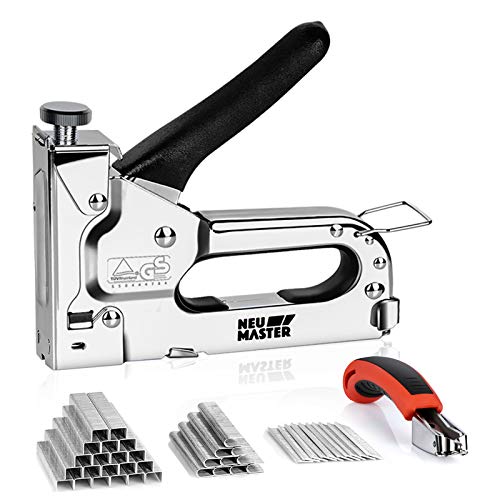
For a hand-operated tool with a quick-load magazine, this NEU MASTER differs from the other options by pairing three fastener types with a staple remover and a rubberized grip. It includes 1,000 T50 staples, 500 T18 staples, and 500 18-gauge staples; compatible staple lengths are given as 5/16, 3/8, and 1/2 inch. Its uses include furniture, carpentry, and home repair, not insulation specifically. That makes it a general-purpose alternative rather than a direct insulation pick; verify that the staple type and length match the facing and framing.
Bottom line: Choose this for general home-repair fastening when a quick-load hand tool is your priority.
How to choose a staple gun for insulation
For insulation, start with the facing and the tool’s compatible staple family rather than the kit’s staple count. A hammer tacker drives with a swing, while a manual stapler drives when its lever is squeezed; the tool must also accept the staple crown and length your fastening surface calls for. Kraft-faced batts are commonly secured at the paper flanges, while unfaced batts require a different retention plan, such as friction fit or support. Avoid crushing the insulation: compression reduces its thickness and can impair its insulating performance. If your job specifies T50 staples, choose a compatible T50 tool; a multi-type stapler is not automatically compatible just because it includes several fasteners.
Staple length and insulation fit
Staple length must suit the facing, flange, and wood surface without relying on a size that the stapler cannot accept. Common lengths in these options range from 1/4 to 1/2 inch for T50 staples, while the Arrow 3-in-1 also includes a 5/8-inch brad; those fasteners are different formats and are not interchangeable. The choice is driven by the material stack and the manufacturer’s staple-family compatibility, not by choosing the longest staple available. Measure the flange and substrate stack, then confirm the tool takes that specific family and length. Keep the staple centered on the flange and drive it flat enough to hold without tearing the facing.
Hammer tackers and hand staplers compared
A hammer tacker suits repeated fastening where a swing is practical; a hand stapler gives more controlled squeeze-and-release operation in confined spots. The hammer-driven tool in this group is specifically identified for insulation, while the hand staplers are presented for general DIY, upholstery, or repair tasks. A hammer tacker may be tiring or awkward overhead, and a hand stapler can demand more repeated grip effort across a large area. Choose by the movement your work area allows, then match the staple family and length to the insulation assembly. For a single small repair, a manual lever may be easier to position; for extended open runs, the swing style may be more convenient.
| Need | Tool direction | Check first |
|---|---|---|
| Repeated fastening on accessible runs | Hammer tacker | Staple family and swing clearance |
| Controlled placement in tight spots | Hand stapler | Lever access and compatible staples |
| Several fastener formats for other tasks | Multi-type stapler | Exact format and length for the insulation job |
Common insulation stapling mistakes
The main mistake is compressing the batt while fastening its facing. Batts are designed to fill the cavity at their intended thickness; pressing them thinner can leave gaps or reduce their designed thermal performance. Another mistake is using a staple based only on length while ignoring its family: T50, T18, and brad fasteners differ in shape and fit. Place staples through the facing flange where the assembly calls for flange stapling, and avoid tearing the paper with a hard or angled strike. Wear gloves and eye protection when handling fiberglass insulation, and keep skin covered; fibers can irritate skin and eyes. If the framing or facing requires an unusual fastener, confirm the fastener specification before purchase.
Frequently Asked Questions
How far apart should insulation facing staples go?
A common practice is to staple faced batt flanges at roughly 8 to 12 inches along the framing, while keeping the paper flat and un-torn. Follow the assembly requirements if they call for a different spacing.
Can I use a regular staple gun for insulation?
A regular hand stapler can work only when its staple family and length match the facing and framing. For repeated work on accessible runs, a hammer tacker is another tool style; check its staple compatibility before use.
Should insulation be compressed under the staples?
No; secure the facing without crushing the batt. Fiberglass batts need to retain their intended thickness to fill the cavity, so avoid pressing the insulation thinner while fastening.
Do insulation staples go through the flange or face?
Faced batts are commonly fastened through the paper flanges along the framing. Keep each staple flat and avoid tearing the flange; the correct placement can vary with the insulation assembly.
What safety gear should I use when stapling fiberglass insulation?
Wear gloves, long sleeves, and eye protection when handling fiberglass, since fibers can irritate skin and eyes. Work carefully with the stapler’s striking or squeezing mechanism and keep hands clear of the staple exit.