
Pontoon Ladders for Elderly: 4 Models Compared

For older passengers, the Lippert SureStep is the clearest fit because it combines extra-wide slip-resistant steps and stainless steel handrails with a 400-pound rating. Choose a different ladder if you need a higher load rating or a telescoping design; those features vary among these models.
A pontoon ladder is a set of steps and rails mounted to help passengers climb between the boat and water or dock. Match its mount and deployed clearance to your boat before ordering.
We earn a commission if you buy through links on this page. As an Amazon Associate I earn from qualifying purchases. Products are compared on manufacturer specifications, not hands-on testing.
- Best overall: Lippert SureStep Pontoon Ladder – Extra-wide slip-resistant steps and stainless steel handrails pair with a 400-pound rating.
- Best for saltwater: Mojiate 4-Step 316 Stainless Ladder – The maker specifies 316 stainless steel, wide anti-slip steps and dual handrails.
- Best for higher capacity: VEVOR 4-Step Telescoping Pontoon Ladder – Its 600-pound rating is the highest specified for this folding, four-step option.
- Best for self-supporting design: 316 Stainless 4-Step Folding Ladder – Its maker specifies a self-supporting telescoping design and 316 stainless steel.
| Product | Best for | Capacity | Material | Step or rail feature | Shop |
|---|---|---|---|---|---|
| Lippert SureStep Pontoon Ladder | Slip-resistant steps | 400 lb | Stainless steel rails | Extra-wide steps; handrails | Check Price on Amazon |
| Mojiate 4-Step 316 Stainless Ladder | Saltwater boarding | 600 lb | 316 stainless steel | 3.94-in steps; 16.5-in dual handrails | Check Price on Amazon |
| VEVOR 4-Step Telescoping Pontoon Ladder | Folding storage | 600 lb | 304 stainless steel; PVC steps | 4.1-in steps; handrails | Check Price on Amazon |
| 316 Stainless 4-Step Folding Ladder | Self-supporting entry | 600 lb | 316 stainless steel | Wide steps; tall handrails | Check Price on Amazon |
Pontoon ladders for elderly passengers
Compare each ladder’s load rating, materials and boarding features, then confirm the mounting fit for your pontoon.
Lippert SureStep Pontoon Ladder
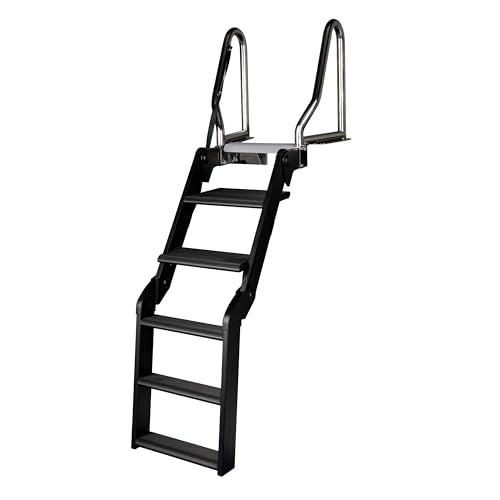
The Lippert SureStep pairs extra-wide, slip-resistant steps with stainless steel handrails, making it the most direct match for buyers prioritizing secure footing and a handhold. Powder-coated aluminum steps and stainless steel rails suit marine use, and the ladder is rated for 400 pounds. The maker says it is designed for stern mounting on factory pontoon decks and meets ABYC standards. Its capacity is lower than the 600-pound ratings on several alternatives, so buyers whose combined user-and-gear load approaches 400 pounds should compare those options and confirm the boat’s mount compatibility.
Bottom line: Choose this if slip-resistant steps and rails matter more than a 600-pound rating.
Mojiate 4-Step 316 Stainless Ladder

The Mojiate stands apart with a maker-specified 316 stainless steel construction and 16.5-inch dual handrails. Its four steps are 3.94 inches wide, with black non-slip threads, and the maker gives it a 600-pound capacity. The telescoping rear-entry design is self-supporting, so the maker says it does not need additional tube supports or standoffs. This is a strong option for buyers who want a high stated capacity and saltwater-oriented material. Check that the ladder’s mounting arrangement and extended reach suit your pontoon, since the self-supporting feature does not establish fit for every deck.
Bottom line: Choose this for 316 stainless construction, dual rails and a 600-pound rating.
VEVOR 4-Step Telescoping Pontoon Ladder

The VEVOR 4-Step uses a folding, telescoping design and includes a bungee cord to keep it retracted, distinguishing it for buyers who want to stow the ladder between uses. The maker specifies 304 stainless steel construction, PVC non-slip steps that are 4.1 inches wide, handrails and a 600-pound capacity. Four steps provide the specified configuration for boarding. The capacity exceeds the Lippert’s 400-pound rating, but the material is 304 rather than the 316 stainless steel specified for some alternatives. Confirm the mounting position and room needed for the ladder to extend and fold.
Bottom line: Choose this if a fold-up design and 600-pound capacity suit your boat.
316 Stainless 4-Step Folding Ladder

The 316 Stainless 4-Step Folding Ladder combines a self-supporting telescoping structure with quick-release mounting brackets, a useful distinction for buyers looking for a rear-entry setup without separate supports. Its maker specifies all-welded 316 stainless steel, wide steps, tall handrails and a 600-pound capacity. The ladder flips up for storage. The features do not give a numerical step width or handrail height, so buyers who need a particular dimension should compare those measurements before choosing. Its specified capacity matches other 600-pound options, so the design and mounting arrangement are the main differentiators.
Bottom line: Choose this if you want a self-supporting telescoping rear-entry ladder.
How to choose a pontoon ladder for older passengers
For older passengers, prioritize a continuous handhold, grippy steps and a load rating that covers everyone climbing at once. A 600-pound rating gives more stated capacity than a 400-pound rating, but include carried gear when considering the total load. Step width also matters: a 4-inch tread gives more foot room than a narrow rung, while anti-slip surfaces help on wet boarding routes. Choose a model with handrails on both sides if a two-handed grip is important, and compare actual rail height where provided. A ladder’s capacity does not guarantee that a pontoon deck or mounting hardware can carry the same load; check the boat’s allowed mounting location and the ladder’s installation requirements.
Mounting and clearance for pontoon ladders
Match the ladder’s intended mounting position to the boat before choosing a folding or telescoping model. Rear-entry and stern-mount designs need clear space outside the deck to deploy, while a folding ladder also needs room to swing or stow. Measure the deck edge to the waterline and check the ladder’s extended reach against that distance; a model’s overall height alone does not tell you how much step is submerged. Confirm the deck surface and attachment points can accept the mounting arrangement, and keep boarding clear of propellers. For a ladder with a 600-pound capacity, the pontoon’s deck, brackets and fasteners still need to support the combined load.
Stainless steel and aluminum ladder materials
Marine ladder materials affect corrosion resistance and maintenance, but they do not eliminate the need to rinse and inspect hardware. 316 stainless steel is generally more corrosion-resistant in chloride exposure than 304 stainless steel, which is why it is often selected for saltwater hardware. Aluminum avoids steel rust but can still corrode, especially where dissimilar metals meet; use compatible marine fasteners and inspect contact points. Powder coating adds a barrier over aluminum, but scratches can expose the base metal. After saltwater use, rinse the ladder and mounting hardware with fresh water, then check welds, hinges and fasteners for looseness or corrosion before boarding.
Safe boarding and ladder care
Use a ladder only when it is fully deployed and secured, and keep hands on the rails while stepping. Wet treads can remain slippery even when textured, so remove algae, sand and residue rather than relying on tread pattern alone. Keep the motor off and propeller stopped before anyone enters or exits the water, and have a second person stabilize the boat when conditions make the deck move. Periodically check mounting bolts, welds, hinges and folding restraints for cracks, movement or corrosion; replace damaged parts before use. Capacity ratings are maximum loads, not permission to overload or climb with multiple people on a ladder at once.
Frequently Asked Questions
How much weight should a pontoon ladder support?
Choose a rating that exceeds the combined weight of the people and gear using the ladder at one time. These options specify 400 or 600 pounds; also confirm the pontoon deck and mounting hardware can carry the load.
Are wider ladder steps easier to use?
Wider treads provide more foot area than narrow rungs, but they do not replace handrails or traction. For wet boarding, favor a textured or slip-resistant tread and keep it clear of algae and debris.
Is 316 stainless steel better for saltwater ladders?
316 stainless steel generally resists chloride corrosion better than 304 stainless steel. Rinsing with fresh water after salt exposure and checking fasteners and welds still matter.
How do I know whether a ladder will fit my pontoon?
Measure the available mounting surface, distance from deck edge to waterline and clearance for the ladder to extend or fold. Confirm the ladder’s mounting style matches the boat before ordering.
Can someone board while the pontoon engine is running?
No; stop the engine and ensure the propeller is no longer turning before anyone enters or exits the water. Keep boarding clear of the propeller zone even when the motor is off.