
Stick-On Nose Pads: 5 Options Compared by Grip and Fit

Silicone Adhesive Nose Pads, 20 Pairs is the most versatile starting point for stick-on nose pads because its 20 pairs suit many eyeglass styles and measure 1.9 x 0.8 cm. Choose Setex Gecko Grip 0.6 mm Pads instead if wet or oily conditions are your main concern, or a thinner pad if you want less added height.
Stick-on nose pads are adhesive-backed cushions for frames without built-in nose pads; bridge shape and available space still determine fit.
We earn a commission if you buy through links on this page. As an Amazon Associate I earn from qualifying purchases. Products are compared on manufacturer specifications, not hands-on testing.
- Best overall: Silicone Adhesive Nose Pads, 20 Pairs – Its 20 pairs and 1.9 x 0.8 cm size offer a broad supply for many eyeglass styles.
- Best for wet or oily wear: Setex Gecko Grip 0.6 mm Pads – The 0.6 mm microfiber design is made to grip in wet, sweaty or oily conditions.
- Best for a slim silicone fit: Bloom&Bloom Clear Silicone Teardrop Pads – Its 1 mm thickness and teardrop shape provide a low-profile silicone option.
| Product | Best for | Material | Thickness or size | Pack count | Shop |
|---|---|---|---|---|---|
| Silicone Adhesive Nose Pads, 20 Pairs | Many frame styles | Silicone | 1.9 x 0.8 cm | 20 pairs | Check Price on Amazon |
| Bloom&Bloom Clear Silicone Teardrop Pads | Low-profile silicone | Silicone | 1 mm | 6 pairs | Check Price on Amazon |
| Setex Gecko Grip 0.6 mm Pads | Wet-condition grip | Microfiber | 0.6 mm | 5 pairs | Check Price on Amazon |
| Clear Silicone Nose Pads, 20 Pack | Everyday cushioning | Silicone | 1 mm | 20 pack | Check Price on Amazon |
| 1.3 mm X-Thin Silicone Pads, 18 mm | Standard-size fit | Silicone | 1.3 mm; 18 mm | 5 pairs | Check Price on Amazon |
Stick-on nose pads for glasses
Compare these adhesive-backed pads by material, profile and intended frame fit.
Silicone Adhesive Nose Pads, 20 Pairs
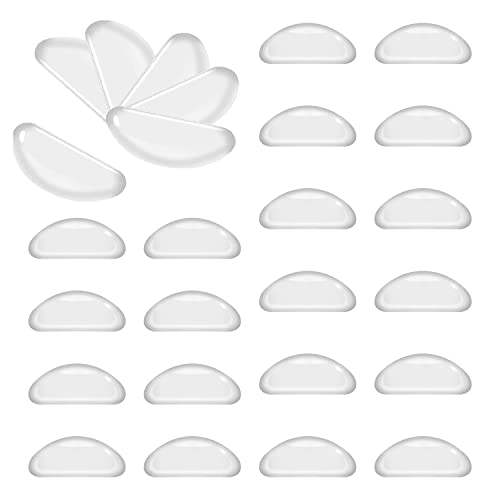
For buyers who want a larger supply and a pad size, these silicone pads come in 20 pairs and measure 1.9 x 0.8 cm. The maker says they are intended for eyeglass frames and can suit many plate-style frames, sunglasses and spectacles. Clean the application area with rubbing alcohol and let it dry fully before pressing on a pad. This option makes sense when you need replacements on hand, but the relatively specific dimensions may not suit a narrow bridge area; measure the usable surface first.
Bottom line: Choose these if you want 20 pairs and your frame has room for a 1.9 x 0.8 cm pad.
Bloom&Bloom Clear Silicone Teardrop Pads

A teardrop outline distinguishes this six-pair silicone set from the other low-profile options. Each pad is 1 mm thick, and the maker says its upgraded adhesive lasts up to three times longer than ordinary nose pads and peels away cleanly. The shape is intended to follow the nose bridge contour, making it a candidate for someone seeking a discreet cushion rather than a bulky lift. Its pack has fewer pairs than the 20-pair alternatives, so it is less suited to buyers who prioritize a larger replacement supply.
Bottom line: Pick this set for a 1 mm teardrop silicone pad in a small six-pair pack.
Setex Gecko Grip 0.6 mm Pads

Unlike the silicone pads here, these 0.6 mm pads use gecko-inspired microfiber structures, with 3,500 per pad. The maker says the material grips in wet, sweaty or oily conditions without sticky residue, and identifies plastic frames including acetate and TR90 as intended fits. That combination makes this the relevant choice for humid days or active wear, especially when minimal thickness matters. The pack contains five pairs, fewer than the 20-pair sets, and its frame fit is centered on plastic rather than every frame construction.
Bottom line: Choose these for thin microfiber grip on compatible plastic frames in sweaty or oily conditions.
Clear Silicone Nose Pads, 20 Pack

These 1 mm silicone pads combine a slim profile with a 20-pack, unlike the smaller-count thin options. The maker describes them for many plastic frames, sunglasses and safety glasses, with cushioning and added grip intended to help limit sliding. A broad compatibility claim does not guarantee the pad matches every bridge: check the bridge shape and available surface, particularly on a small frame. This set suits everyday eyewear when you want a thin cushion and multiple replacements, but frame fit and skin oils can affect grip.
Bottom line: Choose this pack for 1 mm silicone cushioning across a range of plastic eyewear.
1.3 mm X-Thin Silicone Pads, 18 mm

The 18 mm standard size is the distinguishing specification for this five-pair silicone set. At 1.3 mm thick, it is slightly thicker than the 1 mm options and the 0.6 mm microfiber pads, so it may suit someone who wants a little more cushion while keeping a defined size. The maker identifies plastic frames as the intended use and says the adhesive backing is meant to reduce slipping. The 18 mm dimension may be too long for compact contact areas; confirm the usable bridge surface before applying.
Bottom line: Pick these when an 18 mm silicone pad fits your frame and you prefer a 1.3 mm profile.
How to choose stick-on nose pads
Start with the pad footprint and thickness, because an adhesive pad needs a flat contact area and changes how high the frame sits. A 0.6 mm profile adds less height than a 1.3 mm pad, while the 18 mm length option calls for more bridge space than a compact pad. Silicone is the common cushioned style in these choices; microfiber is the distinct alternative for wet or oily grip. Match the pad outline to the frame’s contact area rather than relying on a broad frame-compatibility claim. If the available bridge surface is smaller than the pad footprint, choose a smaller shape instead of letting its edge overhang.
The practical decision rule is simple: choose the thinnest profile that supplies the cushion you want and fits entirely on the frame’s contact area.
Matching pad size to a glasses bridge
Measure the flat area where a pad can sit before choosing a footprint; a pad that overhangs can catch, peel or feel uneven. The 18 mm option is the only product here with a length, while another states a 1.9 x 0.8 cm footprint, equivalent to about 0.75 x 0.31 inches. Those dimensions are not interchangeable: compare length with length and width with width. Nose-pad spacing also matters, since pads placed at different angles can change how frames rest. Leave enough clearance that the pad does not touch the lens or interfere with the frame’s normal position.
For a small contact area, favor a slim, compact shape; for a longer bridge surface, an 18 mm outline may be worth considering if it fits flat.
Silicone and microfiber grip compared
Silicone pads provide a soft cushioning surface, while microfiber grip pads use fine surface structures rather than a silicone face. The microfiber option in this group is 0.6 mm thick and is specifically presented for wet, sweaty or oily conditions; the silicone alternatives span 1 mm and 1.3 mm, as well as a 1.9 x 0.8 cm footprint. These are different constructions, so thickness alone does not determine grip. Sweat, skin oil, bridge shape and frame balance also influence whether glasses slide.
The table separates the material and profile considerations; choose by the condition that matters most rather than assuming every anti-slip style behaves alike.
| Need | Pad characteristic |
|---|---|
| Wet or oily wear | 0.6 mm microfiber grip surface |
| Cushioning with a thin profile | 1 mm silicone |
| A little more thickness | 1.3 mm silicone |
Applying and replacing adhesive nose pads
Clean the frame’s application area with rubbing alcohol and let it dry completely before attaching a pad; moisture or residue can compromise the bond. Position each pad carefully before pressing it down, since shifting an adhesive pad can wrinkle its edge or reduce contact. Replace pads when an edge lifts, the surface accumulates grime, or the cushion no longer sits evenly. Avoid pulling against the lens or bending a delicate frame while removing an old pad. Adhesive pads improve the contact surface but do not correct a frame that is substantially out of alignment.
For safety, do not use nose pads to compensate for damaged or unstable eyewear; have a poorly fitting frame adjusted so it stays secure without excessive pressure.
Frequently Asked Questions
How do I make stick-on nose pads stay in place?
Clean the frame contact area with rubbing alcohol and let it dry fully before application. A flat, residue-free surface gives the adhesive better contact; oil, moisture and a pad that overhangs the frame can undermine the bond.
Can stick-on nose pads fit plastic frames?
Many adhesive pads are intended for plastic frames, and the microfiber option specifically identifies acetate and TR90 among its fits. Check that the bridge has a flat area large enough for the pad footprint before applying.
Are microfiber nose pads better for sweaty weather?
The 0.6 mm microfiber option is made for wet, sweaty or oily conditions. Sweat and skin oils can still affect glasses fit, so frame balance and pad placement remain important.
How thick should adhesive nose pads be?
Available options here range from 0.6 mm microfiber to 1.3 mm silicone. Choose the thinnest pad that gives the desired cushion and fits without raising the frame more than you want.
When should adhesive nose pads be replaced?
Replace a pad when an edge starts lifting, the surface is visibly dirty, or it no longer sits evenly against the bridge. Clean the frame area and let it dry before applying a replacement.