
Stick-On Solar Panels: 5 Flexible Options Compared

For most buyers, Renogy Flexible 100W is the simpler stick-on solar panel choice when a roof has curves and the installation can use a 100W panel; its 240-degree bend and 43-inch length are the deciding fit details. Choose a 200W option instead when you need that rated output and have room for a panel roughly 53 inches long.
Flexible solar panels are thin modules intended to follow gently curved surfaces, but they still need compatible mounting and charge-control equipment.
We earn a commission if you buy through links on this page. As an Amazon Associate I earn from qualifying purchases. Products are compared on manufacturer specifications, not hands-on testing.
- Best overall: Renogy Flexible 100W – Its 100W rating and 43-inch length suit buyers prioritizing a smaller flexible panel.
- Best for 200W output: BougeRV Arch 2.0 200W – It pairs a 200W rating with an ETFE-coated N-type panel.
- Best for 12V systems: Holdwell S 200W – Its MC4 output and stated 23.8V operating voltage suit an MPPT controller for 12V battery banks.
| Product | Best for | Rated output | Length × width | Weight | Shop |
|---|---|---|---|---|---|
| Renogy Flexible 100W | Curved roofs | 100W | 43 × 22.9 in | 5.3 lb | Check Price on Amazon |
| BougeRV Arch 2.0 200W | ETFE surface | 200W | 52.95 × 30.91 in | 8.82 lb | Check Price on Amazon |
| BougeRV Arch Pro 200W | Shading conditions | 200W | 52.95 × 30.91 in | 7.94 lb | Check Price on Amazon |
| Holdwell S 200W | MPPT pairing | 200W | 53.15 × 30.12 in | 6.94 lb | Check Price on Amazon |
| Callsun 200W Flexible | Two-module layout | 200W (2 × 100W) | 43.7 × 24.4 in | 5.66 lb | Check Price on Amazon |
Stick-On Solar Panels Compared
Compare rated output and panel footprint first, then match the surface and electrical setup to your installation.
Renogy Flexible 100W
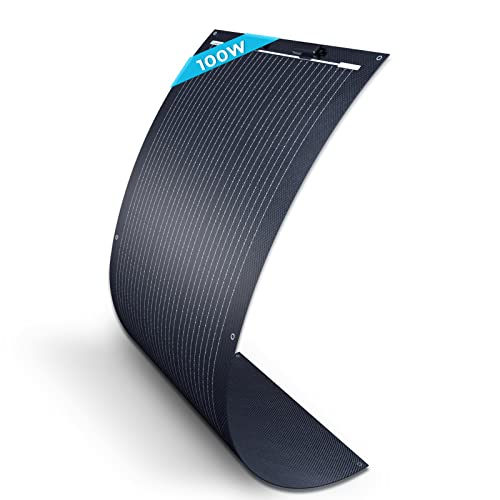
Renogy Flexible 100W is the only 100W option here, so it is the natural fit when a smaller output and footprint matter more than 200W capacity. The panel measures 43 by 22.9 inches and weighs 5.3 pounds. Renogy says it bends within 240 degrees and can provide an average of 500 watt-hours per day depending on sun availability; that figure is not a guarantee for every installation. Its smaller size gives up half the rated wattage of the 200W choices, so buyers needing more panel output should compare those larger formats.
Bottom line: Choose this when the available roof area favors a compact 100W panel.
BougeRV Arch 2.0 200W

BougeRV Arch 2.0 200W stands out for its ETFE coating and N-type 16BB cells in a 200W format. It measures 52.95 by 30.91 inches and weighs 8.82 pounds. BougeRV says the panel reaches up to 25% conversion efficiency and can be wired for 12V or 24/48V systems; system compatibility depends on wiring and controller specifications. The broad footprint and nearly 9-pound weight call for careful roof-space and attachment planning, especially on a curved surface where the panel’s fit and mounting method must be compatible.
Bottom line: Pick this if you want a 200W panel with an ETFE surface.
BougeRV Arch Pro 200W

BougeRV Arch Pro 200W differs from the other 200W panels with its built-in bypass diode design and fiberglass construction. At 52.95 by 30.91 inches, it shares a footprint with BougeRV Arch 2.0 200W but weighs 7.94 pounds. BougeRV says its N-type 16BB cells have a 25% conversion rate and that the bypass diode helps maintain output under partial shade or low light. Its 36V ± 5% open-circuit voltage may not work with every power station, so check the station’s allowed solar input before choosing this panel.
Bottom line: Choose this when partial shade is a concern and the input voltage is compatible.
Holdwell S 200W

Holdwell S 200W is the clearest match for a 12V battery setup using an MPPT charge controller: its Vmp is 23.8V, Voc is 28.6V, and output uses MC4 connectors. The 53.15-by-30.12-inch panel weighs 6.94 pounds and has a 2.5mm PET-laminated body with corner grommets. The temperature range is -20°C to 65°C. Its 21.9% cell efficiency is lower than the 25% claim on the BougeRV models, so buyers prioritizing the highest claimed conversion figure may prefer a different 200W panel.
Bottom line: Pick this for an MC4 panel intended to pair with an MPPT controller and 12V bank.
Callsun 200W Flexible

Callsun 200W Flexible is a two-module 200W setup, listed as 2 × 100W, making it distinct from the single-panel formats. The dimensions are 43.7 by 24.4 inches and the weight is 5.66 pounds. Callsun says its ETFE-coated modules bend up to 240 degrees and use 11BB monocrystalline cells with 23% efficiency.
Bottom line: Choose this when a two-module 200W layout suits the available mounting area.
How to Choose a Stick-On Solar Panel
Start with roof area and rated watts: these choices range from 100W to 200W, and larger output takes more surface area. Panel wattage is a rating under standard test conditions, not a promise of daily energy; orientation, shade, temperature and location change actual production. A solar charge controller regulates panel power for a battery, and its input limits must match the panel voltage and wiring. For a 12V battery, a panel operating voltage above battery voltage generally needs a controller; an MPPT controller can convert higher panel voltage to battery charging voltage. Choose a 100W unit if roof space is tight and the required load is modest; reserve room for a second panel if future expansion matters.
Panel Size and Curved-Surface Fit
Measure a clear, flat mounting footprint before selecting a flexible panel: the 200W choices here are roughly 53 inches long and 30 inches wide, while the 100W options are about 43 inches long. Flexible panels are suited to gentle curves, not sharp bends; conforming too tightly can stress cells and electrical connections. A roof vent, rack, or raised seam can shade part of a module even when most of the surface is sunny. Allow room around edges and wiring for secure attachment and drainage, and use a panel only on a surface its mounting method can hold. With less than 44 inches of clear length, prioritize the shorter 100W formats and verify width as well.
Flexible Panel Materials and Electrical Differences
ETFE and PET are surface materials used on flexible modules; ETFE is commonly chosen for outdoor durability, while PET panels need careful handling to avoid surface damage. Cell architecture also differs: monocrystalline panels use silicon cells, and bypass diodes provide a current path around shaded cell groups to limit the effect of partial shading. The electrical figures matter more than a general system label: Voc is the panel’s open-circuit voltage, while Vmp is its operating voltage. Match Voc to the controller or power station’s maximum solar input, including cold-weather voltage rise, and confirm connector and series/parallel wiring compatibility. A 36V panel may exceed a portable station’s allowed input even if its wattage seems suitable.
| Need | What to compare | Choice cue |
|---|---|---|
| Limited roof area | Panel footprint | Favor shorter dimensions |
| Partial shade | Bypass diode design | Consider the panel with bypass diodes |
| 12V battery bank | Controller and panel voltage | Check Voc, Vmp and controller limits |
| Two-panel layout | Module count and wiring | Confirm series or parallel configuration |
Mounting and Safety Checks
A flexible solar panel still needs a secure attachment and compatible electrical protection; do not rely on the word “stick-on” alone to define the mounting method. Use wiring sized for current and run length, protect cable entries from abrasion, and keep connectors dry and strain-relieved. DC solar circuits can remain energized whenever the panel is in sunlight, so cover the panel or isolate it as appropriate before handling exposed conductors. Never connect a panel directly to a battery without the proper charge control. Check roof material, adhesive or fastener compatibility, bend radius and the panel maker’s mounting limits before installation; a panel that fits the curve but cannot be securely attached is the wrong choice.
Frequently Asked Questions
Can a flexible solar panel stick directly to an RV roof?
Some flexible panels can be attached to a roof, but the mounting approach must suit both the panel and roof surface. Check the panel’s permitted bend and mounting method, and keep cable entries sealed against water.
How much power does a 100W solar panel make daily?
A 100W rating does not mean 100 watts continuously; daily energy changes with sun hours, angle, shade and temperature. Renogy gives an average estimate of 500 watt-hours per day for its 100W panel, dependent on sun availability.
Will a 36V solar panel charge a 12V battery?
A 36V panel can charge a 12V battery only through a controller that accepts the panel’s open-circuit voltage and converts it to the battery’s charging voltage. Check the controller’s maximum input voltage, including cold-weather conditions.
Can flexible solar panels be bent around a sharp roof edge?
Flexible panels are intended for gentle curves rather than sharp creases, which can stress cells and connections. Check the maker’s bend limit and avoid a curve tighter than the panel allows.
What does a bypass diode do in a solar panel?
A bypass diode routes current around a shaded cell group, reducing the impact of partial shading on the rest of the panel. It cannot remove all output loss when a large section is shaded.