
Car Power Adapter Outlet: 4 Inverters Compared

For a car power adapter outlet, the PiSFAU suits buyers who need two AC outlets plus four USB ports in one compact inverter. Choose another model if you need a higher continuous AC rating: BESTEK provides 300W, while the PiSFAU provides 200W.
These inverters convert a vehicle’s 12V DC supply to household-style AC power, and the models here also provide USB charging.
We earn a commission if you buy through links on this page. As an Amazon Associate I earn from qualifying purchases. Products are compared on manufacturer specifications, not hands-on testing.
- Best overall: PiSFAU 200W Car Power Inverter – It combines two AC outlets with four USB ports in a compact 200W inverter.
- Best for higher output: BESTEK 300W Power Inverter – Its 300W continuous AC rating is the highest among these choices.
- Best for compact size: FOVAL 150W Car Power Inverter – The FOVAL measures 3.7 × 2.5 × 1.5 inches and provides 150W continuous output.
| Product | Best for | Continuous AC output | AC outlets | USB ports | Shop |
|---|---|---|---|---|---|
| PiSFAU 200W Car Power Inverter | More charging ports | 200W | 2 | 4 | Check Price on Amazon |
| BESTEK 300W Power Inverter | Higher AC output | 300W | 2 | 2 | Check Price on Amazon |
| FOVAL 150W Car Power Inverter | Smaller footprint | 150W | 1 | 2 | Check Price on Amazon |
| 150W Dual-Outlet Power Inverter | Two AC connections | 150W | 2 | 2 | Check Price on Amazon |
Car Power Adapter Outlets
Compare continuous AC power and port counts to find an inverter that fits your devices and charging needs.
PiSFAU 200W Car Power Inverter

The PiSFAU stands out with four USB ports alongside two AC outlets, giving travelers more simultaneous charging connections than the other options here. It converts 12V DC to 110V AC and measures 5 × 2.7 × 1.4 inches, with a weight of 8.5 ounces. The ABS shell is insulated. Brand says its circuit and heat-dissipation design reduces energy use and operating noise. This model suits a vehicle carrying several USB devices as well as AC-powered gear; its 200W rating is below the BESTEK’s 300W continuous output.
Bottom line: Choose this if you need four USB ports and two AC outlets in one unit.
BESTEK 300W Power Inverter
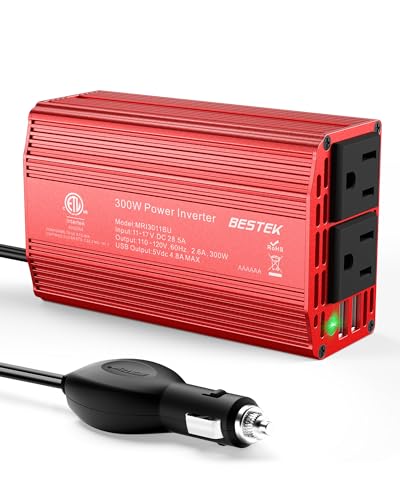
The BESTEK has the highest continuous AC output in this group at 300W, which makes it the option to consider when connected equipment needs more power than a 150W or 200W inverter can supply. It has two AC outlets and two USB ports, and measures 4.8 × 3.1 × 1.9 inches. Brand says the input range is 11–17V and includes Tesla compatibility. The inverter suits buyers prioritizing AC capacity over additional USB connections; it offers two fewer USB ports than the PiSFAU.
Bottom line: Choose this when the devices’ combined AC demand is above 200W and at or below 300W.
FOVAL 150W Car Power Inverter
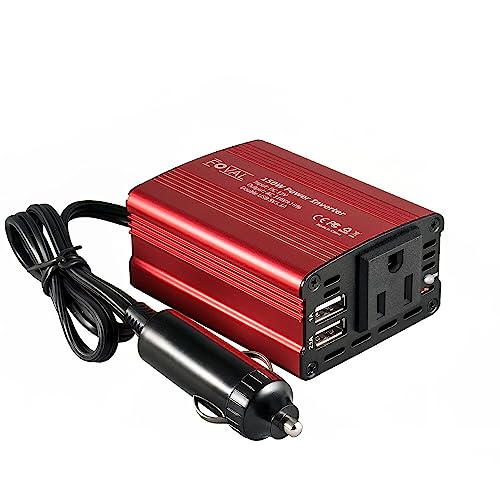
The FOVAL is the smallest measured inverter here at 3.7 × 2.5 × 1.5 inches, making it a space-conscious choice for lighter AC loads. It provides one AC outlet and two USB ports, with a 3.1A maximum combined USB output. Brand says the inverter supplies 150W continuous power from a 12V vehicle connection. The single AC outlet limits how many plug-in devices can connect directly at once, so buyers needing multiple AC connections should choose a two-outlet model instead.
Bottom line: Choose this for a compact setup with up to 150W of AC demand and one AC device.
150W Dual-Outlet Power Inverter

This 150W inverter differs from the FOVAL by providing two AC outlets, useful when two plug-in devices need connections at the same time. It also has two USB ports and measures 3.2 × 2.5 × 1.5 inches. The product features say it has 150W continuous and 300W peak output, plus a smart chip and fuse that shut down output and illuminate a red indicator after a detected fault. Its continuous rating is still 150W, so it is not the choice for equipment whose combined AC draw exceeds that level.
Bottom line: Choose this when two AC outlets matter more than higher continuous wattage.
How to choose a car power adapter outlet
Choose a car inverter by the combined wattage of the AC devices you plan to run, not by the number of outlets alone. Add each device’s input watts, then leave headroom: a practical rule is to keep continuous demand below about 80% of the inverter’s continuous rating. For a 150W unit, that means aiming for roughly 120W or less. Motors, pumps, and compressors can draw a brief startup surge, so their surge demand also needs to fit the inverter’s peak rating. USB ports are separate from AC outlets; count them based on how many phones or tablets need charging at once. With multiple devices, verify each outlet’s limits and the vehicle’s 12V socket rating before connecting a load.
Car inverter outlet types and port counts
Most plug-in car inverters convert a vehicle’s 12V DC into household-style AC, while USB ports provide DC charging directly. The AC socket count tells you how many plugs can connect, but it does not increase the inverter’s total wattage. A two-outlet 150W inverter still has a 150W shared continuous limit. USB output is usually described in amps or watts, and a combined USB rating is shared when multiple ports are used together. Use this guide to match port layout with the devices you plan to charge.
| Need | What to prioritize | Check before use |
|---|---|---|
| One low-draw AC device | Continuous wattage above its draw | Startup surge demand |
| Two AC plugs | Two AC outlets | Combined wattage remains within rating |
| Several USB devices | USB port count and shared output | Combined current capacity |
A standard car accessory socket is commonly fused at 10A or 15A, roughly 120W or 180W at 12V before conversion losses. The vehicle manual or socket marking determines the safe input limit; a 300W inverter can only deliver its full rating if its power connection supports it.
Safe use of a car power inverter
Keep the inverter’s combined load below its continuous rating and use the vehicle manufacturer’s socket limit as a separate ceiling. At 12V, delivering 150W of AC requires more than 12.5A from the car after conversion losses, so a lighter plug or 10A socket may limit that output. Heat builds around inverters under sustained load; keep ventilation openings clear and do not cover the unit with bags or fabric. Disconnect the inverter when the vehicle is parked if the load could drain the battery. Never use an inverter near flammable vapors, and stop using it if the plug, cord, or case becomes unusually hot.
Common car inverter sizing mistakes
The most common sizing mistake is treating peak watts as continuous capacity. Peak output is for brief startup surges, while the continuous rating applies during normal operation; a device that draws 160W continuously will exceed a 150W inverter even if its peak figure is 300W. Another mistake is assuming two outlets double available power. They share the inverter’s total output, so add the wattage of everything connected to AC. USB charging also contributes to the vehicle’s total electrical load. For equipment with a motor, heater, or compressor, check both running watts and startup needs; when those are unknown, use a lower-draw alternative rather than guessing.
Frequently Asked Questions
How many watts can a car outlet provide?
Many vehicle accessory sockets are fused for 10A or 15A, which corresponds to about 120W or 180W at 12V before inverter losses. Check the vehicle manual or socket marking because the fuse and wiring determine the usable input.
Can a car inverter run a laptop?
A car inverter can run a laptop when the laptop’s power draw and any other connected AC load stay below the inverter’s continuous rating. Check the laptop adapter label for watts and leave room for startup or charging peaks.
Can two devices share a car inverter?
Yes, if their combined continuous wattage stays within the inverter’s rating and neither device’s startup surge exceeds its peak capacity. Two AC outlets provide two connections, not twice the available power.
Will a car inverter drain the battery?
Yes, an inverter can drain the vehicle battery while the engine is off, especially under a sustained load. Disconnect it when parked, and avoid relying on battery runtime unless you know the vehicle’s battery capacity and load draw.
What should stay clear around a car inverter?
Keep the inverter’s vents unobstructed and leave it away from fabric, bags, and other heat-trapping material. Inverters can warm during sustained use, so do not operate one near flammable vapors or where hot air cannot escape.