
Stop Leak for Rear Main Seal: 3 Options Compared

For a rear main seal leak, Bar’s Leaks Rear Main Seal Repair is the most directly targeted option because it is designed for rear main leaks and treats 4 to 6 quarts of oil per bottle. Choose a broader seal conditioner instead if you want a formula also intended for other vehicle systems.
Stop leak additives are poured into fluid systems and are intended to condition seals; they are not a mechanical seal replacement.
We earn a commission if you buy through links on this page. As an Amazon Associate I earn from qualifying purchases. Products are compared on manufacturer specifications, not hands-on testing.
- Best overall: Bar’s Leaks Rear Main Seal Repair – Specifically designed for rear main leaks, with one bottle treating 4 to 6 quarts of oil.
- Best for multi-system use: BlueSeal Oil Stop Leak, 8 oz – A petroleum-free formula intended for engine oil and several other fluid systems.
- Best for fluid compatibility: ATP AT-205 Re-Seal, 8 oz – Compatible with conventional and synthetic oils, ATF, gear oil, and hydraulic oil.
| Product | Best for | Bottle size | Oil compatibility | Other systems | Shop |
|---|---|---|---|---|---|
| Bar’s Leaks Rear Main Seal Repair | Rear main leaks | Treats 4–6 quarts | Petroleum-based engine oils | Engine seals and gaskets | Check Price on Amazon |
| BlueSeal Oil Stop Leak, 8 oz | Multi-system conditioning | 8 oz | Gasoline and diesel engine oil | Transmission, steering, differential | Check Price on Amazon |
| ATP AT-205 Re-Seal, 8 oz | Oil type flexibility | 8 oz | Conventional and synthetic oils | Transmission, steering, differential | Check Price on Amazon |
Stop Leak for Rear Main Seal Options
These options range from a rear-main-specific treatment to broader rubber-seal conditioners.
Bar’s Leaks Rear Main Seal Repair
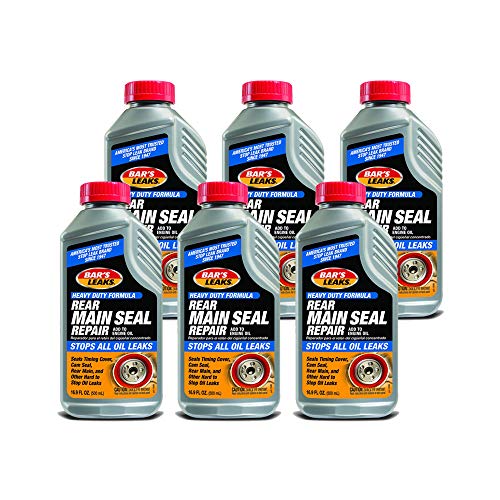
Bar’s Leaks Rear Main Seal Repair is the only formula here specifically designed for rear main leaks. The maker says it works with gasoline, diesel, and turbocharged engines and is compatible with petroleum-based engine oils, including high-mileage and synthetic oils. One bottle treats 4 to 6 quarts; larger systems need additional product. Its intended scope also includes timing cover seals, cam seals, O-rings, and other gaskets, so it may suit an engine with more than one leak.
The six-bottle package is more than a single repair may require, and the product addresses seal-related leaks rather than a damaged part that needs replacement.
Bottom line: Choose this for an engine-oil leak you have identified at the rear main seal.
BlueSeal Oil Stop Leak, 8 oz

BlueSeal Oil Stop Leak, 8 oz stands out for its multi-system use: besides engine oil, the maker intends it for transmissions, power steering, differentials, rack-and-pinion systems, and hydraulics. The 8-ounce petroleum-free, non-clogging formula is poured into the oil sump or crankcase for engine use, and the maker says it conditions and reconditions rubber seals in gasoline and diesel engines.
That broad scope may suit someone treating seals across different systems, but the maker does not specify a rear-main-specific formulation or an engine-oil treatment capacity. Confirm the correct fluid and dosage for your vehicle before using it beyond engine oil.
Bottom line: Choose this when multi-system seal conditioning matters more than a rear-main-specific formula.
ATP AT-205 Re-Seal, 8 oz

ATP AT-205 Re-Seal, 8 oz differentiates itself through its compatibility with several fluid types: conventional and synthetic engine oils, ATF, gear oil, power-steering fluid, and hydraulic oil. Its 8-ounce formula is described as a resealer for rubber seals and gaskets in engines, transmissions, power steering, differentials, and hydraulic systems. The maker also says it contains no petroleum distillates and will not over-swell or break down seals.
That flexibility can help when you need one additive compatible with more than engine oil. Unlike Bar’s Leaks Rear Main Seal Repair, it is not specifically identified as a rear-main seal treatment, and the specifications provide no engine-oil dose, so verify the application amount first.
Bottom line: Choose this if compatibility across several oil and fluid types is your priority.
How to choose a rear main seal stop leak
Choose a formula explicitly aimed at rear main leaks if the leak location is confirmed; a general seal conditioner is a broader alternative. Rear main seals sit between the engine and transmission, so oil at the bellhousing area can also come from another leak path. Before adding anything, check the engine oil level and confirm the fluid is engine oil, not transmission fluid. An additive can condition some worn seals, but it cannot repair a torn seal, damaged sealing surface, or excessive crankshaft play. If oil loss is rapid or the leak persists, arrange mechanical diagnosis rather than repeatedly topping up with additive.
Dosage is another deciding factor: Bar’s Leaks Rear Main Seal Repair treats 4 to 6 quarts per bottle, so compare that range with your engine’s oil capacity and do not assume one bottle covers a larger system.
How rear main seal additives work
Seal conditioners are added to the fluid and are intended to affect rubber seals, but they cannot restore missing or broken material. Rear main seals commonly use elastomer or PTFE designs; the correct approach differs by seal type, and a conditioning additive is not a guaranteed repair for either. A leak caused by installation damage, a worn crankshaft surface, or excess crankcase pressure calls for diagnosis of the underlying cause.
Oil can also migrate from higher engine areas and collect near the rear of the engine, making the apparent leak source misleading. Clean inspection and a repeat check of the leak origin are more useful than treating an assumed location. Never overfill the crankcase to compensate for oil loss; keep the level within the dipstick’s safe range.
Engine oil capacity and additive dosing
Match an additive’s treatment amount to the engine’s oil capacity, not the bottle’s package count. Passenger vehicles commonly hold about 4 to 8 quarts of engine oil, while larger engines can hold more; the filter and engine design affect the exact service-fill amount. Bar’s Leaks Rear Main Seal Repair specifies 4 to 6 quarts per bottle, making it the clearest choice when its treatment range fits the system.
Use the dipstick on level ground after the engine has been off long enough for oil to drain back, and keep the reading between the marked limits. Do not pour a full bottle into an already full crankcase without accounting for the added volume. A practical rule: if the engine holds more than 6 quarts, confirm the required dose rather than assuming one bottle is enough.
| Need | What to compare |
|---|---|
| Rear-main-focused treatment | Look for a rear main seal use and a dose that matches capacity |
| Several fluid systems | Confirm the exact fluid type is named for the application |
| More than 6 quarts of engine oil | Verify dose beyond one 4–6-quart bottle |
When an additive is not the right repair
A stop leak additive is a poor substitute when the seal is physically damaged or the leak is severe. Engine oil pressure can be low even when the dipstick looks acceptable, and a leak that reaches hot exhaust parts can create smoke and a fire risk. If oil drips onto the exhaust, the oil-pressure warning appears, or the level falls quickly, stop driving and have the vehicle inspected.
Rear main seal replacement often requires transmission removal, which is why confirming the leak source matters before authorizing a repair. Also inspect for crankcase ventilation problems: excessive crankcase pressure can push oil past seals that might otherwise remain dry. Addressing the pressure source is more appropriate than adding repeated doses.
Frequently Asked Questions
Can a stop leak fix a rear main seal permanently?
No additive can be relied on as a permanent repair for a damaged seal. Seal conditioners are intended for some worn or dry seals, while a torn seal or damaged crankshaft surface generally requires mechanical repair.
How do I know the leak is from the rear main seal?
Oil near the engine-transmission joint can suggest a rear main leak, but oil can run down from higher points and collect there. Clean inspection and tracing the fresh leak source help distinguish it from other engine leaks.
Can I add stop leak to synthetic engine oil?
Some formulas are specified for synthetic oil, but compatibility differs by product. Bar’s Leaks Rear Main Seal Repair is stated to work with synthetic engine oil; check that the chosen additive names your oil type before adding it.
How much oil does a typical car engine hold?
Many passenger-car engines hold about 4 to 8 quarts, though the exact service-fill amount varies with engine and filter design. Match the additive dose to the vehicle’s capacity and keep the dipstick level within its marks.
Is it safe to drive with a rear main seal leak?
A slow leak may not immediately stop a vehicle, but falling oil level can damage an engine and oil on hot exhaust parts can pose a fire risk. Stop driving if the oil-pressure warning appears, smoke develops, or the level drops rapidly.